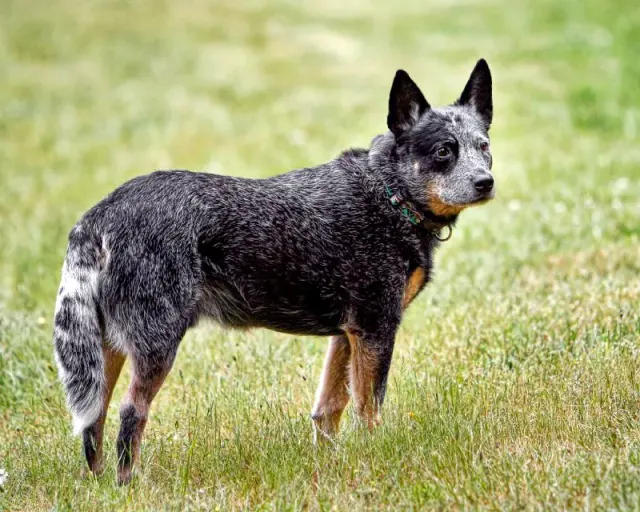
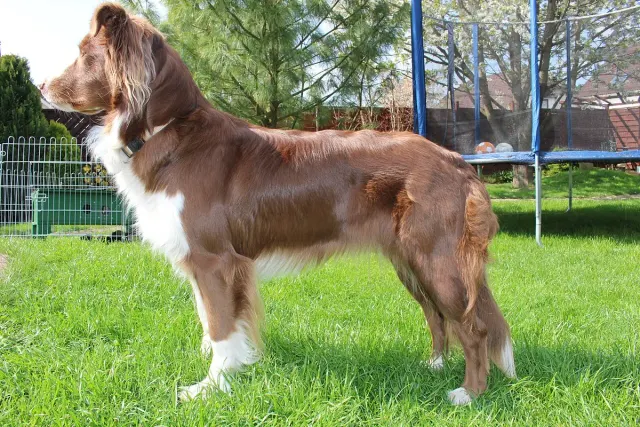
A light, tireless herding dog, the Australian Kelpie can work for hours in the heat. It needs a real job.
History and origins
The Australian Kelpie was developed in late 19th-century Australia from Scottish herding dogs, to manage huge flocks of sheep in hot, arid conditions.
It is famous for running across the backs of tightly packed sheep to reach the head of the flock.
Appearance and colours
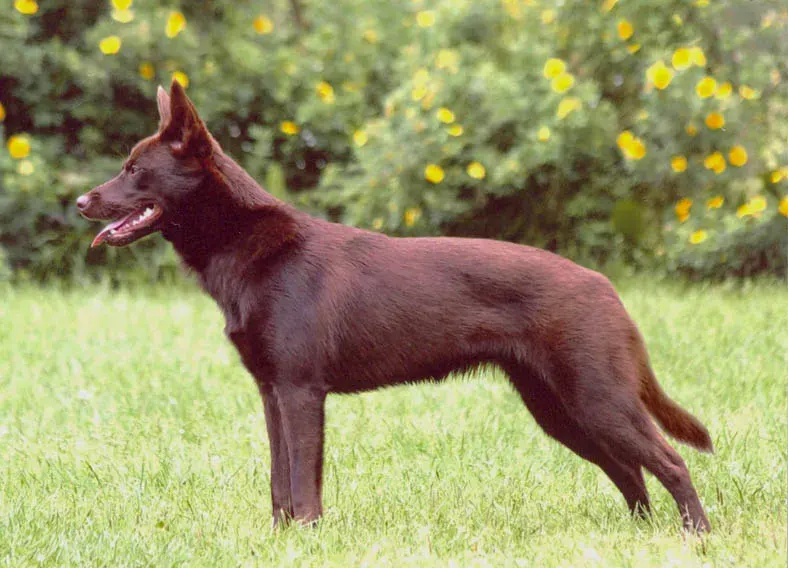
The FCI breed standard describes a lithe, active dog of great quality, with hard muscle and supple limbs that suggest untiring work, slightly longer than tall (10:9) and with a rather fox-like expression softened by almond-shaped eyes.
The double coat has a short, dense undercoat and a close, straight, hard, rain-resisting outer coat about 2–3 cm long, forming a ruff on the neck and a good brush on the tail. Accepted colours are black, black and tan, red, red and tan, fawn, chocolate and smoke blue.
- Height at the withers: 46–51 cm for males, 43–48 cm for females.
Temperament
Quick, intelligent and exceptionally driven, the Kelpie is very loyal to its owner. It is often reserved with strangers.
It learns very quickly but gets bored just as fast, so it needs daily occupation and positive training.
With children and other pets
The standard describes the Kelpie as extremely alert, eager and highly intelligent, with a mild, tractable disposition, almost inexhaustible energy and marked loyalty. It rates 3 out of 5 with children and 3 out of 5 with other dogs in our ratings.
- It suits active families who can involve it in daily activities.
- Without enough work, a herding dog may try to round up children or other pets.
Training tips
The standard explains that the Kelpie was developed when vast sheep properties opened in New South Wales and Victoria, some running over a quarter of a million sheep: a dog was needed that could work in heat, dust storms, rough terrain and over vast distances, doing the work of several men. It has a natural aptitude for working sheep, both in open country and in the yard. It rates 5 out of 5 for trainability and 5 out of 5 for energy in our ratings.
- It needs a job: herding, agility, obedience, scent work or canicross.
- Short daily training sessions suit its quick mind.
- Teach it to rest; it can keep going far longer than its owner.
Health
This is a robust breed. Hip dysplasia, some eye conditions and an inherited neurological disease (cerebellar abiotrophy), for which a test exists, should be monitored.
Ask the breeder for the parents' test results.
This is general information. For any question about your dog's health, consult a veterinarian.
Feeding
Good-quality food matched to its intense activity suits it. A working dog may need much larger rations.
Water should always be available.
Exercise
It needs at least two hours of daily activity, ideally herding work or dog sports (agility, obedience, canicross).
It is a farm dog or an athlete's dog, not a couch dog.
It would be a perfect fit for sheep farmers, but it is unsuited to a city apartment.
Grooming
Its short coat with undercoat needs weekly brushing, more often during the moult.
Check its paw pads after work on hard ground.
Choosing a puppy
Outside Australia, the Kelpie is uncommon. The FCI standard states that any defect of structure or temperament foreign to a working dog is uncharacteristic.
- Ask whether the parents are working dogs and what they do every day.
- Meet both parents if possible and check they are mild-tempered and confident.
Our guide on how to recognise a responsible breeder explains what to ask.
Similar breeds
The Australian Cattle Dog is the other Australian working dog, bred for cattle. The Border Collie and Australian Shepherd are other tireless herding breeds. The Belgian Malinois is a working shepherd with similar drive.