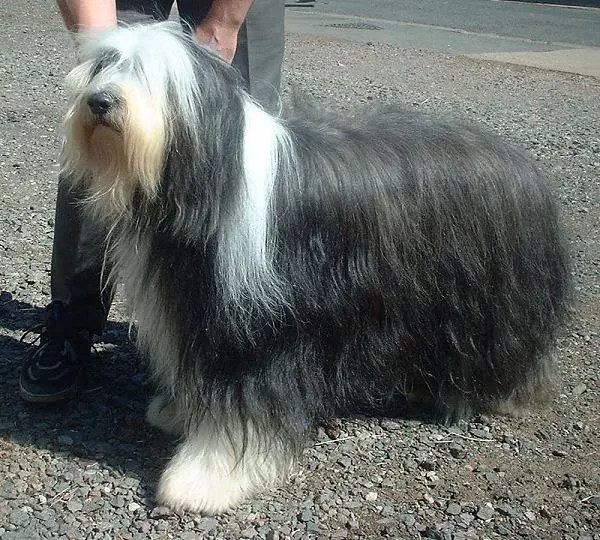
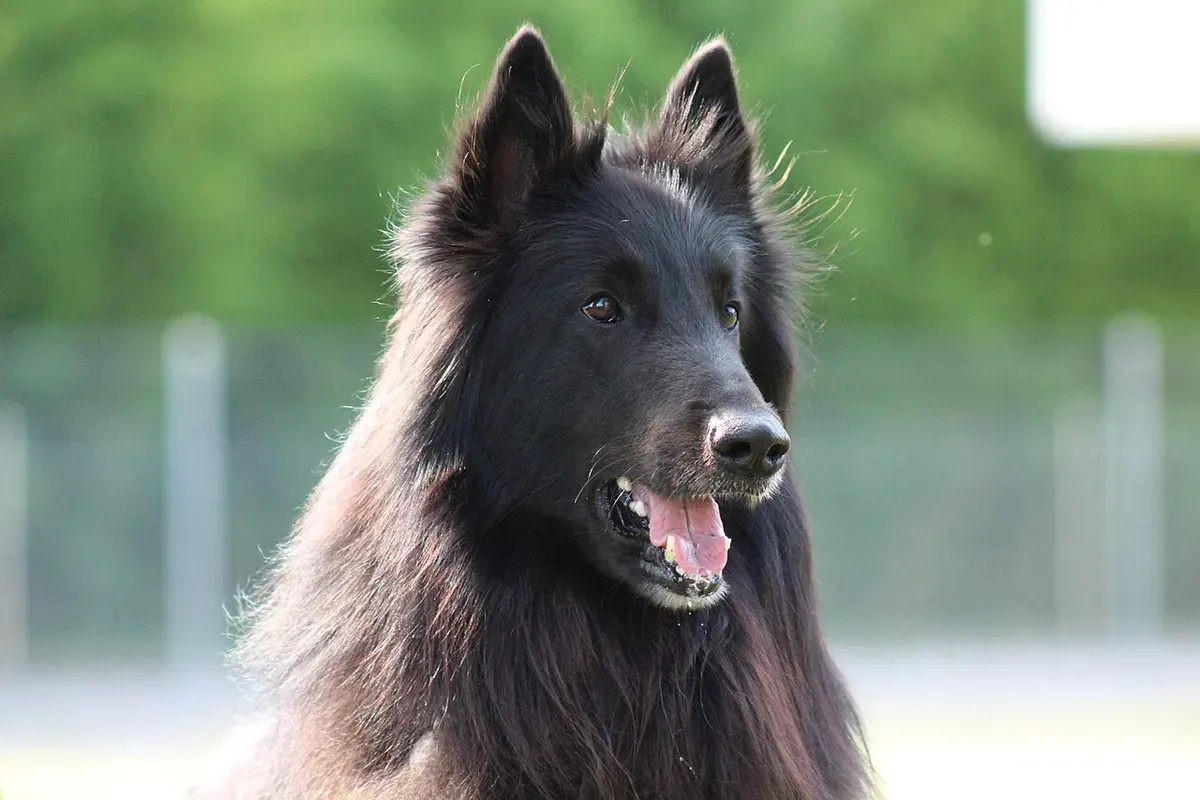
An elegant long-haired black Belgian Shepherd, the Groenendael is lively, sensitive and devoted to its family. It needs plenty of activity.
History and origins
The Groenendael is the long-haired black variety of the Belgian Shepherd. It is named after the village of Groenendael near Brussels, where a breeder established the type in the late 19th century.
Like the other Belgian Shepherds, it herded livestock before becoming a police, sport and family dog.
Appearance and colours
The Groenendael is the long-haired black variety of the Belgian Shepherd. The FCI standard, shared by the four varieties (Groenendael, Tervueren, Malinois and Laekenois), describes a harmoniously proportioned dog of medium size that fits into a square, combining elegance and power, rustic and built for an open-air life, with a high head carriage that gives an impression of "elegant strength".
The Groenendael's hair is short on the head and lower legs but long and smooth on the body, forming a collar or ruff around the neck and an apron on the chest, with fringes on the back of the forearms, over a woolly undercoat. Only uniform black is accepted, with a little white allowed on the chest and toes.
- Ideal height at the withers: 62 cm for males and 58 cm for females (limits: 2 cm less, 4 cm more).
- Weight: about 25–30 kg for males and 20–25 kg for females.
Temperament
Quick, attentive and very sensitive, the Groenendael forms a strong bond with its owner. It is watchful and protective and can be reserved with strangers.
It learns fast but needs gentle, consistent training and early socialisation to avoid shyness or nervousness.
With children and other pets
The standard describes a watchful, active dog, bursting with energy and always ready for action, a keen protector of its owner, with a lively, confident nature showing no fear or aggression. It rates 4 out of 5 with children and 3 out of 5 with other dogs in our ratings.
- It is devoted and protective: it needs to be part of family life, not left alone in a garden.
- Its energy suits active families with older children.
Training tips
The standard explains that the breed was officially born between 1891 and 1897, when Belgian enthusiasts, guided by Professor Reul of the Cureghem veterinary school, sorted the varied herding dogs of Belgium into one breed; originally a sheepdog, it is today a guard, defence, tracking and all-purpose service dog as well as a family dog. It rates 5 out of 5 for trainability and 5 out of 5 for energy in our ratings.
- It needs daily physical exercise and real mental work: obedience, tracking, agility or herding.
- Use calm, consistent, reward-based training; harshness is counterproductive with such a sensitive dog.
Health
This is a generally healthy breed. Hip and elbow dysplasia, some eye conditions and epilepsy have been reported in Belgian Shepherds.
Choose a breeder who screens their dogs, and keep up regular veterinary check-ups.
Common health issues in detail
Epilepsy. Idiopathic epilepsy is studied in the Belgian Shepherd. A genetic study confirmed a risk haplotype on chromosome 14, linked to an insertion in the RAPGEF5 gene and four times more frequent in Belgian Shepherds than in other breeds, which raises the risk when combined with a second region on chromosome 37; it does not fully predict which dogs will develop epilepsy. If your dog has a seizure, see your vet.
Health tests. The Royal Kennel Club recommends hip scoring, elbow grading and eye testing as best practice for breeding dogs.
This is general information. For any question about your dog's health, consult a veterinarian.
Feeding
Good-quality food matched to its activity keeps it athletic. A sporting dog needs more than a companion dog.
Avoid intense exercise straight after meals.
Exercise
It needs one to two hours of activity a day, combining running, games and mental work (obedience, agility, tracking).
Without a job, it may develop anxious or destructive behaviour.
Schedule walks very early in the morning and in the evening, and keep it in the shade and somewhere cool during the hot hours. Do not shave it: the coat also protects it from the sun.
Grooming
Its long black coat needs brushing two to three times a week, and daily during the moult.
Focus behind the ears, under the legs and on the 'trousers', where tangles form.
Choosing a puppy
Choose a breeder who scores hips and elbows, eye-tests the parents and is open about epilepsy in their lines.
- Ask whether any relatives have had seizures.
- Meet the mother: she should be confident and calm, never nervous; the standard penalises dogs lacking self-confidence.
- Ask how the puppies have been socialised.
Our guide on how to recognise a responsible breeder explains what to ask.
Similar breeds
The Belgian Tervuren is the long-haired fawn or grey variety of the same breed, and the Belgian Malinois the short-haired one. The German Shepherd and Dutch Shepherd are other versatile working shepherds.