A small dog with a monkey-like face and a shaggy coat, the Affenpinscher is funny, self-assured and devoted to its owners.
History and origins
The Affenpinscher is an old small German breed originally used to catch rodents in homes and stables. Its name means 'monkey pinscher' in German, because of its expression.
It contributed to the creation of the Brussels Griffon.
Appearance and colours
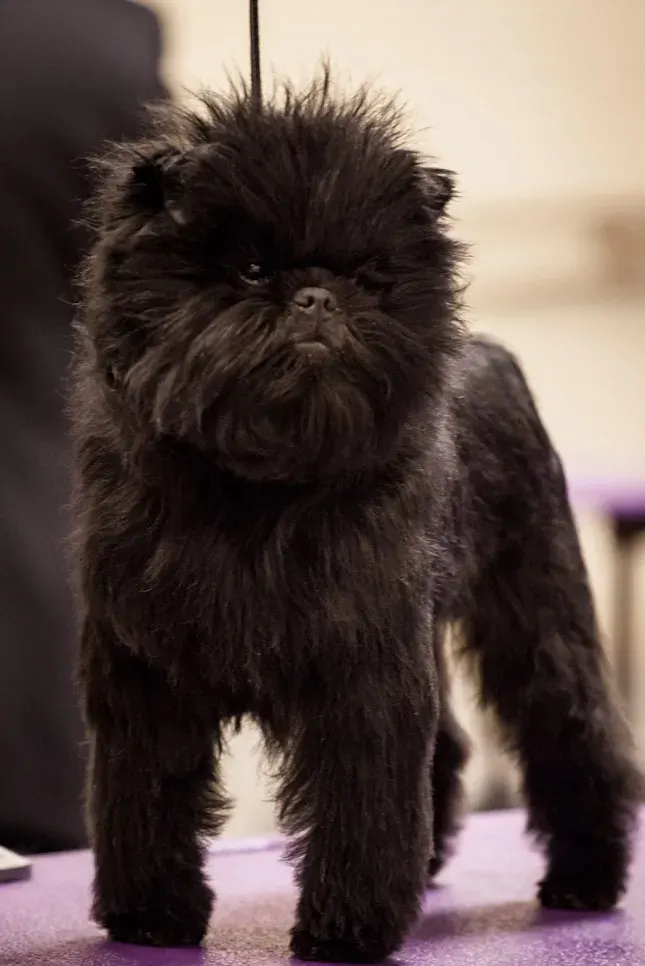
The FCI breed standard describes a small, compact, rough-haired dog with a monkey-like expression, built as square as possible. Its name means "monkey pinscher" in German. The coat on the body is harsh and dense; on the head, bushy eyebrows, a wreath of hair around the eyes, a beard, a topknot and hair on the cheeks should stand out as hard and straggly as possible, which gives the breed its typical expression.
The FCI standard accepts only one colour: pure black with a black undercoat. The Royal Kennel Club lists black as the standard colour and records red and black and tan as non-standard colours.
- Height at the withers: 25–30 cm for males and females.
- Weight: about 4–6 kg.
Temperament
Mischievous, curious and confident, the Affenpinscher often behaves like a big dog. It is affectionate with its family and watchful.
It can be stubborn and dislikes rough handling, so it suits calm, older children better.
With children and other pets
The standard describes the Affenpinscher as fearless, alert, persistent and devoted, sometimes full of quick-tempered passion, and an agreeable family dog. The Royal Kennel Club calls it a mischievous, curious little "black devil" with great character. It rates 2 out of 5 with children in our ratings.
- It is tiny and can be hurt by rough handling: it suits calm homes with older children.
- Its fearlessness means it may challenge much bigger dogs, so supervise meetings.
Training tips
The Royal Kennel Club notes that the breed was developed in Germany as a vermin killer, which explains its persistence. It rates 2 out of 5 for trainability in our ratings.
- Keep sessions short, playful and reward-based.
- Start early with handling, grooming and calm greetings.
Health
Kneecap luxation, some eye conditions and, because of its short muzzle, respiratory sensitivity to heat should be watched.
Dental care is important.
Common health issues in detail
The Royal Kennel Club notes that the Affenpinscher's background includes flat-faced breeds, and it publishes general advice on flat-faced dogs: a short skull can crowd the teeth and cause dental and gum problems, and dogs with a very short muzzle can have breathing difficulties. Not every flat-faced dog has these problems. The breed also has a breed club health scheme.
We found no large population study of health in the Affenpinscher.
This is general information. For any question about your dog's health, consult a veterinarian.
Feeding
Small-breed food in small portions suits it.
Limit treats.
Exercise
Daily walks and indoor games are enough.
It loves to explore and rummage.
It makes a good city apartment dog, provided its barking is kept in check.
Grooming
Its harsh, shaggy coat needs brushing once or twice a week; stripping or a tidy-up trim a few times a year helps.
Keep the hair around the eyes clear.
Choosing a puppy
The FCI standard disqualifies aggressive or overly shy dogs. Look for a breeder who takes part in the breed club health scheme and can show you both parents breathing quietly and moving freely.
- Ask about dental problems and breathing in the parents and relatives.
- Meet the mother and check that she is confident and friendly.
Our guide on how to recognise a responsible breeder explains what to ask.
Similar breeds
The Brussels Griffon is a related toy breed: the Royal Kennel Club notes that Griffon Bruxellois blood was added to the Affenpinscher after the Second World War. The Miniature Pinscher and German Pinscher belong to the same German pinscher family. The Miniature Schnauzer is another small German dog with a harsh, bearded coat.