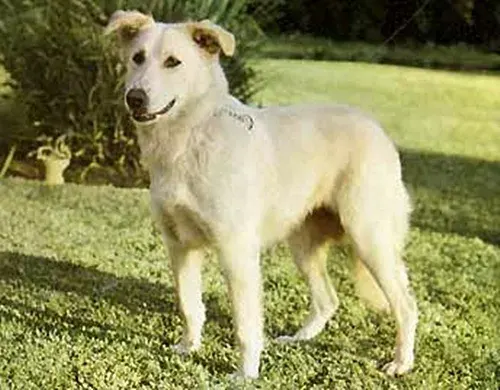
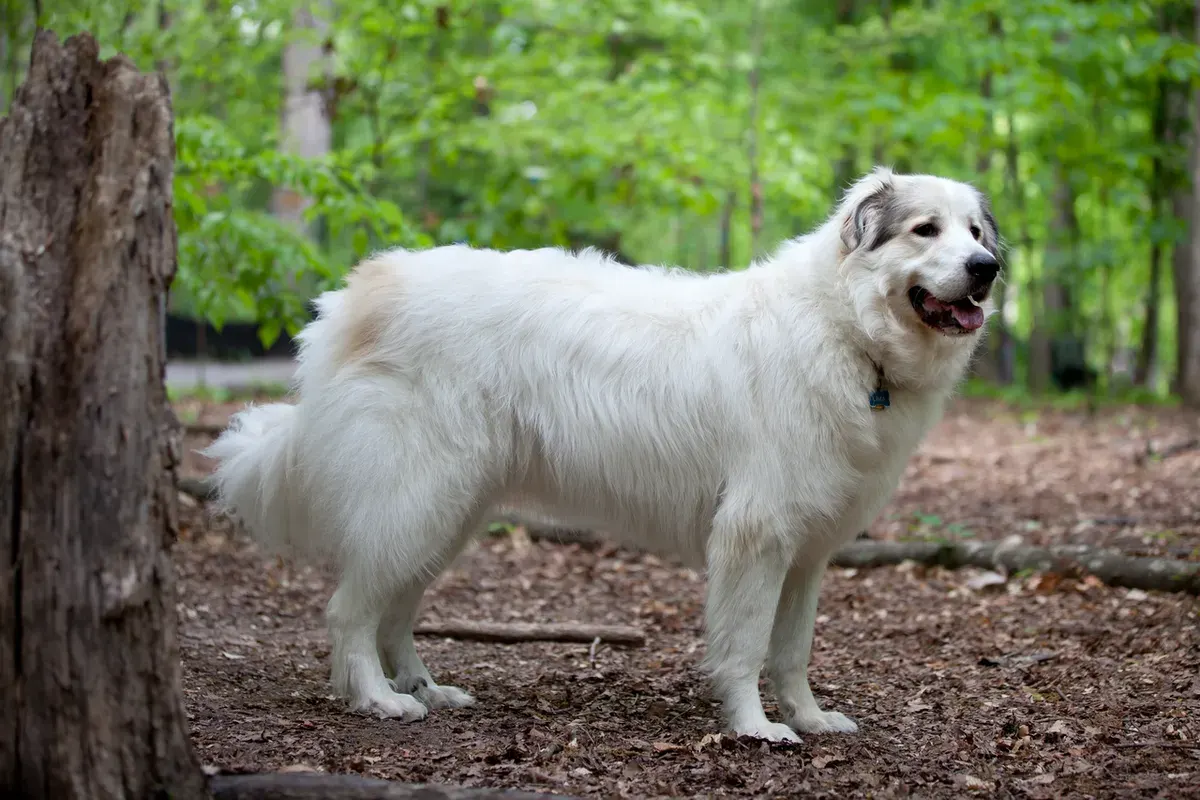
A majestic large white dog, the Pyrenean Mountain Dog has guarded flocks in the Pyrenees for centuries. Calm and independent, it is a born guardian.
History and origins
The Pyrenean Mountain Dog (the Great Pyrenees in North America) has protected sheep from wolves and bears in the Pyrenees for centuries. It also guarded castles.
It is still used today to protect flocks in the mountains.
Appearance and colours
The FCI breed standard describes a dog of great size, imposing and strongly built, but not without a certain elegance. The coat is well furnished, flat, quite long and supple, crisper on the shoulders and back, longer on the tail and neck, with very thick, woolly breeches and a thick undercoat.
The colour is white, or white with grey (badger or wolf), pale yellow or orange patches on the head, ears and tail base, and sometimes on the body; badger-grey patches are the most appreciated.
- Height at the withers: 70–80 cm for males, 65–75 cm for females (+2 cm tolerated).
Temperament
Calm, patient and independent, it is gentle with its family and wary of strangers. It keeps watch mostly at night and barks to deter intruders.
It is not an obedience dog: it needs patient training and early socialisation.
With children and other pets
The standard describes a flock guardian selected for guarding and deterring predators as well as for attachment to its flock; its main qualities are strength and agility combined with gentleness and attachment to those it protects. It rates 4 out of 5 with children and 3 out of 5 with other dogs in our ratings.
- It is a gentle family dog but a natural guardian.
- It sheds a lot (4 out of 5 in our ratings).
Training tips
According to the standard, the breed has been in the Pyrenees since time immemorial, guarded castles in the Middle Ages, was mentioned by Gaston Fébus in the 14th century and reached the court of Louis XIV; the official standard was registered in 1923. The Royal Kennel Club notes that Louis XIV named it the Royal Dog of France. It rates 2 out of 5 for trainability in our ratings.
- Use calm, patient, consistent training.
- Avoid exercise in the heat: it rates 2 out of 5 for heat tolerance.
Health
Hip dysplasia, kneecap luxation and bloat should be watched for. It has double dewclaws on its hind legs.
Regular veterinary follow-up is recommended.
Common health issues in detail
The Royal Kennel Club recommends as best practice for breeding dogs hip and elbow scoring and eye testing, and notes that the breed can be affected by conformation-related problems.
We found no large population study of health in the Pyrenean Mountain Dog.
This is general information. For any question about your dog's health, consult a veterinarian.
Feeding
It often eats less than its size would suggest. Large-breed food in two meals and slow growth are recommended.
Avoid excess weight.
Exercise
Calm walks and a large area to watch over are enough.
Solid fencing is essential, as it tends to extend its territory.
In summer, give it shade, coolness and water. It would suit sheep farmers in the mountains, but it is unsuited to apartments and city life.
Grooming
Its thick white coat needs brushing once or twice a week, far more during the moult.
Do not shave it: the coat protects it from the sun.
Choosing a puppy
Choose a breeder who scores hips and elbows and eye-tests the parents.
- Ask for the parents' hip, elbow and eye results.
- Meet the mother: she should be calm and gentle.
- Ask whether the parents work with livestock or live as companions.
Our guide on how to recognise a responsible breeder explains what to ask.
Similar breeds
The Maremma Sheepdog and Kuvasz are other white flock guardians. The Leonberger and Newfoundland are other gentle giants.