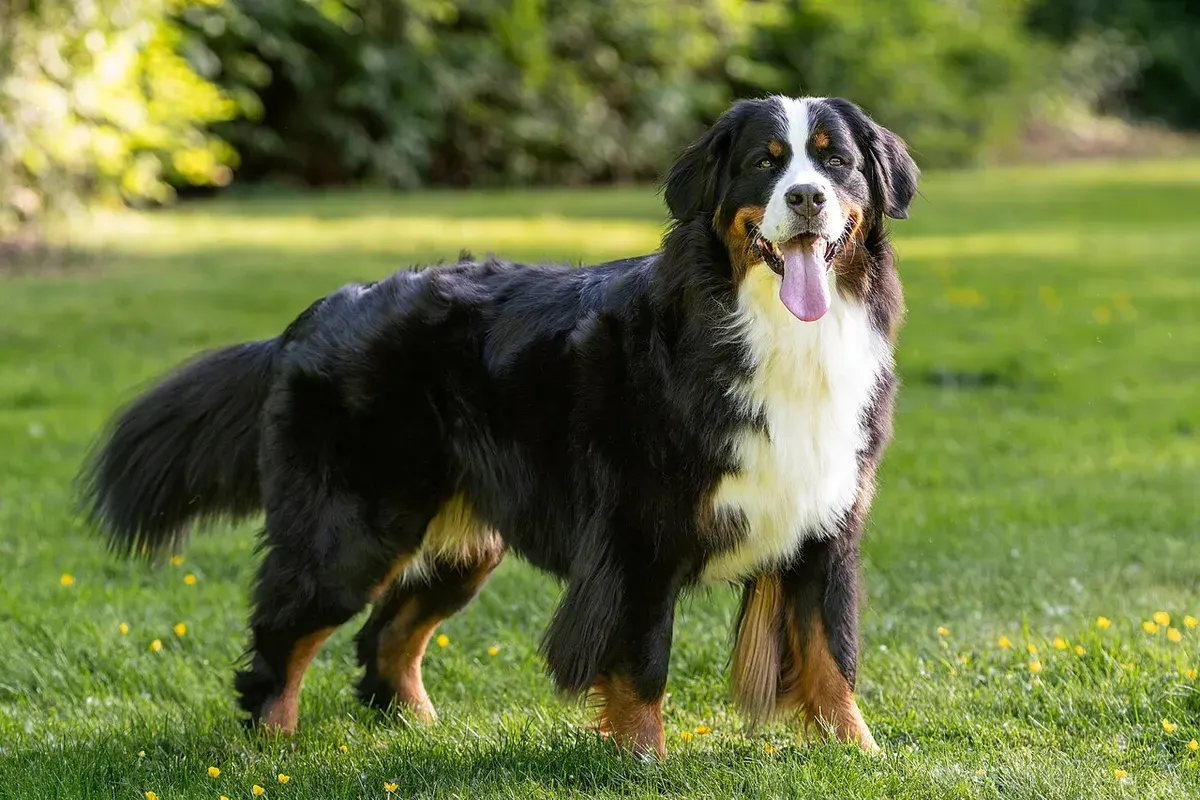
A handsome tricolour dog from the Swiss Alps, the Bernese is gentle, loyal and excellent with families, but copes very badly with heat.
History and origins
The Bernese Mountain Dog comes from the canton of Bern in Switzerland, where it guarded farms, drove cattle and pulled carts of milk and cheese.
It is the only long-haired breed among the four Swiss mountain dogs.
Appearance and colours
The FCI breed standard describes a long-haired, tricoloured, strong and agile working dog of above-medium size, harmonious and well balanced, rather compact than long (height to length about 9:10). The Royal Kennel Club calls it a Swiss draught dog used to pull carts.
The coat is long, shining, straight or slightly wavy. The main colour is jet black, with rich tan on the cheeks, above the eyes, on all four legs and on the chest, and white markings: a symmetrical blaze and muzzle band, an unbroken white mark on the throat and chest, and ideally white feet and tail tip.
- Height at the withers: 64–70 cm for males (ideal 66–68 cm), 58–66 cm for females (ideal 60–63 cm).
Temperament
Calm, affectionate and very attached to its family, the Bernese is gentle with children and usually sociable with other animals.
Sensitive, it learns well with positive training and dislikes being left alone.
With children and other pets
The standard describes a self-confident, attentive, vigilant dog, fearless in everyday situations, good-natured and devoted to its own people, self-assured and placid with strangers, of medium temperament and docile. It rates 5 out of 5 with children and 4 out of 5 with other dogs in our ratings.
- It is gentle and patient, but large: supervise play with small children.
- It wants to be with its family, indoors.
Training tips
The standard explains that the breed was a farm dog around Bern, used as a guard, draught and cattle-driving dog. It was first called "Dürrbächler", after the hamlet and inn of Dürrbach near Riggisberg, where these long-haired tricoloured dogs were especially numerous; a breed club was founded in 1907. It rates 4 out of 5 for trainability in our ratings.
- It enjoys calm, reward-based training and tasks such as cart pulling.
- Keep exercise moderate while it grows, and avoid exertion in heat: it rates 1 out of 5 for heat tolerance.
Health
Its life expectancy is short, largely because of a high rate of cancers (including histiocytic sarcoma). Hip and elbow dysplasia and bloat are also reported.
Choose a breeder who selects for health and longevity.
Common health issues in detail
Short life expectancy and cancer. A Swiss study of 389 Bernese Mountain Dogs born in 2001 and 2002 found a median life expectancy of only 8.4 years: 8.8 years for females and 7.7 years for males. Neoplasia (cancer and other tumours) was the most frequent cause of death, in 58% of the dogs, although many diagnoses were not confirmed by laboratory tests. Other causes included degenerative joint disease, spinal disorders, kidney disease and gastric volvulus. See your vet promptly about any lump, lameness, weight loss or tiredness.
Health tests. The Royal Kennel Club recommends hip scoring and elbow grading for breeding dogs as a minimum.
This is general information. For any question about your dog's health, consult a veterinarian.
Feeding
Puppies should grow slowly on large-breed food. Adults: two meals and a controlled weight.
Avoid exercise after meals.
Exercise
It needs about an hour of daily activity: walks, hikes in cool weather and suitable carting games.
Avoid jumping and intense effort during growth.
It needs a house with a shady garden rather than an apartment.
Grooming
Its long, thick coat sheds enormously: brush several times a week, daily during the moult.
Do not shave it.
Choosing a puppy
Choose a breeder who hip-scores and elbow-grades the parents and is open about the age and causes of death of older relatives.
- Ask for the parents' hip and elbow results.
- Ask how long the parents' and grandparents' generations lived, and what they died of.
- Meet the mother: she should be good-natured and placid.
Our guide on how to recognise a responsible breeder explains what to ask.
Similar breeds
The Greater Swiss Mountain Dog is a larger, short-coated Swiss mountain dog with the same colours. The Saint Bernard is another large Swiss breed. The Newfoundland and Leonberger are other giant, long-coated family dogs.