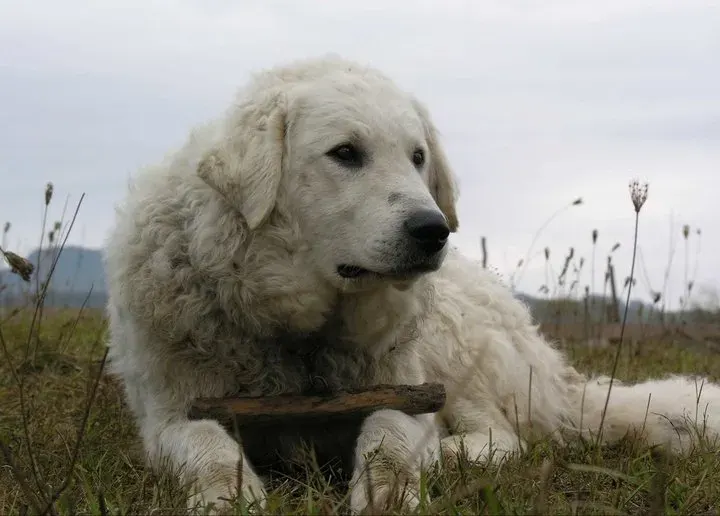
A large Hungarian guardian with a wavy white coat, the Kuvasz is noble, brave and highly protective of its family.
History and origins
The Kuvasz is an ancient guardian of flocks and estates in Hungary. It is thought to have travelled with the Magyar tribes, and it was also prized as a guard dog by the Hungarian nobility.
Nearly lost after the Second World War, it was rebuilt from a handful of dogs.
Appearance and colours
The FCI breed standard describes a strong, large dog with a dense, wavy white coat, radiating nobility and strength, strong-boned but not coarse, with lean muscles. The coat is moderately harsh, wavy and slightly stiff, not tending to mat, with a fine undercoat, short hair on the head and feet, and a ruff and mane, especially in males.
The colour is white; ivory is permitted. The nose, eyelids and lips are black.
- Height at the withers: 71–76 cm for males, 66–70 cm for females.
- Weight: 48–62 kg for males, 37–50 kg for females.
Temperament
Loyal, proud and independent, the Kuvasz is very protective of its territory and people. It is gentle with its family but wary of strangers.
It is not for beginners: early socialisation, consistent training and respect for its independence are essential.
With children and other pets
The standard describes a brave, fearless dog that defends the people in its care and their property, even with its life; self-confident, faithful and dependable, it loves its owner but may become aggressive if ill-treated. It rates 3 out of 5 with children and 2 out of 5 with other dogs in our ratings.
- It is a protective guardian that suits experienced owners.
- The standard says it needs plenty of exercise and must be kept busy.
Training tips
According to the standard, the Kuvasz is an ancient Hungarian shepherd dog whose ancestors arrived in the Carpathian basin with the Magyars, to guard flocks against predators and thieves; it was also a favourite hunting dog in the time of King Matthias Corvinus. As herding declined it moved into villages and towns. It rates 2 out of 5 for trainability in our ratings.
- Use calm, consistent training and early socialisation.
- It sheds a lot (4 out of 5 in our ratings).
Health
Hip and elbow dysplasia and osteochondrosis in young dogs are the main concerns.
Growth should be managed carefully and the parents screened.
This is general information. For any question about your dog's health, consult a veterinarian.
Feeding
Large-breed food in two meals and slow growth are essential.
Avoid excess weight.
Exercise
It needs daily walks and plenty of space. It likes to patrol its territory.
High, solid fencing is necessary.
Its white coat reflects some of the sun. It is a dog for a house with large grounds, on the outskirts or in the countryside, not an apartment dog.
Grooming
Its wavy white double coat needs weekly brushing, more often during heavy moults.
It gets less dirty than you might think.
Choosing a puppy
The FCI standard says only healthy dogs with typical breed conformation should be used for breeding.
- Ask what health checks the parents have had.
- Meet the mother: she should be confident and calm.
Our guide on how to recognise a responsible breeder explains what to ask.
Similar breeds
The Komondor is another Hungarian flock guardian. The Maremma Sheepdog, Pyrenean Mountain Dog and Kangal Shepherd Dog are other livestock guardians.