Very muscular but usually gentle with people, the American Bully is a recent breed that comes in several sizes, from Pocket to XL.
History and origins
The American Bully was developed in the United States from the 1990s, mainly from the American Staffordshire Terrier and the American Pit Bull Terrier, with the aim of producing a heavily built companion dog with a stable temperament.
It is recognised by American registries such as the American Bully Kennel Club and the United Kennel Club, but not by the Fédération Cynologique Internationale. There are several size categories: Pocket, Standard, Classic and XL.
Appearance and colours
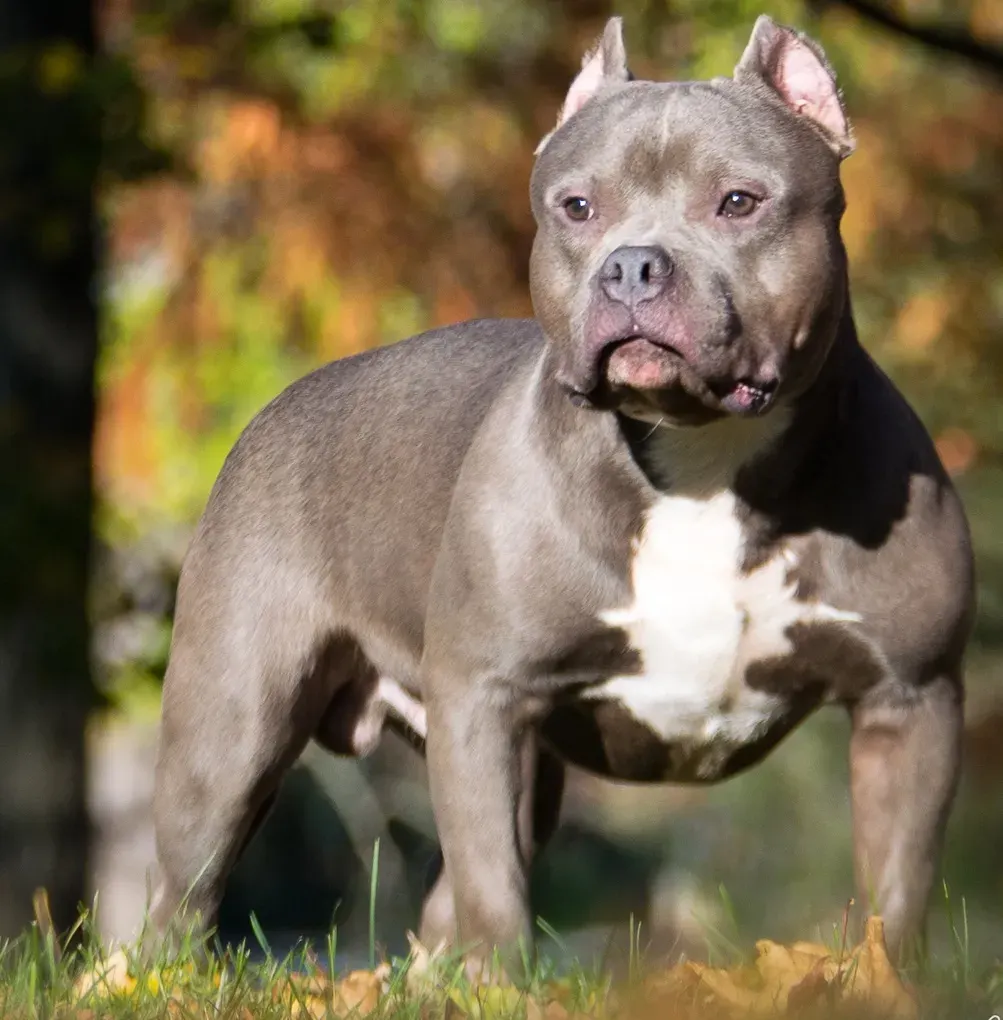
The United Kennel Club (UKC) standard describes a compact, strong, thick-set dog with great strength for its size, developed as an extension of the American Pit Bull Terrier with input from other bull breeds, including the American Bulldog. Its large, broad head is a key feature. Overall balance, soundness and good muscle tone matter more than mass: the UKC disqualifies overly massive dogs and dwarfism.
The coat is glossy, smooth, close and moderately stiff. Any colour is accepted except merle; albinism and blue eyes are disqualifying.
The UKC recognises three sizes:
- Pocket: 36–43 cm at the withers for males, 33–41 cm for females.
- Standard and Classic: 43–51 cm for males, 41–48 cm for females; the Classic has a lighter frame.
- XL: over 51 cm to 58 cm for males, over 48 cm to 56 cm for females.
Temperament
Affectionate, confident and playful, the American Bully is usually very people-focused, including with children. It may, however, be intolerant of other dogs.
Its physical strength calls for careful socialisation and consistent training from puppyhood.
Some regions restrict ownership of this breed; check your local regulations.
With children and other pets
The UKC describes the American Bully first and foremost as a companion, confident and full of zest for life, gentle and friendly despite its powerful appearance, and an excellent family dog. It states that aggression towards people is uncharacteristic and highly undesirable. It rates 4 out of 5 with children but 2 out of 5 with other dogs in our ratings.
- It is strong for its size: supervise play with children and teach calm greetings.
- Socialise it widely with other dogs from puppyhood.
Training tips
The UKC notes that the ideal American Bully has the athleticism to do well in performance events. It rates 3 out of 5 for trainability in our ratings.
- Use reward-based training and teach loose-lead walking early.
- Keep it fit and lean; it should be agile, not heavy.
- Take care in hot weather and avoid hard exercise in the heat.
Health
Its very bulky build and sometimes short muzzle can lead to breathing and joint problems (hips, elbows) and poor heat tolerance. Skin allergies are common.
Avoid breeders who exaggerate size at the expense of health, and have it checked regularly by a veterinarian.
This is general information. For any question about your dog's health, consult a veterinarian.
Feeding
It tends to gain weight, so good-quality food in measured amounts is better than 'bulking' diets. A lean, muscular Bully lives better and longer.
Adjust the ration to its size and activity.
Exercise
Daily walks of about an hour, play and training sessions are usually enough. It is not built for intense, prolonged effort.
Avoid exercise during the hot hours.
Its muscle mass makes it heat-sensitive: early-morning and evening walks, shade, fresh water and a ventilated home are essential in summer. Pocket and Standard sizes can live in an apartment if they get enough exercise.
Grooming
Its short coat needs weekly brushing. Clean any skin folds and watch for redness and itching.
An occasional bath with a mild shampoo is enough.
Choosing a puppy
The UKC disqualifies extreme size, dwarfism, deafness, viciousness and extreme shyness. Choose a breeder who puts health, movement and temperament before size or bulk.
- Meet both parents: they should be friendly and move freely, without struggling to breathe.
- Be wary of puppies advertised for extreme size or "rare" colours.
Our guide on how to recognise a responsible breeder explains what to ask.
Similar breeds
The American Pit Bull Terrier is its parent breed, lighter and more athletic. The American Staffordshire Terrier and Staffordshire Bull Terrier are related bull-and-terrier breeds. The Bulldog is another heavy, short-coated bull breed.