A gentle giant with a lion-like mane, the Leonberger is a calm, patient and very sociable family dog, but poorly suited to heat.
History and origins
The Leonberger was created in the 19th century in the town of Leonberg, Germany, from crosses between the Saint Bernard, the Newfoundland and the Pyrenean Mountain Dog. The goal was a dog resembling the lion on the town's coat of arms.
It was prized by several European royal families.
Appearance and colours
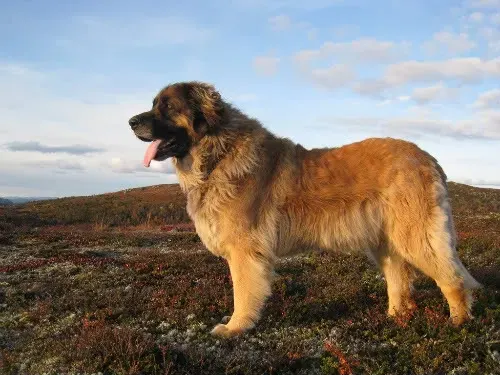
The FCI breed standard describes a large, strong, muscular yet elegant dog, distinguished by a balanced build and confident calm with a lively temperament; males especially are powerful. The coat is medium-soft to coarse, long and close-fitting over a thick undercoat, with a mane on the neck and chest, feathering on the front legs and ample breeches.
Colours are lion yellow, red, reddish-brown and sandy (cream), and all combinations between them, always with a black mask.
- Height at the withers: 72–80 cm for males (ideal 76 cm), 65–75 cm for females (ideal 70 cm).
Temperament
Calm, gentle and very sociable, the Leonberger is patient with children and welcoming to visitors while staying watchful.
It learns well with positive training, but its size makes good lead manners essential from puppyhood.
With children and other pets
The standard describes an agreeable family dog that can be taken anywhere, distinguished by marked friendliness towards children, neither shy nor aggressive, obedient and fearless. It rates 5 out of 5 with children and 4 out of 5 with other dogs in our ratings.
- It is a gentle family dog, but very large and strong.
- It sheds a great deal (5 out of 5 in our ratings).
Training tips
According to the standard, around 1840 Heinrich Essig, a councillor in Leonberg near Stuttgart, crossed a Newfoundland bitch with a "Barry" male from the Great St Bernard hospice, later adding a Pyrenean Mountain Dog, aiming for a lion-like dog, the lion being the town's heraldic animal; the first dogs called Leonbergers were born in 1846. It rates 4 out of 5 for trainability in our ratings.
- Start calm, reward-based training and lead training early.
- Avoid exercise in the heat: it rates 1 out of 5 for heat tolerance.
Health
The breed is prone to inherited neurological diseases (polyneuropathy), dysplasia, bloat and some cancers. Genetic tests are available.
Choose a breeder who tests their breeding dogs.
Common health issues in detail
The Royal Kennel Club recommends as a minimum for breeding dogs hip and elbow scoring and eye testing including gonioscopy, and as best practice DNA tests for laryngeal paralysis and polyneuropathy (LPPN3), Leonberger polyneuropathy (LPN1 and LPN2) and leukoencephalomyelopathy (LEMP). It notes that the breed can be affected by conformation-related problems.
In a UK study of giant breeds under veterinary care, the median age at death of Leonbergers was 9.3 years, based on 28 deaths.
This is general information. For any question about your dog's health, consult a veterinarian.
Feeding
Puppies should grow slowly on large-breed food. Adults: two meals a day and rest after eating.
Avoid excess weight.
Exercise
It needs daily walks of about an hour, with no strenuous exercise during growth. It loves water.
Avoid any activity in hot weather.
It needs a house with a shady garden and ideally access to water to cool off.
Grooming
Its thick double coat sheds enormously: brush several times a week, daily during the moult.
Do not shave it.
Choosing a puppy
Choose a breeder who does the hip, elbow, eye and DNA tests recommended by the Royal Kennel Club.
- Ask for the parents' hip, elbow, eye and polyneuropathy DNA results.
- Ask how long the parents' relatives lived.
- Meet the mother: she should be calm and friendly.
Our guide on how to recognise a responsible breeder explains what to ask.
Similar breeds
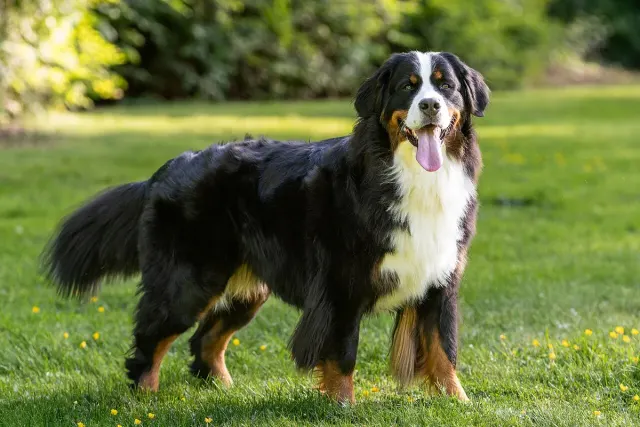
The Saint Bernard, Newfoundland and Pyrenean Mountain Dog were used to create it. The Bernese Mountain Dog is another large family dog.