Massive and covered in folds, the Neapolitan Mastiff is an impressive, calm and loyal guardian whose health needs close attention.
History and origins
The Neapolitan Mastiff descends from the great guard mastiffs of ancient Italy. It was preserved around Naples, where it guarded farms and properties.
The breed was established and recognised in the mid-20th century.
Appearance and colours
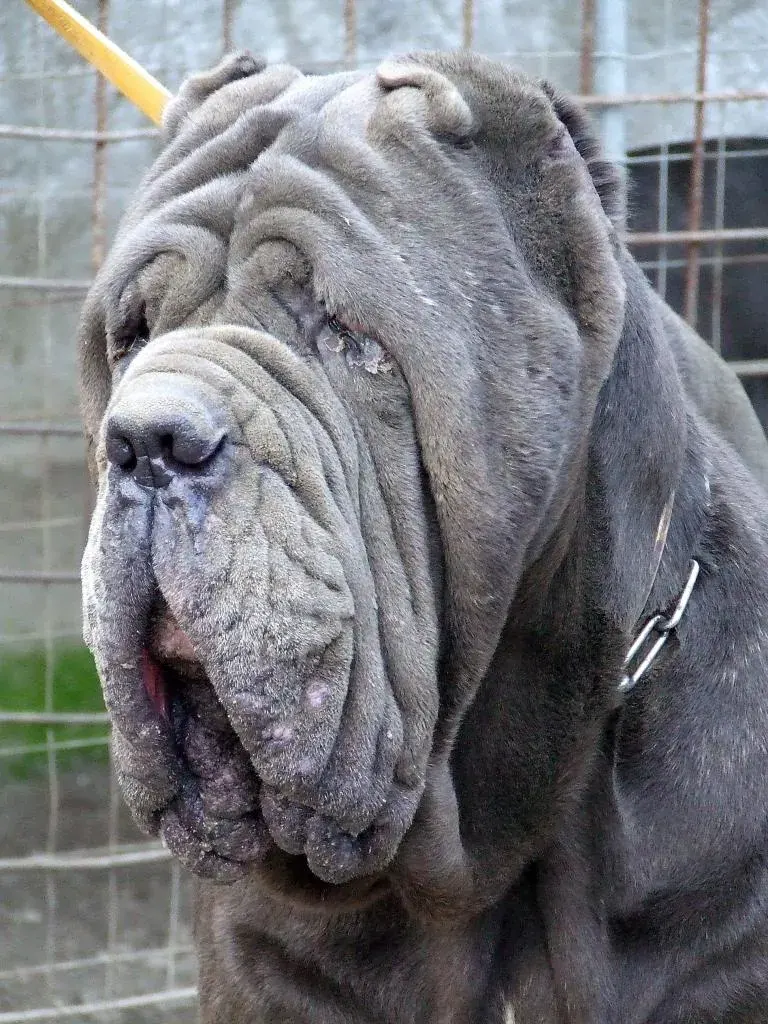
The FCI breed standard describes a large, heavy, massive dog of bulky appearance, longer than tall. The coat is short, hard and dense, of equal length all over and no longer than 1.5 cm.
Preferred colours are grey, lead grey and black, but brown, fawn and deep fawn are also allowed, all possibly brindled; a little white on the chest or toes is permitted.
- Height at the withers: 65–75 cm for males, 60–68 cm for females.
- Weight: 60–70 kg for males, 50–60 kg for females.
Temperament
Calm, loyal and very protective, the Neapolitan Mastiff is wary of strangers and a deterrent by its appearance alone. It is affectionate with its family.
It needs an experienced owner, early socialisation and firm, patient training.
Some regions restrict ownership of this breed; check your local regulations.
With children and other pets
The standard describes a steady, loyal dog, not aggressive, a guard of property and its inhabitants, always vigilant, intelligent, noble and majestic. It rates 3 out of 5 with children and 2 out of 5 with other dogs in our ratings.
- It suits experienced owners with space.
- It is very heavy: start lead training early.
Training tips
According to the standard, the Neapolitan Mastiff descends from the great Roman mastiff described by Columella in the first century AD; spread across Europe with the Roman legions, it is the ancestor of many mastiff breeds. It survived for centuries in the countryside around Vesuvius and Naples and has been re-selected since 1947. It rates 2 out of 5 for trainability in our ratings.
- Use calm, consistent, reward-based training.
- Avoid exercise in the heat: it rates 1 out of 5 for heat tolerance.
Health
Its heavily folded skin encourages infections, and its drooping eyelids cause eye irritation. Dysplasia, bloat, heart problems and heatstroke are also significant risks.
Very regular veterinary follow-up is essential.
Common health issues in detail
The Royal Kennel Club recommends as a minimum for breeding dogs hip and elbow scoring, and eye testing as best practice, and notes that the breed can be affected by conformation-related problems.
We found no large population study of health in the Neapolitan Mastiff.
This is general information. For any question about your dog's health, consult a veterinarian.
Feeding
Puppies should grow slowly on large-breed food. Adults need two or three meals a day and rest after each one.
Avoid any excess weight.
Exercise
It needs calm daily walks without intense effort.
Heat severely limits its activity.
It needs a house with a garden and well-informed owners.
Grooming
Its short coat needs weekly brushing, but skin and facial folds must be cleaned and dried several times a week. It drools a lot.
Keep an eye on its eyes.
Choosing a puppy
Choose a breeder who scores hips and elbows, eye-tests the parents and breeds for moderate, healthy conformation.
- Ask for the parents' hip, elbow and eye results.
- Look at the parents' eyes and skin folds: they should not be sore or inflamed.
- Meet the mother: she should be calm and steady.
Our guide on how to recognise a responsible breeder explains what to ask.
Similar breeds
The Mastiff, Dogue de Bordeaux and Bullmastiff are other heavy mastiffs. The Cane Corso is a lighter Italian molosser.