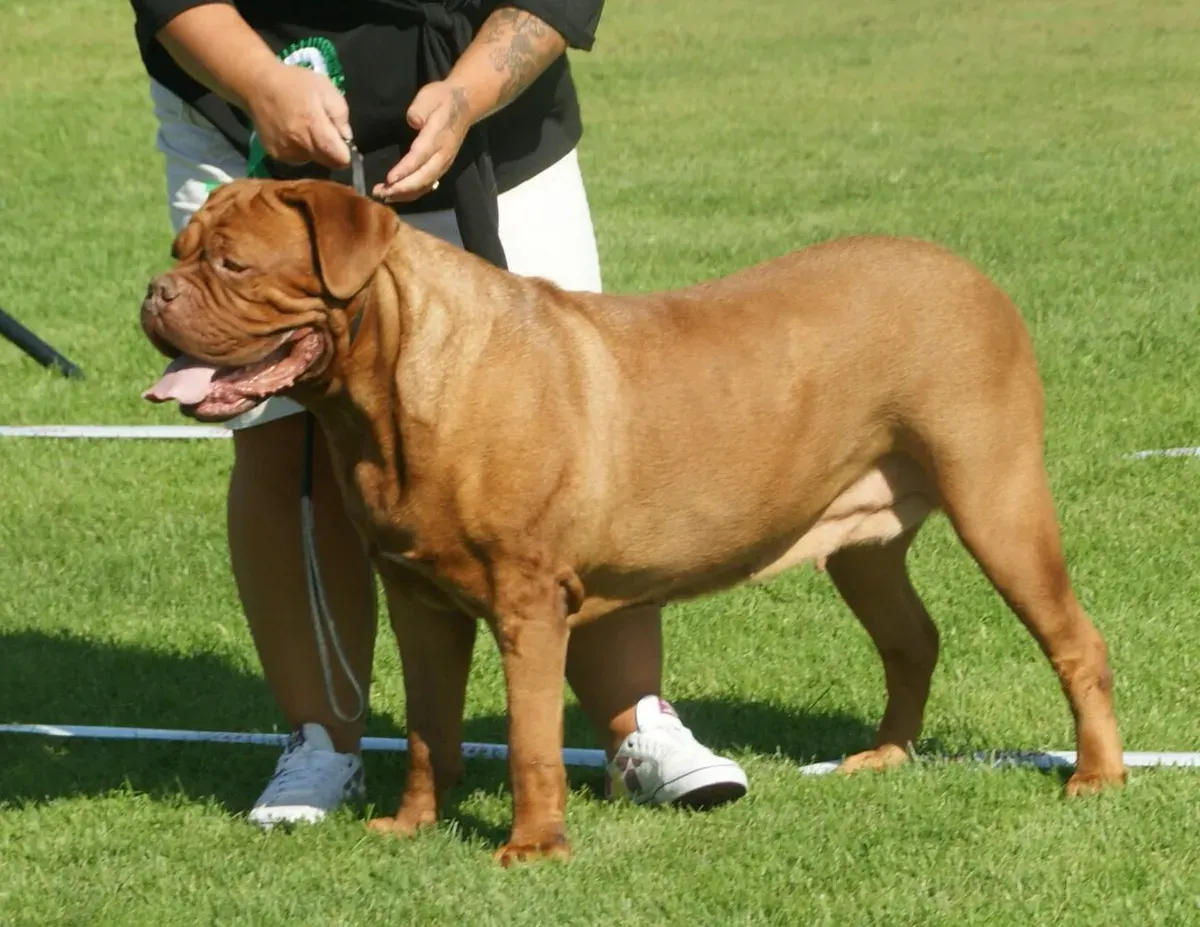
A fawn French mastiff with a massive head, the Dogue de Bordeaux is a calm guardian deeply attached to its family.
History and origins
The Dogue de Bordeaux is an old mastiff from south-west France, used for guarding, hunting big game and, in the past, for fights that are now banned.
The breed became world-famous through the 1989 film 'Turner & Hooch'.
Appearance and colours
The FCI breed standard describes a typical brachycephalic molosser: very powerful and muscular yet harmonious, built rather close to the ground, stocky, athletic and imposing. The head is voluminous, broad and angular. The coat is fine, short and soft to the touch.
The colour is solid fawn in all shades from mahogany to isabella, with either a black or a brown mask; limited white patches on the chest and the ends of the legs are permitted.
- Height at the withers: 60–68 cm for males, 58–66 cm for females.
Temperament
Calm, affectionate and very loyal, the Dogue de Bordeaux is a natural guardian, wary of strangers. It is often gentle with the family's children.
It can be stubborn and dominant, so early, firm and kind training is essential.
Some regions restrict ownership of this breed; check your local regulations.
With children and other pets
The standard describes a former fighting dog gifted for guarding, which it does with vigilance and great courage but without aggressiveness; a good companion, very attached to its owner and very affectionate, calm and balanced. It rates 3 out of 5 with children and 2 out of 5 with other dogs in our ratings.
- It is affectionate with its family but very strong: supervise it with children.
- The standard notes that males usually have a dominant character.
Training tips
According to the standard, the Dogue de Bordeaux is one of the oldest French breeds, probably descended from the dogs of the Alans; it was used to hunt boar, to guard houses and cattle and in the service of butchers, and it was nearly lost after the Second World War before a fresh start in the 1960s. It rates 2 out of 5 for trainability in our ratings.
- Start calm, reward-based training and lead training early, before it is fully grown.
- Avoid exercise in the heat: it rates 1 out of 5 for heat tolerance.
Health
Its life expectancy is short. The breed is prone to heart problems, dysplasia, bloat and cancers, and because of its short muzzle, to breathing difficulties and heatstroke.
Regular veterinary follow-up is essential.
Common health issues in detail
The breed has a short life for its size. In a UK study of giant breeds under veterinary care, the Dogue de Bordeaux was the most common giant breed; its median age at death was 7.7 years, compared with 8.9 years for giant breeds overall.
The Royal Kennel Club recommends at minimum hip and elbow scoring and eye testing for breeding dogs, and notes that the breed can be affected by conformation-related problems.
This is general information. For any question about your dog's health, consult a veterinarian.
Feeding
Puppies should grow slowly on large-breed food. Adults: two meals a day and rest after eating.
Excess weight worsens its joint and breathing problems.
Exercise
Calm walks are enough. It is not built for running or prolonged effort.
Avoid any activity in hot weather.
Outings only early in the morning or late in the evening in summer. It needs a house with a garden.
Grooming
Its short coat needs weekly brushing. Clean and dry the facial folds regularly. It drools a lot.
Check its eyes and ears.
Choosing a puppy
Choose a breeder who scores hips and elbows, eye-tests the parents and breeds for moderate, healthy conformation.
- Ask for the parents' hip, elbow and eye results.
- Ask how old the parents' and grandparents' generations lived to.
- Meet the mother: she should be calm and confident.
Our guide on how to recognise a responsible breeder explains what to ask.
Similar breeds
The Mastiff, Bullmastiff and Neapolitan Mastiff are other heavy mastiff breeds. The Cane Corso is a more athletic molosser.