One of the heaviest dogs in the world, the Mastiff is a calm, dignified giant that is very gentle with its family.
History and origins
The Mastiff is a very old English breed descended from large guard and war mastiffs known in Britain since antiquity. It guarded estates and castles.
Nearly lost after the Second World War, it was revived thanks to dogs imported from North America.
Appearance and colours
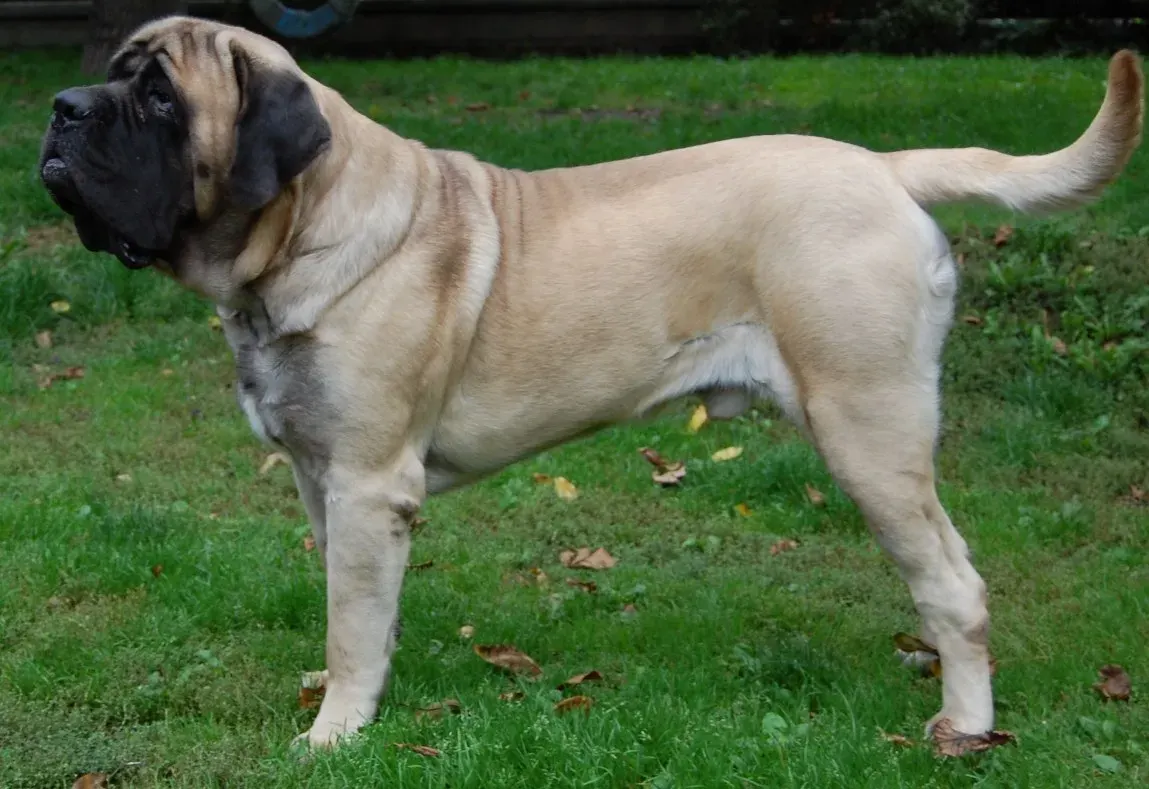
The FCI breed standard describes a large, powerful, well-knit dog whose head looks square from any angle, with a broad, deep, long body on wide-set legs and sharply defined muscles; size is desirable only if combined with quality and soundness. The coat is short and close-lying, coarser over the neck and shoulders.
Colours are apricot, fawn or brindle, always with a black muzzle, ears and nose and black around the eyes; excessive white is highly undesirable.
Temperament
Calm, dignified and affectionate, the Mastiff deters intruders by its presence alone. It is usually very gentle with children, but its bulk means play must be supervised.
It must learn lead walking early, as an adult cannot be held back by force.
Some regions restrict ownership of this breed; check your local regulations.
With children and other pets
The standard describes a combination of grandeur and courage: calm, affectionate to its owners but capable of guarding, usually indifferent to strangers; timidity is unacceptable. It rates 4 out of 5 with children and 3 out of 5 with other dogs in our ratings.
- It is a calm family dog but very heavy and strong.
- It needs space and a car big enough to carry it.
Training tips
According to the standard, the Mastiff has been in Britain for many hundreds of years; the Romans found mastiff-type dogs there and took some to fight in Rome's arenas. The breed almost disappeared from Britain after the Second World War and was rebuilt with imported stock. It rates 3 out of 5 for trainability in our ratings.
- Start calm, reward-based training and lead training early, before it is fully grown.
- Avoid exercise in the heat: it rates 2 out of 5 for heat tolerance.
Health
Its very large size explains a short life expectancy. Hip and elbow dysplasia, bloat, and heart and eye problems have been reported.
Rigorous veterinary follow-up is essential.
Common health issues in detail
In a UK study of giant breeds under veterinary care, the median age at death of Mastiffs was 9.6 years, based on 56 deaths. An international survey of owners of 1,036 deceased dogs of several mastiff breeds found a median age at death of 8 years; the most common causes were cancer (47%), old age (16%), heart problems (8%) and stomach problems including bloat (7%).
The Royal Kennel Club recommends as a minimum for breeding dogs hip and elbow scoring, and eye testing as best practice, and notes that the breed can be affected by conformation-related problems.
This is general information. For any question about your dog's health, consult a veterinarian.
Feeding
Puppies should grow very slowly on large-breed food. For adults, split the ration into two or three meals.
Excess weight is very harmful to its joints.
Exercise
Calm, regular walks are enough. Avoid intense effort, especially during growth and in hot weather.
Above all it enjoys family life.
It needs a house with a garden and a large food and veterinary budget.
Grooming
Its short coat needs weekly brushing. It drools, so keep towels handy.
Clean the folds of the head as needed.
Choosing a puppy
Choose a breeder who scores hips and elbows, eye-tests the parents and breeds for moderate, healthy conformation.
- Ask for the parents' hip, elbow and eye results.
- Ask how long the parents' relatives lived.
- Meet the mother: she should be calm and confident.
Our guide on how to recognise a responsible breeder explains what to ask.
Similar breeds
The Bullmastiff, Neapolitan Mastiff and Dogue de Bordeaux are other mastiff breeds. The Great Dane is another giant.