An elegant, smooth-coated black-and-tan terrier, the Manchester is lively, clever and affectionate, and easy to groom.
History and origins
The Manchester Terrier was developed in the 19th century around Manchester, England, to hunt rats and rabbits. Crosses with the Whippet gave it a sleek outline and speed.
Today it is a relatively rare breed.
Appearance and colours
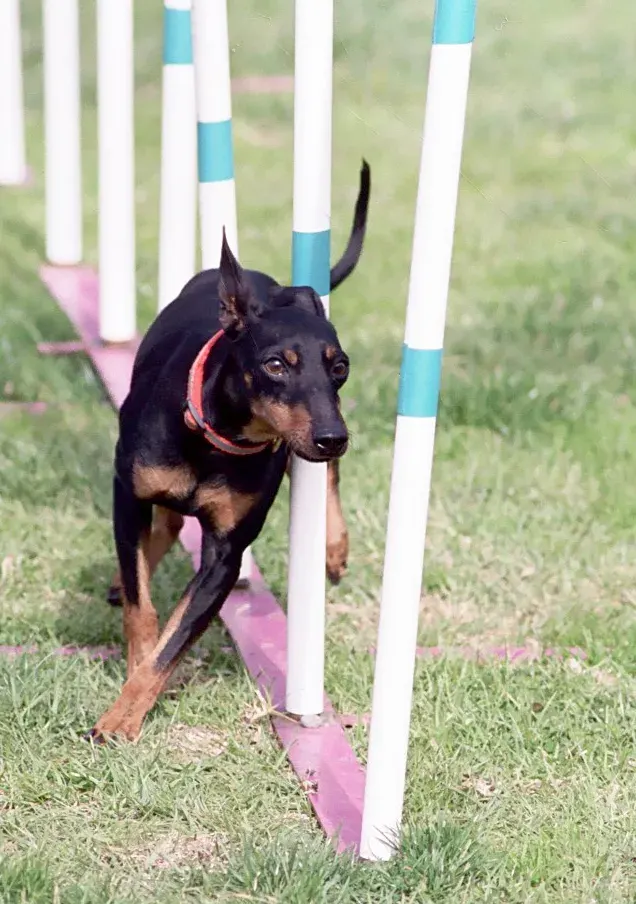
The FCI breed standard describes a compact, elegant and sound terrier with substance, and a long, flat, narrow, wedge-shaped skull. The coat is close, smooth, short and glossy.
The colour is jet black and rich mahogany tan, with tan on the muzzle, cheeks, above the eyes, on the throat in a distinct V, on the legs (with black "thumbmarks" above the feet) and under the tail.
- Ideal height at the withers: 41 cm for males, 38 cm for females.
Temperament
Quick, perceptive and very attached to its family, the Manchester is a cheerful companion and a good watchdog. It remains a rodent hunter.
It learns quickly with positive training.
With children and other pets
The standard describes a keen, alert, gay and sporting dog, discerning and devoted. It rates 3 out of 5 with children and 3 out of 5 with other dogs in our ratings.
- It is a devoted companion.
- Its short coat needs little grooming.
Training tips
According to the standard, the breed's name reflects its origin, and there is probably some Whippet in its ancestry; bred as a ratter, it had classes of its own at the weekly pub dog shows held in Manchester in the mid-1800s. The Royal Kennel Club notes that it was developed in the city to keep down rats in the towns and mills. It rates 3 out of 5 for trainability in our ratings.
- Use short, varied, reward-based sessions.
- Its hunting instinct is strong: be careful with small animals.
Health
This is a robust breed. Some eye diseases, von Willebrand disease and kneecap luxation should be monitored.
Regular veterinary follow-up is recommended.
Common health issues in detail
The Royal Kennel Club recommends as best practice for breeding dogs DNA tests for von Willebrand disease type 1 (vWD1), juvenile dilated cardiomyopathy (JDCM) and xanthinuria type II, a cause of urinary stones, and eye testing.
We found no large population study of health in the Manchester Terrier.
This is general information. For any question about your dog's health, consult a veterinarian.
Feeding
Food for small active dogs, in measured portions, suits it.
Watch its weight.
Exercise
It needs about an hour of daily activity, with running and games. It enjoys agility.
Keep it on a lead outside fenced areas.
Its very short coat helps it cope with heat, but avoid scorching ground and the hot hours. In winter it may feel cold in the mountains. It lives very well in an apartment if walked every day.
Grooming
Its short, glossy coat needs only a weekly rub with a grooming mitt.
It feels the cold somewhat.
Choosing a puppy
Choose a breeder who does the recommended DNA tests and eye-tests the parents.
- Ask for the parents' vWD1, JDCM, xanthinuria and eye results.
- Meet the mother: she should be alert and friendly.
Our guide on how to recognise a responsible breeder explains what to ask.
Similar breeds
The Miniature Pinscher and German Pinscher are other smooth black-and-tan dogs. The Whippet may be among its ancestors, and the Smooth Fox Terrier is another smooth-coated terrier.