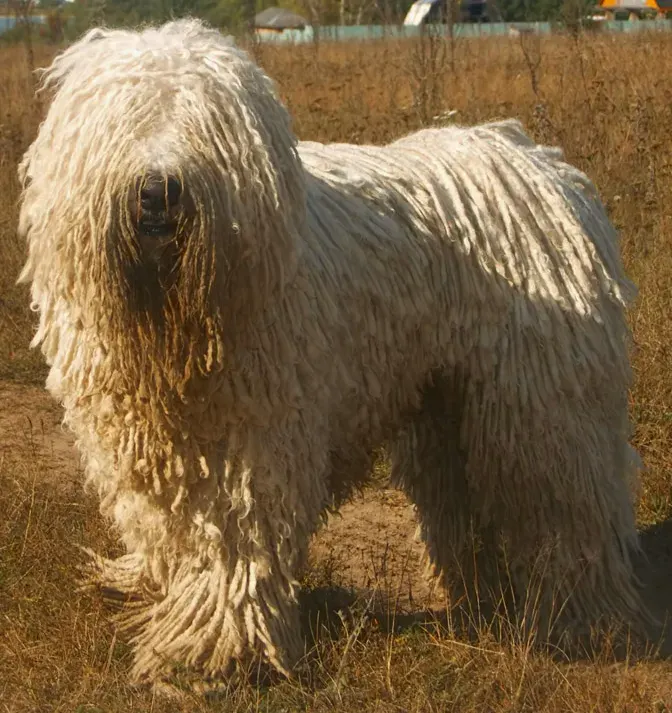
A Hungarian giant covered in long white cords, the Komondor is an imposing, calm and highly protective livestock guardian.
History and origins
The Komondor is a livestock guardian from Hungary, where it protected sheep and cattle from wolves and thieves. Its ancestors are thought to have arrived with nomadic peoples from Asia.
Its corded coat protected it from bites and bad weather.
Appearance and colours
The FCI breed standard describes a large, powerfully built dog whose dignified bearing arouses respect and even fear; its robust body is covered with long, dense, matted and corded hair, and the thickly coated head rises above the body. The coat is longest on the croup, loins and back of the thighs (at least 20–27 cm).
The colour is ivory.
- Height at the withers: at least 70 cm for males, at least 65 cm for females.
- Weight: 50–60 kg for males, 40–50 kg for females.
Temperament
Calm and dignified at home, the Komondor becomes a formidable guardian when it senses a threat. It is very attached to its family and wary of strangers.
Independent, it needs an experienced owner, intensive socialisation and firm, respectful training.
With children and other pets
The standard describes imperturbable courage in guarding the flock and its owner's home; it attacks silently, regards its territory as its own and will not tolerate other creatures in it, and is suspicious by nature. It rates 3 out of 5 with children and 2 out of 5 with other dogs in our ratings.
- It is a territorial guardian that suits only experienced owners.
- Its corded coat needs a great deal of care (5 out of 5 for grooming needs in our ratings).
Training tips
According to the standard, the Komondor is an old Hungarian herding breed of Asian origin, whose ancestors almost certainly came to the Carpathian basin with the nomadic Old Magyars. The Royal Kennel Club calls it the largest of the Hungarian pastoral breeds and a formidable flock guard. It rates 2 out of 5 for trainability in our ratings.
- Socialise it early and carefully.
- Use calm, consistent training.
Health
Hip dysplasia, bloat and skin problems linked to coat care should be monitored.
Regular veterinary follow-up is essential.
This is general information. For any question about your dog's health, consult a veterinarian.
Feeding
Good-quality giant-breed food in two meals suits it. It often eats less than its size would suggest.
Puppy growth should be slow.
Exercise
Daily walks and a large area to guard are enough.
It does not need intense sport, but it does need solid fencing.
It is a farm guardian, completely unsuited to apartments, and remains a demanding, rare breed.
Grooming
Its cords form naturally but must be separated by hand regularly to prevent matted plates. Drying after a bath can take a whole day.
Caring for this coat is a real commitment.
Choosing a puppy
The FCI standard says only healthy dogs with typical breed conformation should be used for breeding.
- Ask what health checks the parents have had.
- Meet the mother: she should be calm and confident.
- Ask the breeder to show you how the cords are cared for.
Our guide on how to recognise a responsible breeder explains what to ask.
Similar breeds
The Puli and Kuvasz are other Hungarian shepherd breeds. The Maremma Sheepdog and Pyrenean Mountain Dog are other white livestock guardians.