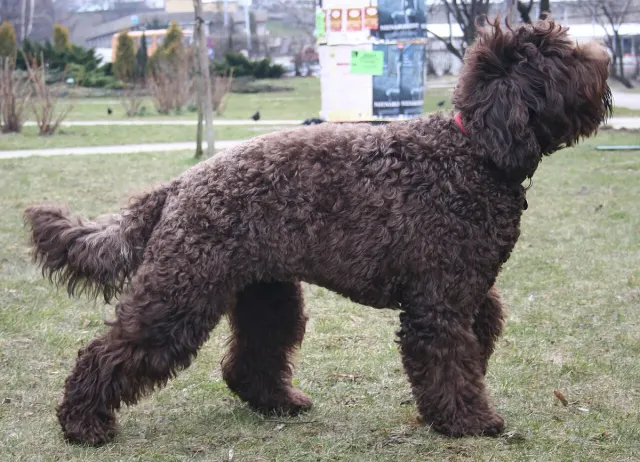
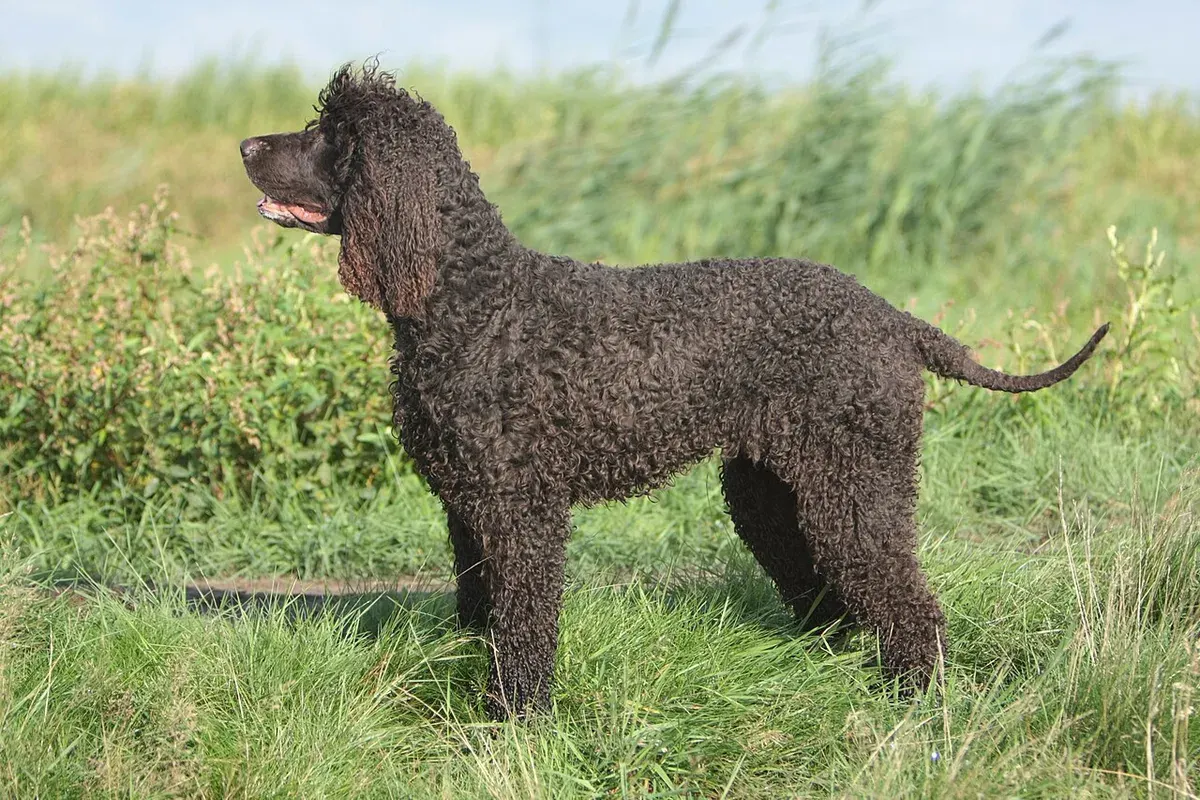
A large, curly, liver-coloured spaniel with a 'rat tail', the Irish Water Spaniel is a superb swimmer, playful and full of humour.
History and origins
The Irish Water Spaniel is an old breed from Ireland, used to retrieve waterfowl in marshes and cold rivers.
Its nearly hairless 'rat tail' is a unique feature.
Appearance and colours
The FCI breed standard describes a smart, upstanding, strongly built and compact dog. The coat is made of dense, tight, crisp ringlets with a natural oiliness, a topknot of long, loose curls, a smooth face and throat, and the breed's most peculiar feature, a "rat tail".
The colour is a very rich puce liver; white on the chest is objectionable.
- Height at the withers: 53–59 cm for males, 51–56 cm for females.
Temperament
Cheerful, intelligent and humorous, it is very attached to its family but often reserved with strangers.
It can be stubborn; varied, positive and patient training suits it.
With children and other pets
The standard describes a proud dog combining great intelligence and endurance with a bold, dashing eagerness, immense stamina and loyalty: a good family dog with a sense of humour, but discerning with strangers. It rates 4 out of 5 with children and 3 out of 5 with other dogs in our ratings.
- It is a loyal family dog with plenty of energy.
- Its curly coat needs regular care (4 out of 5 for grooming needs in our ratings).
Training tips
According to the standard, the origins are obscure; an Irish reference to water dogs that pursue waterfowl dates from 1600, and the rat tail makes an indigenous Irish ancestor very likely; the breed club was founded in 1890. The Royal Kennel Club notes that, although classed as a spaniel, it works as a retriever, especially from water. It rates 3 out of 5 for trainability in our ratings.
- Retrieving and swimming suit it well.
- Avoid exercise in the heat: it rates 2 out of 5 for heat tolerance.
Health
Hip dysplasia, hypothyroidism and certain drug reactions should be monitored.
Regular veterinary follow-up is recommended.
Common health issues in detail
The Royal Kennel Club recommends as a minimum for breeding dogs hip and elbow scoring and, since April 2025, eye testing.
We found no large population study of health in the Irish Water Spaniel.
This is general information. For any question about your dog's health, consult a veterinarian.
Feeding
Food matched to its activity suits it.
Avoid excess weight.
Exercise
It needs one and a half to two hours of daily activity, ideally with swimming.
It loves water.
Swimming is ideal for cooling off. It needs a house with a garden, ideally near water.
Grooming
Its curly coat sheds very little but needs regular brushing and shaping every two months.
Dry its ears well after swimming.
Choosing a puppy
Choose a breeder who scores hips and elbows and eye-tests the parents.
- Ask for the parents' hip, elbow and eye results.
- Meet the mother: she should be confident and friendly.
Our guide on how to recognise a responsible breeder explains what to ask.
Similar breeds
The Portuguese Water Dog, Spanish Water Dog, Poodle and Barbet are other curly-coated water dogs.