A versatile dog with a woolly, curly coat, the Spanish Water Dog is hard-working, loyal and well suited to hot climates.
History and origins
The Spanish Water Dog is an old breed from Andalusia and southern Spain, used to herd livestock, help fishermen and retrieve waterfowl.
It has been recognised by the Fédération Cynologique Internationale since the late 20th century.
Appearance and colours
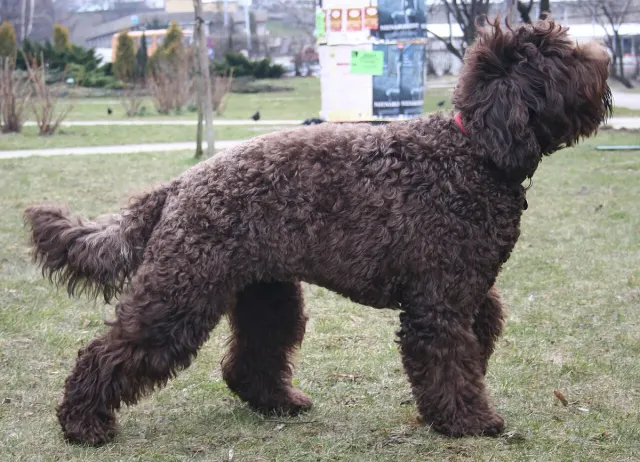
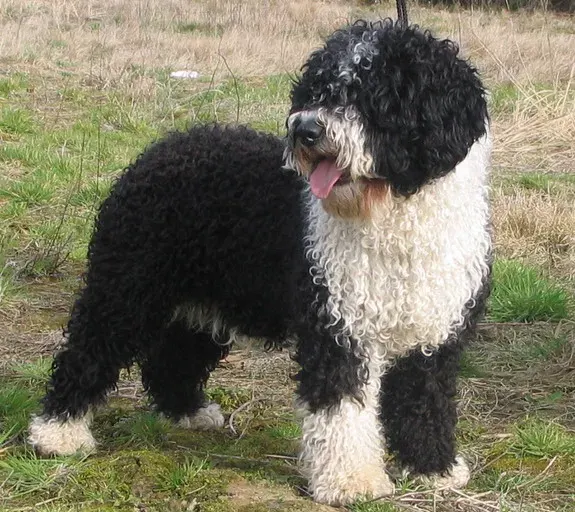
The FCI breed standard describes a rustic, well-proportioned, athletic dog of medium weight, somewhat elongated, with well-developed muscles and keen sight, hearing and scent. The coat is always curly and woolly, curly when short and able to form cords when long; clipping is allowed if it is complete and even.
Colours are solid white, black or chestnut in various shades, or white with black or brown.
- Height at the withers: 44–50 cm for males, 40–46 cm for females.
- Weight: 18–22 kg for males, 14–18 kg for females.
Temperament
Loyal, hard-working and very attached to its family, it is often reserved with strangers and can be protective. It keeps a herding instinct.
Intelligent, it learns well with consistent training and early socialisation.
With children and other pets
The standard describes a faithful, obedient, cheerful, hard-working, watchful and well-balanced dog with an outstanding ability to learn, adapting to all situations. It rates 4 out of 5 with children and 3 out of 5 with other dogs in our ratings.
- It is a cheerful, active family dog.
- It needs daily work and exercise.
Training tips
According to the standard, the breed has been in the Iberian Peninsula since ancient times and shares its origin with the old Barbet; it is most common in Andalusia, where it was long known as the "Turkish dog" and works as a sheepdog and a helper to waterfowl hunters and fishermen. The Royal Kennel Club calls it a robust retriever and herder. It rates 4 out of 5 for trainability in our ratings.
- It learns easily with reward-based training.
- Herding, retrieving and swimming suit it.
Health
This is a fairly robust breed. Hip dysplasia, some eye diseases and hypothyroidism should be monitored; genetic tests exist.
Regular veterinary follow-up is recommended.
Common health issues in detail
The Royal Kennel Club recommends as a minimum for breeding dogs a DNA test for progressive retinal atrophy (prcd-PRA) and eye testing including gonioscopy, and as best practice DNA tests for congenital hypothyroidism with goitre (CHG) and neuroaxonal dystrophy (NAD), and hip scoring.
We found no large population study of health in the Spanish Water Dog.
This is general information. For any question about your dog's health, consult a veterinarian.
Feeding
Food matched to its activity suits it.
Avoid excess weight.
Exercise
It needs one and a half to two hours of daily activity: walks, swimming, agility and herding work.
It loves water.
In summer, a short clip improves its comfort. It needs a house with a garden and active owners.
Grooming
Its woolly coat is not brushed: it naturally forms cords. It is clipped to one length once or twice a year. It sheds very little.
Dry it well after swimming.
Choosing a puppy
Choose a breeder who does the DNA tests, eye testing and hip scoring recommended by the Royal Kennel Club.
- Ask for the parents' DNA, eye and hip results.
- Meet the mother: she should be cheerful and confident.
Our guide on how to recognise a responsible breeder explains what to ask.
Similar breeds
The Portuguese Water Dog, Lagotto Romagnolo, Barbet and Poodle are other curly-coated water dogs.