Intelligent, cheerful and barely shedding, the Poodle comes in four sizes, from Toy to Standard, and adapts to almost any household.
History and origins
The Poodle descends from old European water dogs used to retrieve waterfowl; its French name 'Caniche' is linked to 'cane', a female duck. France is its reference country with the Fédération Cynologique Internationale.
Prized at European courts and later by circus performers for its brightness, it was bred in several sizes. The FCI recognises four varieties: Standard, Medium, Miniature and Toy.
Appearance and colours
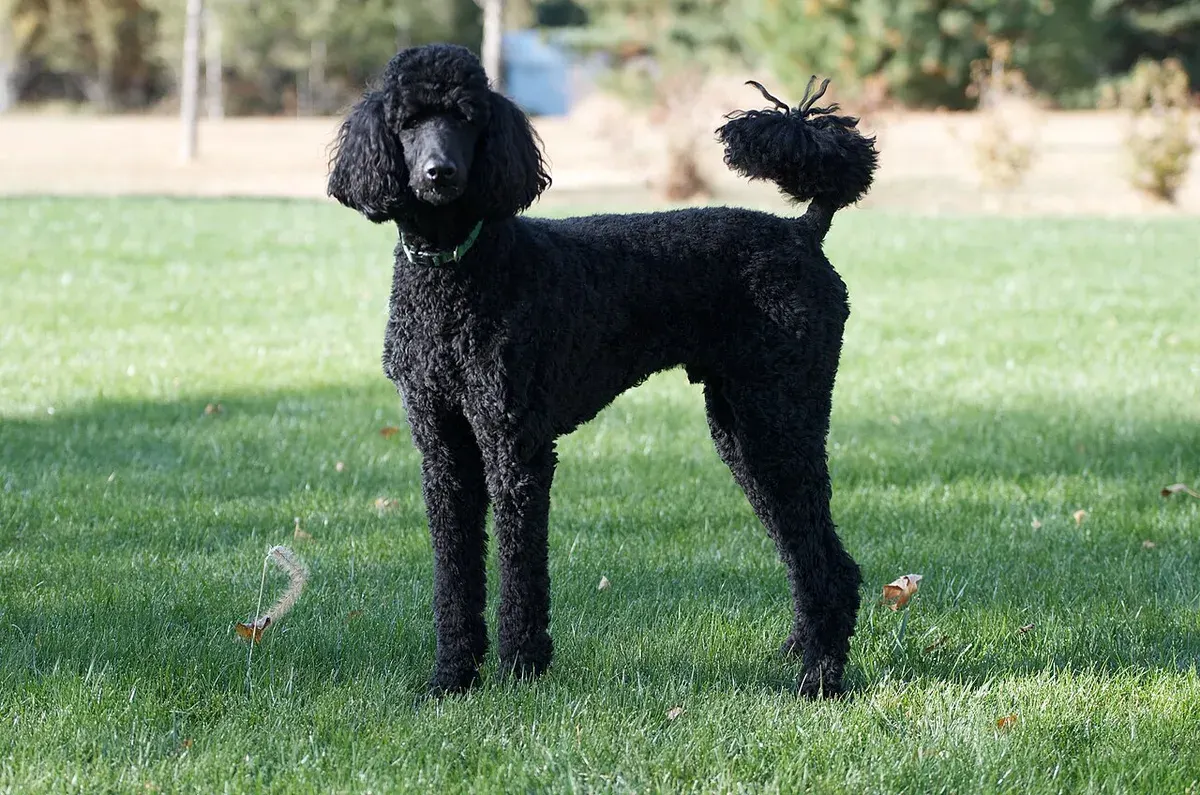
The FCI breed standard describes a dog of medium proportions, harmoniously built, alert and active, giving an impression of elegance and pride. The body is slightly longer than it is tall, and the standard asks that the small varieties remain scaled-down Poodles, with no sign of dwarfism.
The coat is profuse and of fine, woolly texture. It is either curly, with even, elastic, very frizzy curls, or corded, forming cords at least 20 cm long. Solid colours only: black, white, brown, grey and fawn, which ranges from pale fawn to red fawn or apricot. Any white marking on a coloured dog is highly undesirable.
The FCI recognises four sizes, measured at the withers:
- Standard: over 45 cm and up to 60 cm (with a 2 cm tolerance)
- Medium: over 35 cm and up to 45 cm
- Miniature: over 28 cm and up to 35 cm
- Toy: over 24 cm and up to 28 cm, ideally 25 cm
Temperament
Highly intelligent, attentive and full of humour, the Poodle loves to learn and to please. It is usually sociable with children, other dogs and cats when well socialised.
Sensitive, it copes poorly with raised voices and long periods alone. It may become a barker if under-occupied.
With children and other pets
The standard describes the Poodle as renowned for its loyalty and able to learn and be trained, which makes it a particularly pleasant companion. It rates 4 out of 5 with children and with other dogs in our ratings, but the right size matters for each family.
- Toy and Miniature Poodles are small and fragile: teach children to sit on the floor to cuddle them and never to carry them around.
- A Standard Poodle is a big, athletic dog; teach calm greetings so it does not jump up.
- Grooming is part of family life: let children help brush the dog gently, under supervision, so the puppy learns to enjoy being handled.
Training tips
The Poodle was originally used for wildfowling, retrieving from water, and its standard stresses that it learns readily. It scores 5 out of 5 for trainability in our ratings.
- Use reward-based training and vary the exercises: tricks, obedience, agility and retrieving games all suit it.
- Teach it to stand still for brushing, nail trims and handling of the feet, ears and face from the first weeks.
- Small Poodles still need real training; treat a Toy like a dog, not a toy.
Health
Poodles often live long lives. Depending on size, inherited eye problems, kneecap luxation (small sizes) or hip and stomach problems (Standard) can occur. Responsible breeders carry out health screening.
Its hairy, drop ears favour ear infections, so regular cleaning and veterinary follow-up are recommended.
Common health issues in detail
Health concerns differ with size. Small Poodles are especially affected by kneecap problems, while large Poodles appear more at risk of bloat, and all sizes can carry inherited eye diseases.
Kneecaps. In a Japanese study of 2,048 puppies of nine common breeds, patellar luxation (a kneecap that slips out of place) affected 20% of the puppies overall, and Toy Poodles had the highest prevalence. Littermates of puppies with a moderate or severe luxation had a 16-fold higher risk, pointing to a strong genetic influence.
Bloat. In a US study within the Dog Aging Project, Poodles and Poodle mixes were the breed group with the highest occurrence of gastric dilatation-volvulus (GDV), a life-threatening twisting of the stomach. Dogs over 40 kg, males and thin dogs were also at higher risk. GDV is an emergency: a swollen belly, retching without bringing anything up, or restlessness need a vet straight away.
Health tests for Standard Poodles. The Royal Kennel Club lists as best practice:
- DNA tests for two forms of progressive retinal atrophy (prcd-PRA and PRA rcd4) and for von Willebrand disease (vWD1), a bleeding disorder
- an eye examination and hip scoring by X-ray
Since January 2025 it registers imported Standard Poodles, and litters by overseas sires, only if they are proven clear or carriers of both forms of progressive retinal atrophy.
This is general information. For any question about your dog's health, consult a veterinarian.
Feeding
Needs vary enormously between a 3 kg Toy and a Standard Poodle over 20 kg, so choose food suited to its size and activity.
Small sizes are prone to tartar; suitable kibble and tooth brushing help keep the mouth healthy.
Exercise
The Poodle is sportier than it looks. Small sizes are happy with daily walks and play, while Standards enjoy long outings, swimming and dog sports such as agility.
Learning and puzzle games are essential to its well-being.
In summer a shorter clip can improve comfort, while keeping enough hair to protect the skin from the sun. Because it sheds little, it often suits households that care about a hair-free home. Budget for a groomer in your city, as coat care is a regular expense.
Grooming
Its curly coat grows continuously and sheds very little, but it mats unless brushed several times a week. A clip at a groomer is needed every four to eight weeks.
Clean its ears and eyes regularly.
Choosing a puppy
First choose the size that fits your home and lifestyle, then look for a breeder who health tests for that size.
- For a Standard, ask for the parents' DNA results for both forms of progressive retinal atrophy and for von Willebrand disease, an eye examination and hip scores.
- For a Toy or Miniature, ask whether the parents' kneecaps have been checked by a vet, and watch them move.
- Ask how the puppies have been introduced to brushing, bathing and the hairdryer.
- Be wary of "teacup" or other extreme miniatures: the standard excludes any sign of dwarfism.
Our guide on how to recognise a responsible breeder explains what to ask.
Similar breeds
The Barbet is the old French water dog from which the Poodle descends. The Portuguese Water Dog and the Lagotto Romagnolo are other curly-coated water dogs that shed little. The Bichon Frise is a small companion with a curly white coat.