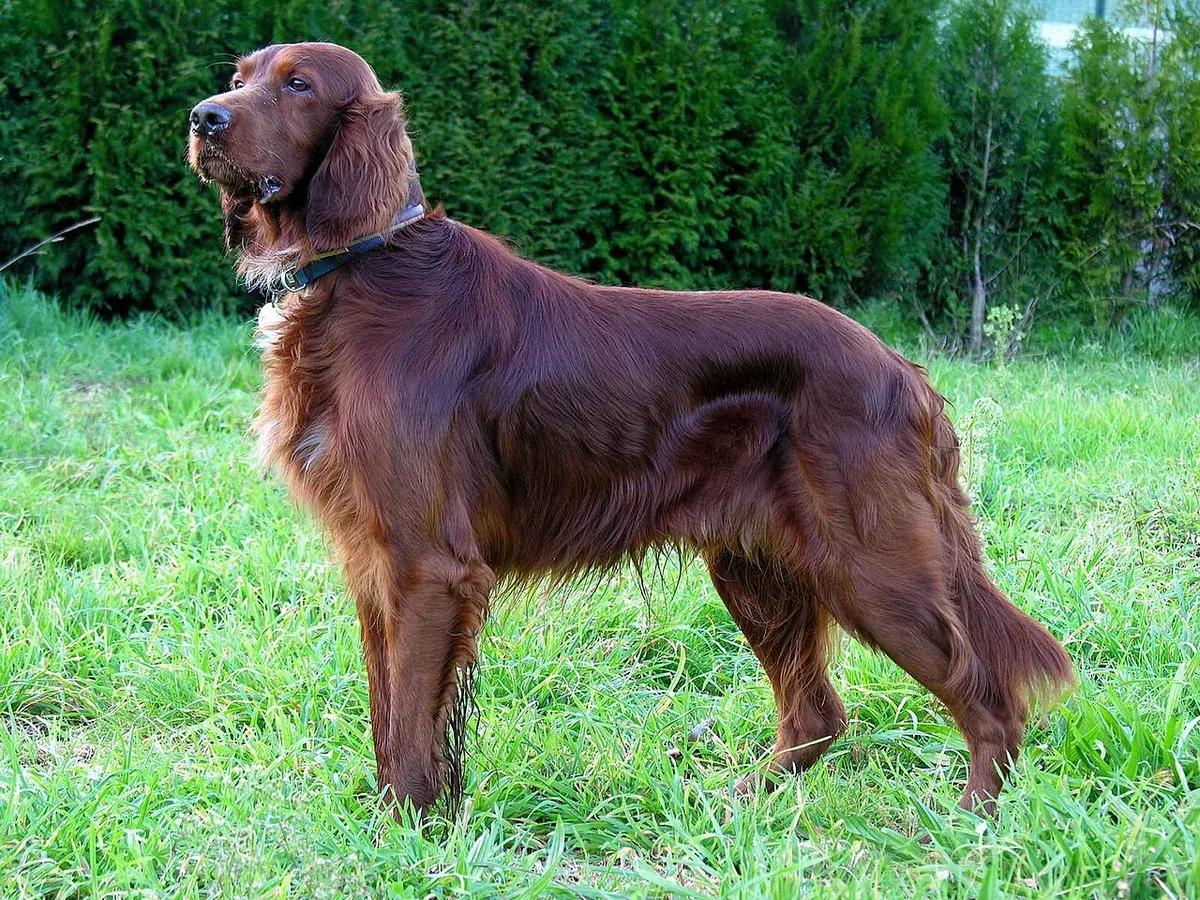
A stunning dog with a flaming mahogany coat, the Irish Setter is cheerful, exuberant and affectionate, an eternal teenager full of energy.
History and origins
The Irish Red Setter was developed in 18th-century Ireland as a pointing dog for bird hunting. Its solid red coat became standard in the 19th century.
It has also become a popular family and show dog.
Appearance and colours
The FCI breed standard describes a racy, athletic dog, full of quality, balanced and kindly in expression, with a long, lean head. The coat is short and fine on the head and front of the legs, of moderate length and flat elsewhere, with long, fine feathering on the ears, legs, belly and tail.
The colour is a rich chestnut with no trace of black; white on the chest, throat and toes, or a small star or narrow blaze on the face, does not disqualify.
- Height at the withers: 58–67 cm for males, 55–62 cm for females.
Temperament
Cheerful, sociable and very affectionate, the Irish Setter loves everyone and stays playful and exuberant for a long time. It is excellent with children.
It can be easily distracted and stubborn, so patient, positive training is needed.
With children and other pets
The standard describes an affectionate, loyal, keen, intelligent and energetic dog. It rates 5 out of 5 with children and 4 out of 5 with other dogs in our ratings.
- It is an affectionate family dog that needs a great deal of exercise.
- Brush the feathering regularly.
Training tips
According to the standard, the Irish Red Setter was developed in Ireland as a working dog for hunting game, from the Irish Red and White Setter and an unknown solid red dog; the breed club was founded in 1882 and issued the standard in 1886. The Royal Kennel Club calls it a glamorously coated red setter from Ireland. It rates 3 out of 5 for trainability in our ratings.
- Use patient, reward-based training and teach recall early.
- It rates 5 out of 5 for energy: it needs long daily runs in safe areas.
Health
Hip dysplasia, bloat, hypothyroidism and some inherited eye diseases (tests exist) should be monitored.
Regular veterinary follow-up is recommended.
Common health issues in detail
A Dutch study of 48 Irish Setters with idiopathic epilepsy found a mean age at first seizure of 41 months; generalised tonic-clonic seizures were the most common type, and 54% of the dogs had cluster seizures. If your dog has a seizure, see your veterinarian.
The Royal Kennel Club recommends as a minimum for breeding dogs a DNA test for progressive retinal atrophy (rcd4 PRA), and as best practice DNA tests for canine leukocyte adhesion deficiency (CLAD) and PRA rcd1, which imported dogs must have, plus hip and elbow scoring and eye testing.
This is general information. For any question about your dog's health, consult a veterinarian.
Feeding
Split the ration into two meals and avoid exercise straight afterwards.
Adjust the amount to its activity.
Exercise
It needs at least two hours of daily activity, with free runs in a safe area.
Without an outlet it becomes restless.
It needs a house with a garden and a very active family.
Grooming
Its long, silky coat needs brushing two to three times a week, with attention to the feathering.
Check for grass seeds after outings.
Choosing a puppy
Choose a breeder who does the DNA tests, hip and elbow scoring and eye testing, and can tell you about epilepsy in the puppy's family.
- Ask for the parents' DNA, hip, elbow and eye results.
- Ask whether the parents or relatives have had seizures.
- Meet the mother: she should be affectionate and outgoing.
Our guide on how to recognise a responsible breeder explains what to ask.
Similar breeds
The Gordon Setter and English Setter are the other setters. The Hungarian Vizsla and Golden Retriever are other red or golden gundogs.