The sturdiest of the setters, the black-and-tan Gordon Setter is loyal, brave and very attached to its family.
History and origins
The Gordon Setter was developed in Scotland in the early 19th century, notably on the Duke of Gordon's estate, to hunt grouse on the moors.
Heavier and more enduring than other setters, it works methodically.
Appearance and colours
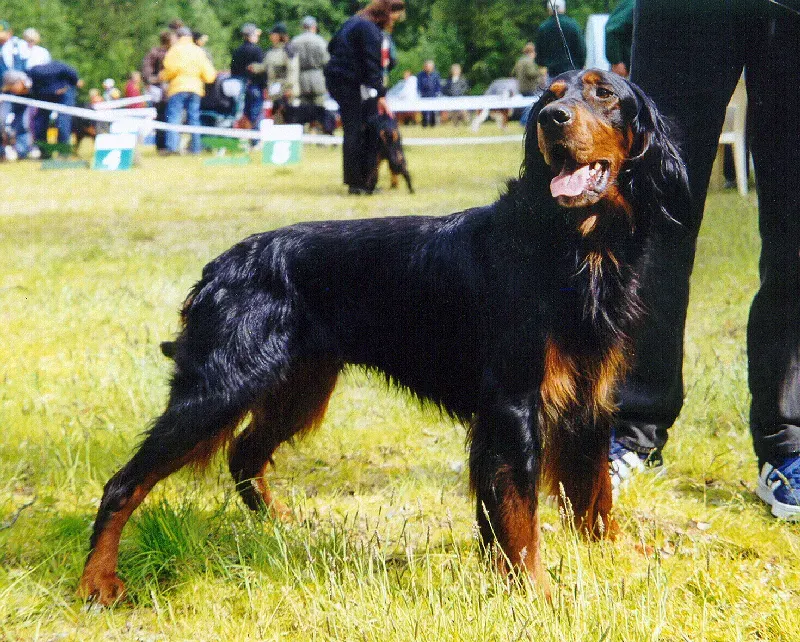
The FCI breed standard describes a stylish dog with galloping lines, built like a weight-carrying hunter and symmetrical throughout. The coat is short and fine on the head and front of the legs, of moderate length and flat elsewhere, with long, silky feathering on the ears, legs and belly.
The colour is a deep, shining coal black without rustiness, with lustrous chestnut-red (tan) markings over the eyes, on the muzzle, chest and legs.
- Height at the withers: 66 cm for males, 62 cm for females.
- Weight: 29.5 kg for males, 25.5 kg for females.
Temperament
Loyal, confident and affectionate, the Gordon Setter is more reserved with strangers than other setters and can be protective. It is very attached to its family.
It needs consistent, patient training.
With children and other pets
The standard describes an intelligent, able and dignified dog, bold and outgoing, with a kindly, even disposition. It rates 4 out of 5 with children and 3 out of 5 with other dogs in our ratings.
- It is a kind family dog that needs a great deal of exercise.
- Brush the feathering regularly.
Training tips
The Royal Kennel Club describes the Gordon as the heavyweight of the setter breeds, named after the Duke of Gordon, who began developing setters seriously between 1800 and 1820 at Gordon Castle in Scotland. The FCI classifies it as a pointing dog with a working trial. It rates 3 out of 5 for trainability in our ratings.
- Use patient, reward-based training and teach recall early.
- Avoid exercise in the heat: it rates 2 out of 5 for heat tolerance.
Health
Hip dysplasia, bloat, hypothyroidism and an inherited eye disease (tests exist) should be monitored.
Regular veterinary follow-up is recommended.
In summer: walks during the cool hours and leishmaniasis prevention.
Common health issues in detail
The Royal Kennel Club recommends as a minimum for breeding dogs a DNA test for progressive retinal atrophy (rcd4 PRA) and hip scoring, and as best practice eye testing and elbow scoring. It also notes that the breed can be affected by conformation-related problems.
We found no large population study of health in the Gordon Setter.
This is general information. For any question about your dog's health, consult a veterinarian.
Feeding
Split the ration into two meals and avoid exercise straight afterwards.
Adjust it to its activity.
Exercise
It needs one and a half to two hours of daily activity, ideally in nature.
It enjoys hiking.
It needs a house with a garden.
Grooming
Its long coat needs brushing two to three times a week. Care for the feathering.
Check for grass seeds after outings.
Choosing a puppy
Choose a breeder who does the rcd4 DNA test, hip and elbow scoring and eye testing.
- Ask for the parents' DNA, hip, elbow and eye results.
- Meet the mother: she should be kind and outgoing.
Our guide on how to recognise a responsible breeder explains what to ask.
Similar breeds
The Irish Red Setter and English Setter are the other setters. The English Pointer is another British pointing dog, and the Flat-coated Retriever another dark, feathered gundog.