A large scent hound from south-west France with a bluish ticked coat, the Grand Bleu de Gascogne is calm, noble and has a magnificent voice.
History and origins
The Grand Bleu de Gascogne is one of the oldest French scent hounds. It once hunted wolf, boar and deer in south-west France.
It is renowned for its very fine nose and deep, powerful voice.
Appearance and colours
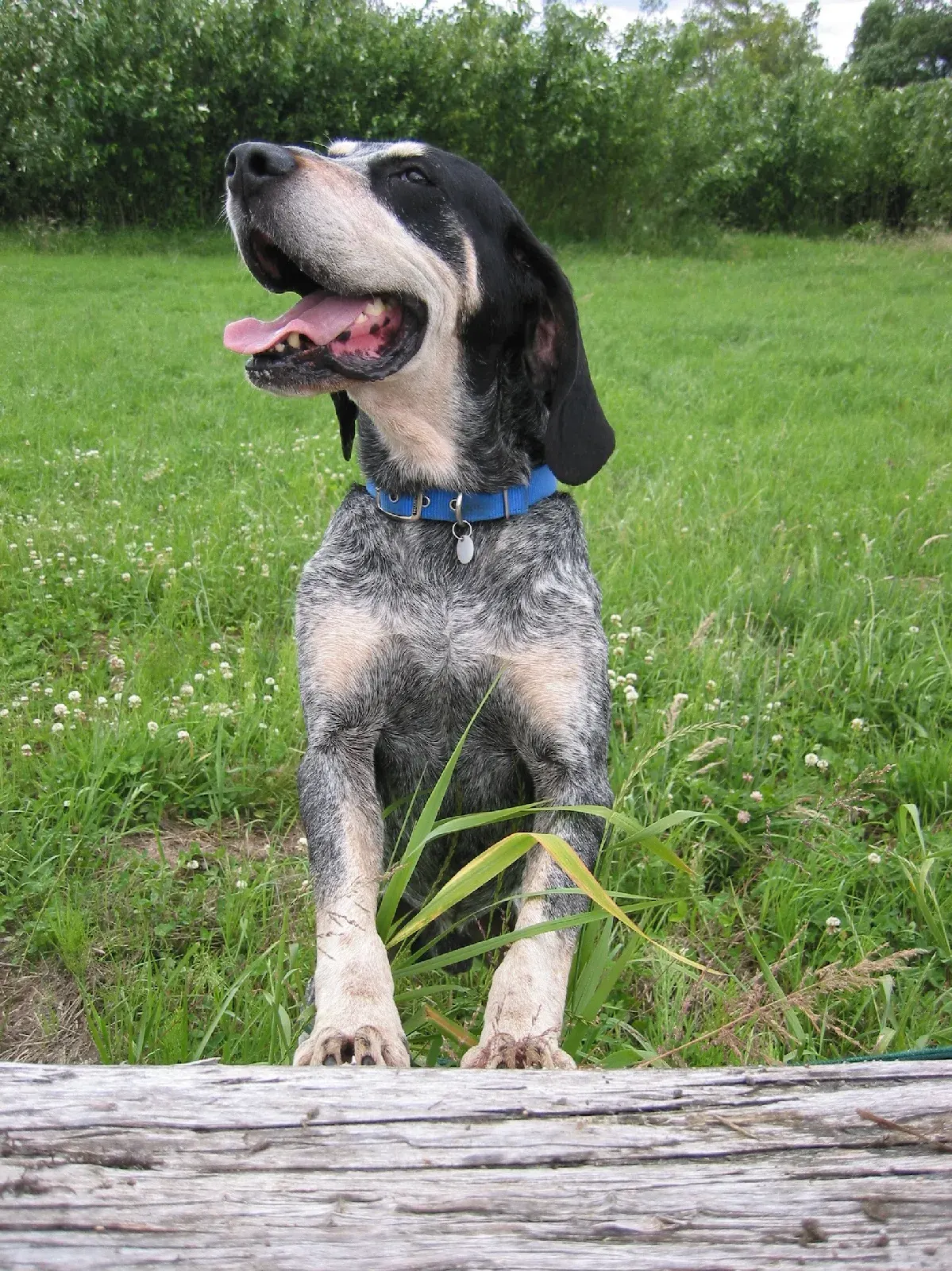
The FCI breed standard describes an ancient breed of outstanding French type in head, coat and expression, imposing and giving an impression of calm strength and great nobility. The coat is short, quite thick and very dense.
The coat colour is entirely mottled black and white, giving a slate-blue effect, with or without black patches; two black patches usually cover the ears and surround the eyes, and two tan spots over the eyes give a "four-eyed" look.
- Height at the withers: 65–72 cm for males, 62–68 cm for females.
Temperament
Calm, gentle and sociable, it is happy living in a pack and gets on well with other dogs. It is affectionate with its family but independent.
Its hunting instinct is strong and recall is difficult once it is on a trail.
With children and other pets
The standard describes a hound with a very fine nose and a sonorous, deep howling voice, instinctively a pack hound, calm in temperament and easy to command. It rates 4 out of 5 with children and 5 out of 5 with other dogs in our ratings.
- It usually lives well with other dogs.
- It has a powerful voice.
Training tips
According to the standard, this very old breed made up the packs of Gaston Fébus in the 14th century, used to hunt wolf, bear and boar; widespread in south-western France, it takes its name from Gascony and is the origin of the "southern" French scenthounds. The Royal Kennel Club calls it the long-legged aristocrat of the French scenthounds. It rates 2 out of 5 for trainability in our ratings.
- Keep it on a lead or in safe, fenced areas: it follows scent.
- It needs a lot of space and long daily walks.
Health
This is a fairly robust breed. Hip dysplasia, ear infections and bloat should be monitored.
Regular veterinary follow-up is recommended.
For a hunting dog in rural areas, sandfly prevention (leishmaniasis) is important.
This is general information. For any question about your dog's health, consult a veterinarian.
Feeding
Food matched to its activity, in two meals, suits it.
Avoid exercise after meals.
Exercise
It needs long daily outings and tracking work, ideally in the countryside.
Keep it on a long line or in an enclosed area.
It is made for the countryside, not for apartments.
Grooming
Its short coat needs weekly brushing. Clean its long ears regularly.
Check for ticks and grass seeds after outings.
Choosing a puppy
The FCI standard says only healthy dogs with typical breed conformation should be used for breeding.
- Ask what health checks the parents have had.
- Meet the mother: she should be calm and friendly.
Our guide on how to recognise a responsible breeder explains what to ask.
Similar breeds
The Bloodhound, Porcelaine, English Foxhound and Black and Tan Coonhound are other large scenthounds.