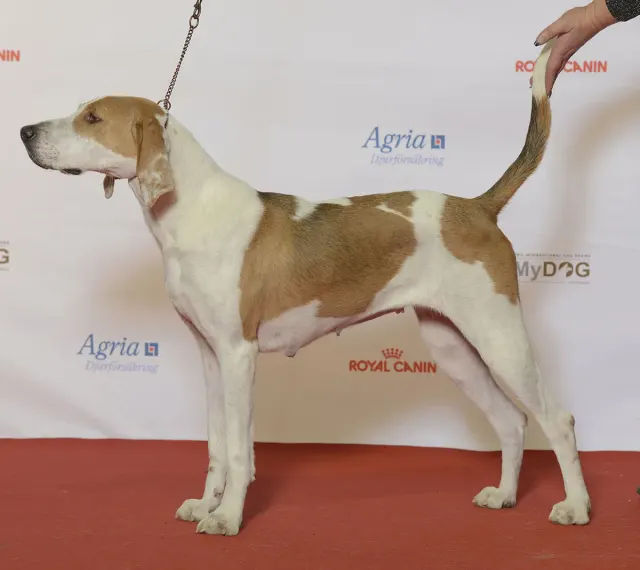
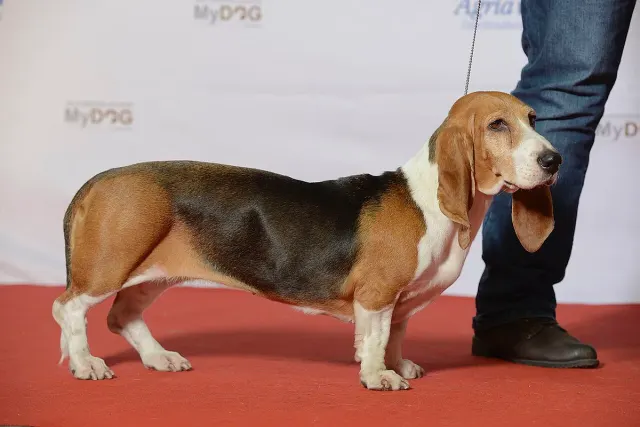
With its long ears and soulful look, the Basset Hound is a placid, affectionate dog with a remarkable nose.
History and origins
The Basset Hound was developed in 19th-century England from French bassets, to hunt hare and rabbit on foot using its exceptional nose.
Its short legs let hunters follow it without horses.
Appearance and colours
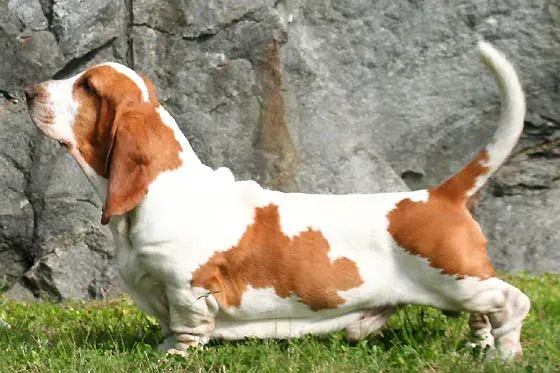
The FCI breed standard describes a short-legged hound of considerable substance, well balanced and full of quality, and insists that it is a working hound that must be strong, active and capable of great endurance in the field. A little wrinkle may appear at the brow and beside the eyes. The Royal Kennel Club describes a distinctive scent hound developed in England from French stock.
The coat is smooth, short and close, without feathering. Colours are generally black, white and tan (tricolour) or lemon and white (bicolour), but any recognised hound colour is acceptable; the Royal Kennel Club also lists red and white and tan and white.
- Height at the withers: 33–38 cm.
Temperament
Calm, gentle and very sociable, the Basset Hound gets on with everyone, children and dogs included. It can be stubborn and follow a scent without listening.
It has a deep voice and may howl when bored.
With children and other pets
The standard describes a placid hound, never aggressive or timid, and affectionate, with a pack instinct and a deep, melodious voice. It rates 5 out of 5 with children and 5 out of 5 with other dogs in our ratings.
- It is sociable and gentle, and usually happy to share its home with other dogs.
- Its voice carries: think of your neighbours.
Training tips
According to the standard, the Basset was reputedly bred by monks in France in the Middle Ages to hunt in heavy cover with its nose close to the ground, and was developed to perfection in Britain; it hunts hare persistently, at a relatively slow pace, over great distances. It rates 2 out of 5 for trainability in our ratings.
- Keep it on a lead or in a secure area: once on a scent, it follows its nose.
- Use patient, food-based training and scent games.
Health
Its long back, drooping eyelids and large ears expose it to disc herniation, eye problems (ectropion, glaucoma) and ear infections. Bloat and obesity are also risks.
Regular veterinary follow-up is essential.
Common health issues in detail
Glaucoma. The breed can inherit glaucoma, a painful rise in pressure inside the eye that can cause blindness. A study found that all Basset Hounds with primary open-angle glaucoma carried two copies of a deletion in the ADAMTS17 gene; in 223 other Basset Hounds, the mutation had a frequency of about 8%, and about 0.7% of the population was predicted to be affected. A DNA test can help breeders avoid producing affected puppies.
Health tests. The Royal Kennel Club recommends for breeding dogs:
- eye testing, including gonioscopy for pectinate ligament abnormality (PLA), a defect of the eye's drainage angle linked to another form of glaucoma (minimum)
- DNA tests for Lafora disease and for primary open-angle glaucoma (POAG-3), and elbow grading (best practice)
The Royal Kennel Club also notes that the breed can be affected by conformational concerns and has a breed club health scheme.
This is general information. For any question about your dog's health, consult a veterinarian.
Feeding
It is greedy and gains weight easily, which strains its back, so measure portions.
Two meals a day, with no exercise straight afterwards.
Exercise
Calm daily walks of about an hour, with chances to sniff, suit it.
Avoid jumping and repeated stair-climbing.
Calm indoors, it can live in an apartment, ideally with a lift to spare its back.
Grooming
Its short coat needs weekly brushing. Clean its long ears and facial folds often.
It drools a little.
Choosing a puppy
Choose a breeder who eye-tests the parents, including gonioscopy, carries out the recommended DNA tests and takes part in the breed club health scheme.
- Ask to see current eye certificates and DNA results for both parents.
- Look for clean, healthy eyes and a sound, active build, as the standard asks for a dog fit for work.
- Meet the mother: she should be placid and friendly.
Our guide on how to recognise a responsible breeder explains what to ask.
Similar breeds
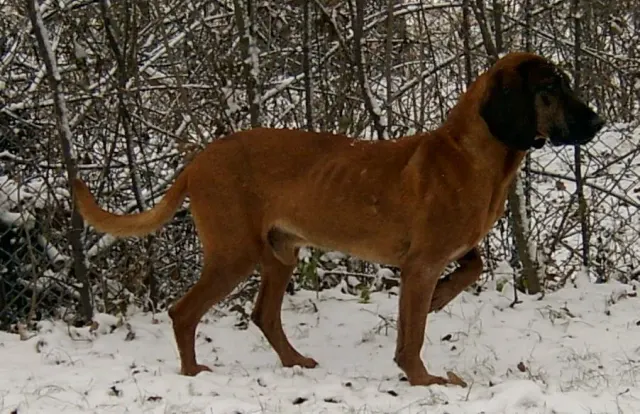
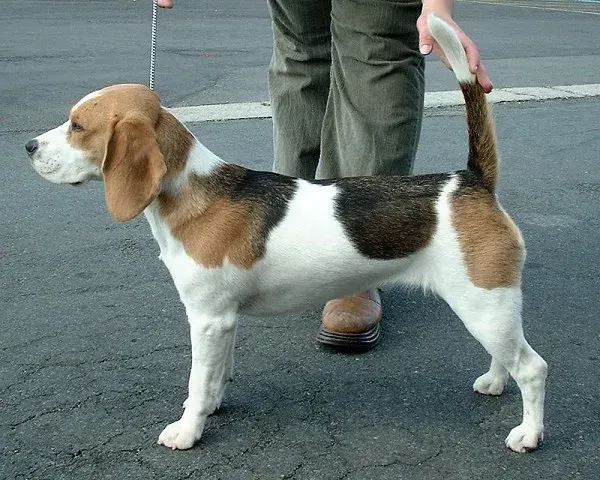
The Basset Artésien Normand is one of the French bassets of the same family. The Beagle is another small pack hound that hunts hare. The Bloodhound is a large scent hound with a similar voice and nose. The Petit Basset Griffon Vendéen is a rough-coated French basset.