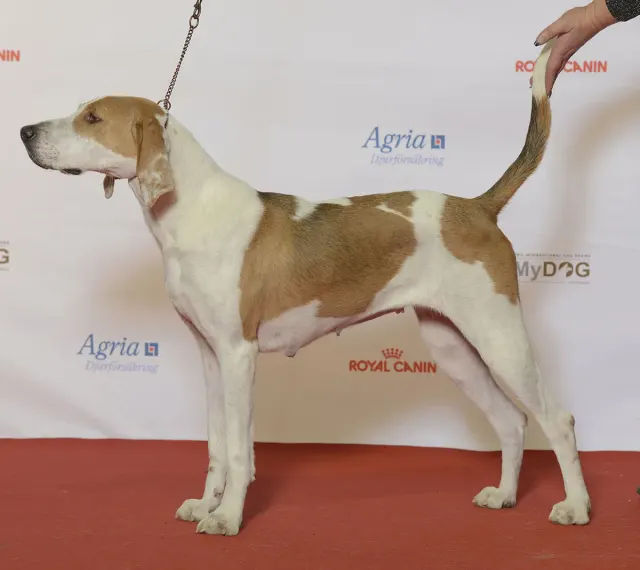
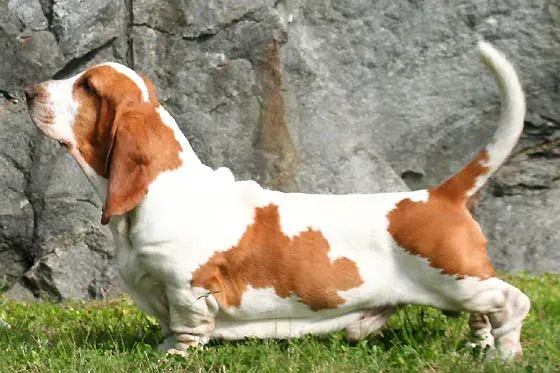
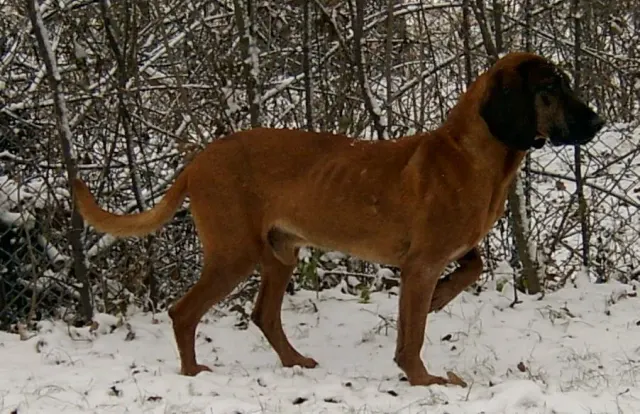
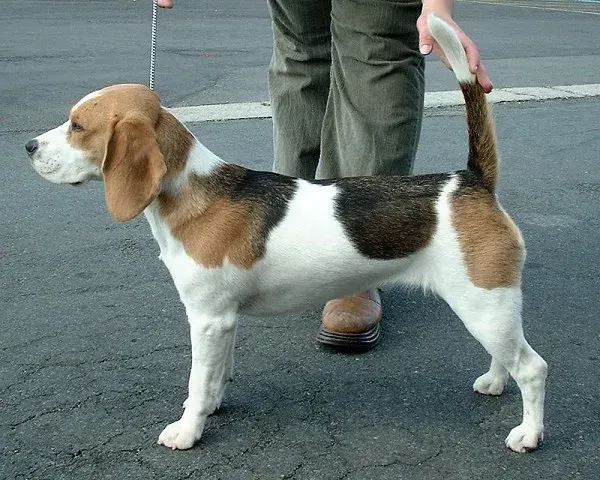
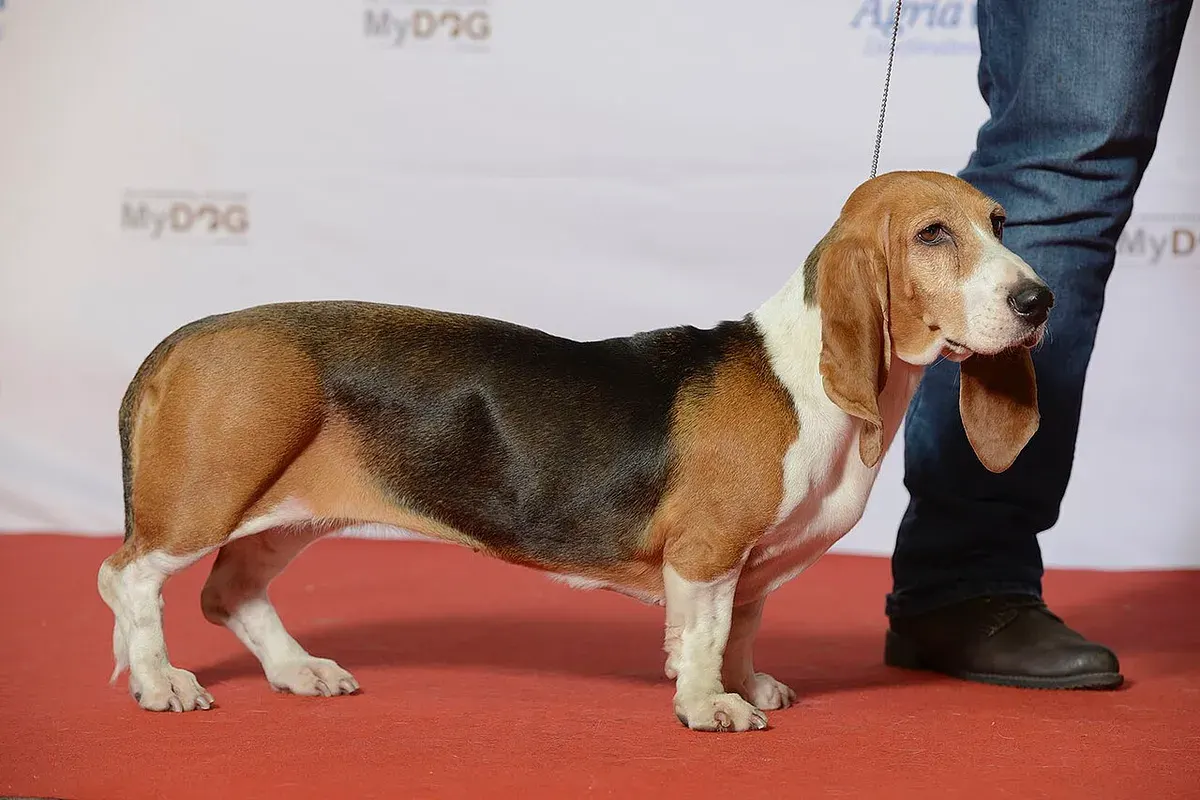
An elegant long-eared French basset, the Basset Artésien Normand is gentle, affectionate and easy to live with, with an excellent nose.
History and origins
The Basset Artésien Normand descends from the bassets of Artois and Normandy in northern France. It hunted rabbit and hare on foot, following the trail with persistence.
It is one of the ancestors of the English Basset Hound.
Appearance and colours
The FCI breed standard describes a long dog for its size, well balanced and compact, whose head recalls the nobility of the large Norman hound. Its body length is about 8:5 in relation to its height, and the very long, fine ears curl inward.
The coat is close, short and smooth without being too fine. There are two colours: tricolour (fawn with a black blanket and white, the head largely tan with a darker circle on each temple) and bicolour (fawn and white).
- Height at the withers: 30–36 cm, with a tolerance of 1 cm.
- Weight: 15–20 kg.
Temperament
Gentle, affectionate and sociable, it gets on very well with children and other dogs. It is calm indoors and livelier outside.
Its nose can make it deaf to calls; patient, reward-based training works well.
With children and other pets
The standard describes an outgoing and very affectionate dog. The United Kennel Club adds that its appealing nature makes it attractive to pet homes and families. It rates 5 out of 5 with children and 5 out of 5 with other dogs in our ratings.
- It is a sociable pack hound that enjoys company.
- Its long body needs care: discourage jumping from furniture.
Training tips
According to the standard, controlled breeding of the short-haired French basset began around 1870, when Count Le Couteulx de Canteleu fixed a straight-legged type (Artois) and Louis Lane a crooked-legged type (Normand); the name Basset Artésien Normand was adopted in 1924. The breed hunts rabbit, hare and even deer with the gun, alone or in a pack, slipping through dense cover where big dogs cannot go, with an excellent nose and a melodious voice. It rates 2 out of 5 for trainability in our ratings.
- Use a long line until recall is reliable: it follows its nose.
- Scent games and tracking suit it perfectly.
Health
Its long back exposes it to disc herniation, and its long ears to ear infections. Excess weight increases these risks.
Regular veterinary follow-up is recommended.
This is general information. For any question about your dog's health, consult a veterinarian.
Feeding
It loves food, so measure portions to keep its weight stable.
Avoid too many treats.
Exercise
Daily walks of about an hour, with chances to sniff, are enough.
Avoid jumping and repeated stair-climbing.
Calm indoors, it can live in an apartment, ideally with a lift to spare its back.
Grooming
Its short coat needs weekly brushing. Clean its ears regularly.
It is an easy-care dog.
Choosing a puppy
The Basset Artésien Normand is rare outside France. The FCI standard states that only healthy dogs with breed-typical conformation should be used for breeding.
- Meet both parents if possible and check that they move freely and comfortably.
- Ask about back problems in the parents and relatives.
Our guide on how to recognise a responsible breeder explains what to ask.
Similar breeds
The Basset Hound is a heavier short-legged scenthound. The Petit Basset Griffon Vendéen is a rough-coated French basset. The Beagle is a small pack hound. The Porcelaine is a larger French scenthound.