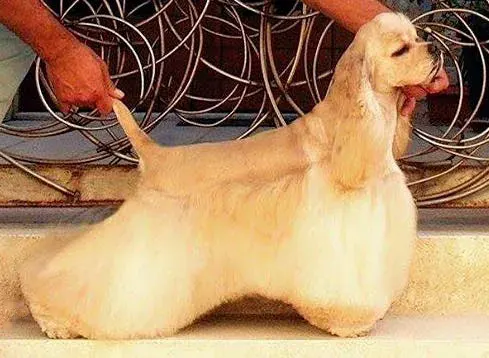
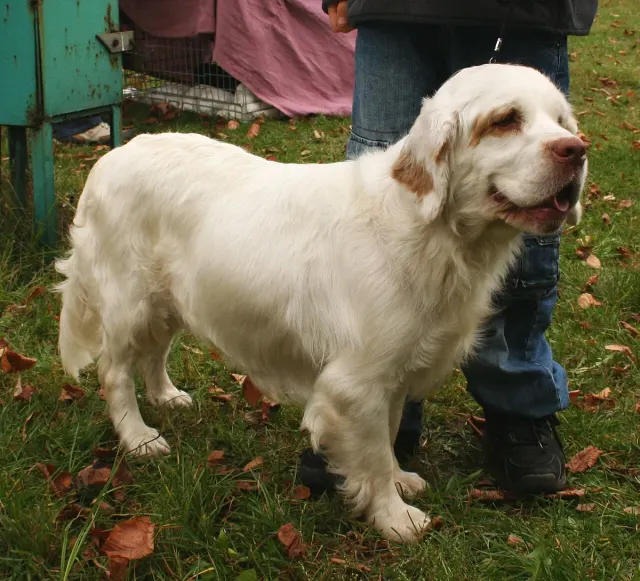
Cheerful, affectionate and forever wagging, the English Cocker Spaniel is an endearing family dog and an enthusiastic hunter.

History and origins
The English Cocker Spaniel was developed in England to flush and retrieve small game, especially woodcock, which gave it its name.
It has become one of the most popular family dogs in Europe.
Appearance and colours
The FCI breed standard describes a merry, sturdy, sporting dog, well balanced and compact, measuring about the same from withers to ground as from withers to tail. The coat is flat and silky, never wiry, wavy or curly, with feathering on the legs and body.
Colours include solids (black, red, golden, liver, black and tan, liver and tan), where only a little white on the chest is tolerated, and particolours and tricolours such as black and white, orange and white, liver and white or lemon and white, with or without ticking.
- Height: about 39–41 cm for males, 38–39 cm for females.
- Weight: about 13–14.5 kg.
Temperament
Merry, affectionate and sociable, the English Cocker loves company and usually gets on well with children. It is lively and curious.
It learns well with positive training; some lines can be sensitive and possessive.
With children and other pets
The standard describes a gentle, affectionate dog full of life and exuberance, with a merry nature and an ever-wagging tail. It rates 5 out of 5 with children and 4 out of 5 with other dogs in our ratings.
- It is a cheerful, people-focused family dog.
- Check the ears regularly: long, feathered ears need care.
Training tips
According to the standard, Cocker Spaniels were recognised as a separate breed from Field and Springer Spaniels soon after the Kennel Club was formed in 1873; the name comes from the "cocking spaniel", used to flush woodcock. Today there are working and show types, the show Cocker being sturdier and heavier. It rates 4 out of 5 for trainability in our ratings.
- Reward-based training and scent games suit it well.
- Working-type Cockers need a lot of activity.
Health
Its long ears make it prone to ear infections. Some eye diseases, an inherited kidney disease and deafness (in parti-coloured dogs) should also be monitored. Tests are available.
Regular veterinary follow-up is recommended.
Common health issues in detail
A UK study of English Cocker Spaniels under veterinary care found that the most common problems were dental (periodontal) disease (21.0%), ear infections (otitis externa, 10.1%) and obesity (9.9%); the median age at death was 11.4 years. Aggression was recorded more often in males (5.0%) than females (2.9%), and more often in solid-coloured dogs (7.0%) than in other colours (3.7%).
The Royal Kennel Club recommends as a minimum for breeding dogs DNA tests for acral mutilation syndrome (AMS) and progressive retinal atrophy (prcd-PRA), and as best practice DNA tests for adult-onset neuropathy (AON) and familial nephropathy (FN), eye testing including gonioscopy, and hip scoring.
This is general information. For any question about your dog's health, consult a veterinarian.
Feeding
It loves food and gains weight easily, so measure portions.
A narrow bowl keeps its ears clean at mealtimes.
Exercise
It needs one to one and a half hours of daily activity, with search and retrieving games.
It loves to sniff and explore.
In summer, walk it during the cool hours and watch its ears, which are more prone to infection in the heat. A regular tidy-up trim improves its comfort in summer.
Grooming
Its silky coat needs brushing two to three times a week and regular grooming. Clean and dry its ears often.
Check for grass seeds after outings.
Choosing a puppy
Choose a breeder who does the DNA tests, eye tests and hip scoring recommended by the Royal Kennel Club.
- Ask for the parents' DNA, eye and hip results.
- Meet the mother: she should be gentle and confident.
- Ask whether the parents are from working or show lines.
Our guide on how to recognise a responsible breeder explains what to ask.
Similar breeds
The English Springer Spaniel and Welsh Springer Spaniel are larger British spaniels. The American Cocker Spaniel is its American relative, and the Cavalier King Charles Spaniel is a smaller companion spaniel.