Long, low and full of confidence, the Dachshund is a brave hunter turned affectionate companion. It comes in three sizes and three coat types.
History and origins
The Dachshund ('badger dog' in German) was bred in Germany to hunt badgers and foxes underground and to track wounded game.
The Fédération Cynologique Internationale recognises three sizes (standard, miniature and rabbit) and three coats (smooth, long-haired and wire-haired).
Appearance and colours
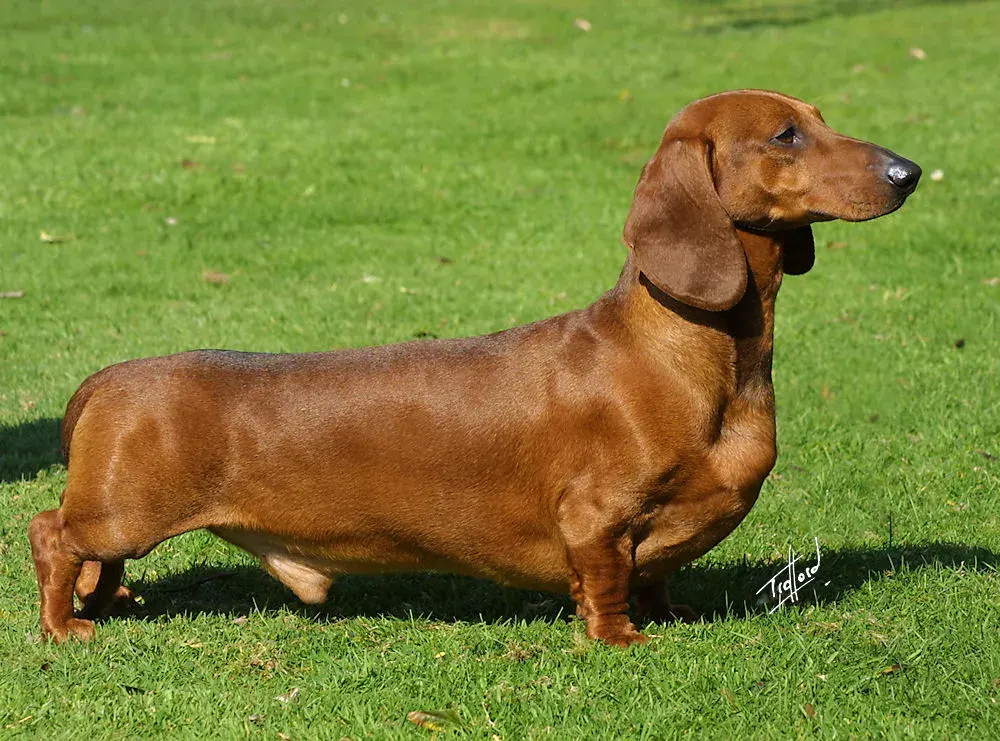
The FCI breed standard describes a low, short-legged, elongated but compact dog, very muscular, with a cheeky, challenging head carriage and an alert expression. The ground clearance is about one third of the height at the withers, and the body length is about 1.7 to 1.8 times the height.
There are three coat varieties:
- Smooth-haired: short, dense, shiny and harsh.
- Wire-haired: a close, wiry topcoat with undercoat, a clearly defined beard and bushy eyebrows.
- Long-haired: a shiny coat with undercoat, longer on the throat and underside, with feathering on the legs and a full "flag" on the tail.
Colours include one-coloured red; black or brown with tan markings; and, depending on the variety, dapple and wild boar. The Royal Kennel Club refuses to register puppies from two dapple parents because of the risk of impaired vision and hearing.
The FCI classifies sizes by chest circumference, measured from 15 months old:
- Standard: over 35 cm (females) or 37 cm (males), up to 45 or 47 cm
- Miniature: over 30 or 32 cm, up to 35 or 37 cm
- Rabbit: 25–30 cm (females) or 27–32 cm (males)
Temperament
Brave, curious and very attached to its family, the Dachshund has a strong personality. It can be stubborn, vocal and wary of strangers.
Patient, consistent, reward-based training works better than force.
With children and other pets
The standard describes a friendly dog, neither fearful nor aggressive, with an even temperament, and a passionate, persistent hunter with an excellent nose. It rates 3 out of 5 with children and with other dogs in our ratings.
- Its back is vulnerable: teach children never to pick it up by the front legs, and to support its chest and hindquarters with both hands.
- Supervise play with large, boisterous dogs, which can injure a small long-backed dog.
- It was bred to hunt small animals: introductions to rabbits, rodents and cats need great care.
Training tips
The Dachshund was bred to work independently above and below ground, which explains its persistence and a trainability score of 2 out of 5 in our ratings.
- Use patient, reward-based training with tasty food rewards, in short sessions.
- Make recall training a game, and use a long line until it is reliable.
- Give its nose work to do: tracking and scent games suit a breed that the standard says excels at tracking wounded game.
Health
Its long back makes it very prone to disc herniation, which can cause paralysis: avoid jumping off furniture, repeated stair-climbing and excess weight. Inherited eye diseases also occur depending on the variety.
See a vet urgently if it shows back pain or weakness in the hind legs.
Common health issues in detail
Intervertebral disc disease (IVDD), in which a spinal disc ruptures or bulges and presses on the spinal cord, is the major health problem of the breed. Researchers at the Royal Veterinary College cite earlier work estimating that Dachshunds have a 10 to 12 times higher risk of IVDD than other breeds, and that 19–24% show signs of it during their lifetime.
Which dogs. In the DachsLife 2015 survey of 2,031 Dachshunds, 15.7% had been diagnosed with IVDD. The risk varied between the varieties, from 24.4% in Standard Smooth-haired to 7.1% in Standard Wire-haired Dachshunds. Older dogs and neutered dogs had higher odds.
Exercise and lifestyle. Dogs that exercised for more than an hour a day, and dogs their owners described as highly or moderately active, had lower odds of IVDD, while those exercised for less than 30 minutes a day had higher odds. The authors stress that these findings need confirming by further studies. Keeping your Dachshund lean and active is, in any case, good practice.
Signs to watch. Back pain, reluctance to move or climb, a hunched posture, or weakness or wobbling in the hind legs need a vet the same day.
Health tests. The Royal Kennel Club recommends spine screening for breeding dogs under its IVDD screening scheme, supported by Dachshund Health UK (minimum), and an eye examination (best practice).
This is general information. For any question about your dog's health, consult a veterinarian.
Feeding
It is very greedy and gains weight easily, which worsens back problems. Weigh portions and limit treats.
Choose food suited to its size.
Exercise
It needs daily walks and scent games. It has more stamina than it looks.
Carry it on stairs where possible and use a harness.
In summer, walk it during the cool hours: being low to the ground, it feels hot pavements more. It may feel the cold in winter in mountain regions.
Grooming
The smooth coat needs little care; the long coat should be brushed several times a week; the wire coat needs hand-stripping twice a year.
Check its ears and teeth.
Choosing a puppy
Choose the variety and size first, then a breeder who screens for back health.
- Ask whether the parents have been X-ray screened under an IVDD scheme, and ask about back problems in the wider family.
- Ask for eye examination results.
- Avoid puppies from two dapple parents, which the Royal Kennel Club will not register because of the health risks.
- Meet the mother: she should be friendly and confident, neither fearful nor aggressive, as the standard asks.
- Consider an adult from a breed rescue.
Our guide on how to recognise a responsible breeder explains what to ask.
Similar breeds
The Basset Hound is a heavier short-legged scent hound. The German Hunting Terrier is another German earth dog bred to go underground. The Jack Russell Terrier is a small, energetic hunting terrier of similar weight.