With its lion-like mane and blue tongue, the Chow Chow is a dignified, calm and independent dog that is very sensitive to heat.
History and origins
The Chow Chow is one of the oldest breeds, originating in northern China, where it served as a guard, sled and hunting dog.
Its blue-black tongue and stilted gait are unique features of the breed.
Appearance and colours
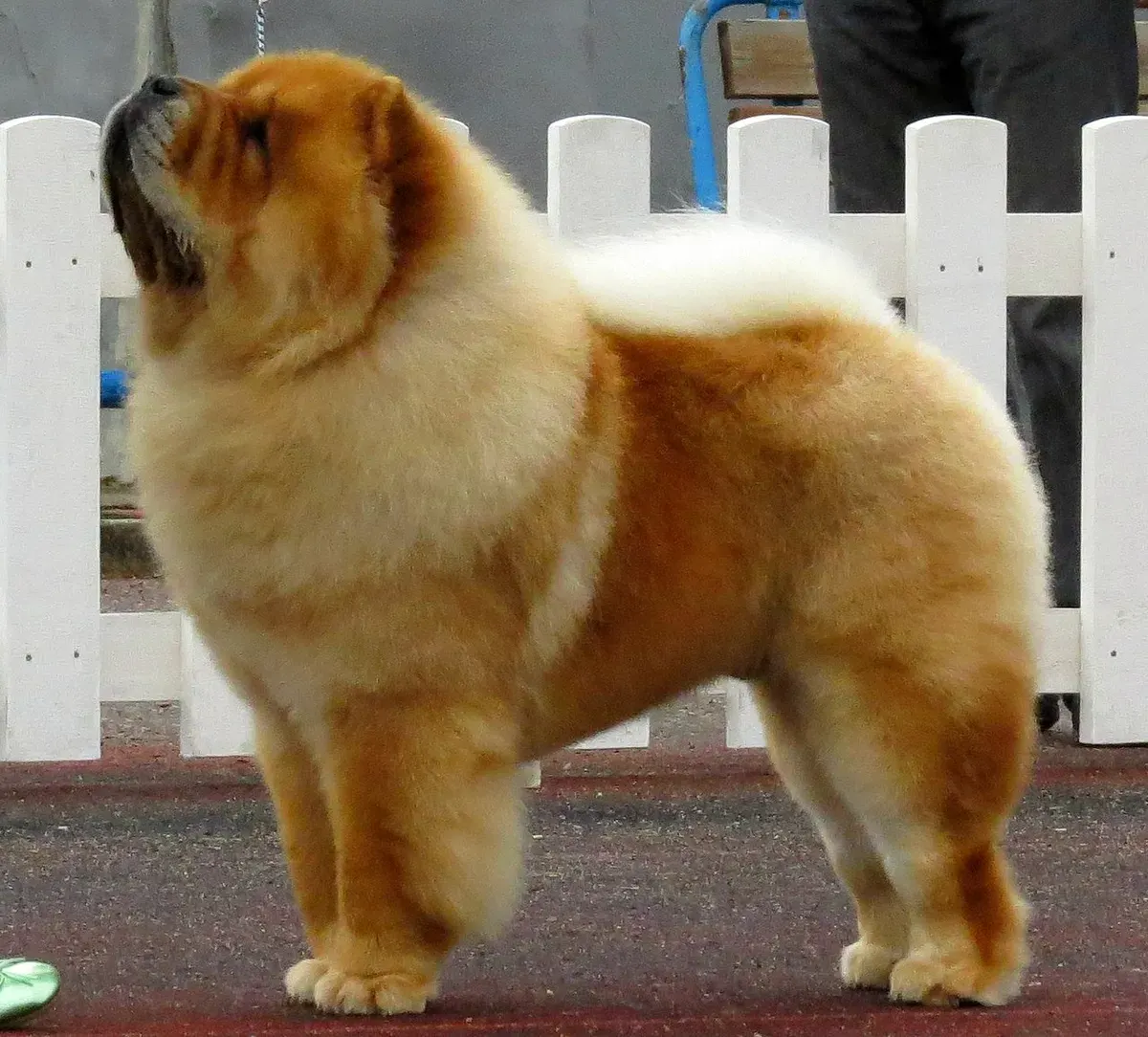
The FCI breed standard describes an active, compact, short-coupled and well-balanced dog, lion-like in appearance, with a proud, dignified bearing and a tail carried over the back. A bluish-black tongue is characteristic. The standard insists that the dog must always move freely and must not have so much coat that it impedes activity or causes distress in hot weather.
The coat is either rough (profuse, dense, straight and stand-off, with a mane and breeches) or smooth (short, dense, straight and plush). Colours are solid black, red, blue, fawn, cream or white, often shaded but never patched or parti-coloured.
- Height at the withers: 48–56 cm for males, 46–51 cm for females.
Temperament
Dignified, reserved and independent, the Chow is loyal to its family but aloof with strangers. It dislikes rough handling, so care is needed with young children.
Early socialisation and calm, consistent training are essential.
With children and other pets
The standard describes a quiet dog and a good guard: independent, loyal, yet aloof. It rates 2 out of 5 with children and 2 out of 5 with other dogs in our ratings.
- It suits calm adult households and older, respectful children.
- It is usually reserved with strangers.
Training tips
According to the standard, the Chow has been known in China for more than 2,000 years as a guard and hunting dog, related to Nordic spitz dogs with something of the mastiff; it reached other countries only around 1800 and became noticed in Britain in the 1920s. The Royal Kennel Club links it to the Han Dynasty. It rates 2 out of 5 for trainability in our ratings.
- Use calm, patient, reward-based training and early socialisation.
- Avoid exercise in heat: it rates 1 out of 5 for heat tolerance.
Health
The breed is prone to entropion (inward-rolling eyelids), hip and elbow dysplasia, skin problems and, with its broad muzzle, heat sensitivity.
Regular veterinary follow-up is essential.
Common health issues in detail
Entropion. In a UK study of more than 2.2 million dogs under veterinary care in 2019, the Chow Chow had the second-highest annual prevalence of entropion, an inward-rolling eyelid that rubs the eye, at 9.28% (after the Shar-Pei). The authors describe eyelid problems caused by breeding for abnormal eyelid shape as a welfare priority. If your dog squints, has a weepy eye or rubs its face, see your vet.
Health tests. The Royal Kennel Club recommends hip scoring, elbow grading and eye testing for breeding dogs as a minimum, and notes that the breed has a breed club health scheme and can be affected by conformational concerns.
This is general information. For any question about your dog's health, consult a veterinarian.
Feeding
Good-quality food in measured portions suits it; it is not very active and gains weight.
Fresh water must be available at all times.
Exercise
Calm daily walks during the cool hours are enough.
It dislikes intense exertion.
Calm indoors, it can live in an apartment if the home stays cool.
Grooming
Its thick coat (rough or smooth) needs brushing several times a week and sheds heavily during moults.
Do not shave it.
Choosing a puppy
Choose a breeder who scores hips and elbows, eye-tests the parents and selects for open eyes and a moderate coat.
- Look at the parents' eyes: they should be clear, with no squinting or tearing.
- Ask whether the parents or relatives have needed eyelid surgery.
- Meet the mother: she should be calm and confident.
Our guide on how to recognise a responsible breeder explains what to ask.