A massive guardian with a thick coat, the Caucasian Shepherd is utterly loyal to its family and formidable towards intruders.
History and origins
The Caucasian Shepherd has protected flocks and villages in the Caucasus Mountains (Georgia, Armenia, Azerbaijan, southern Russia) from wolves and thieves for centuries.
It was later used to guard sensitive sites in the Soviet Union.
Appearance and colours
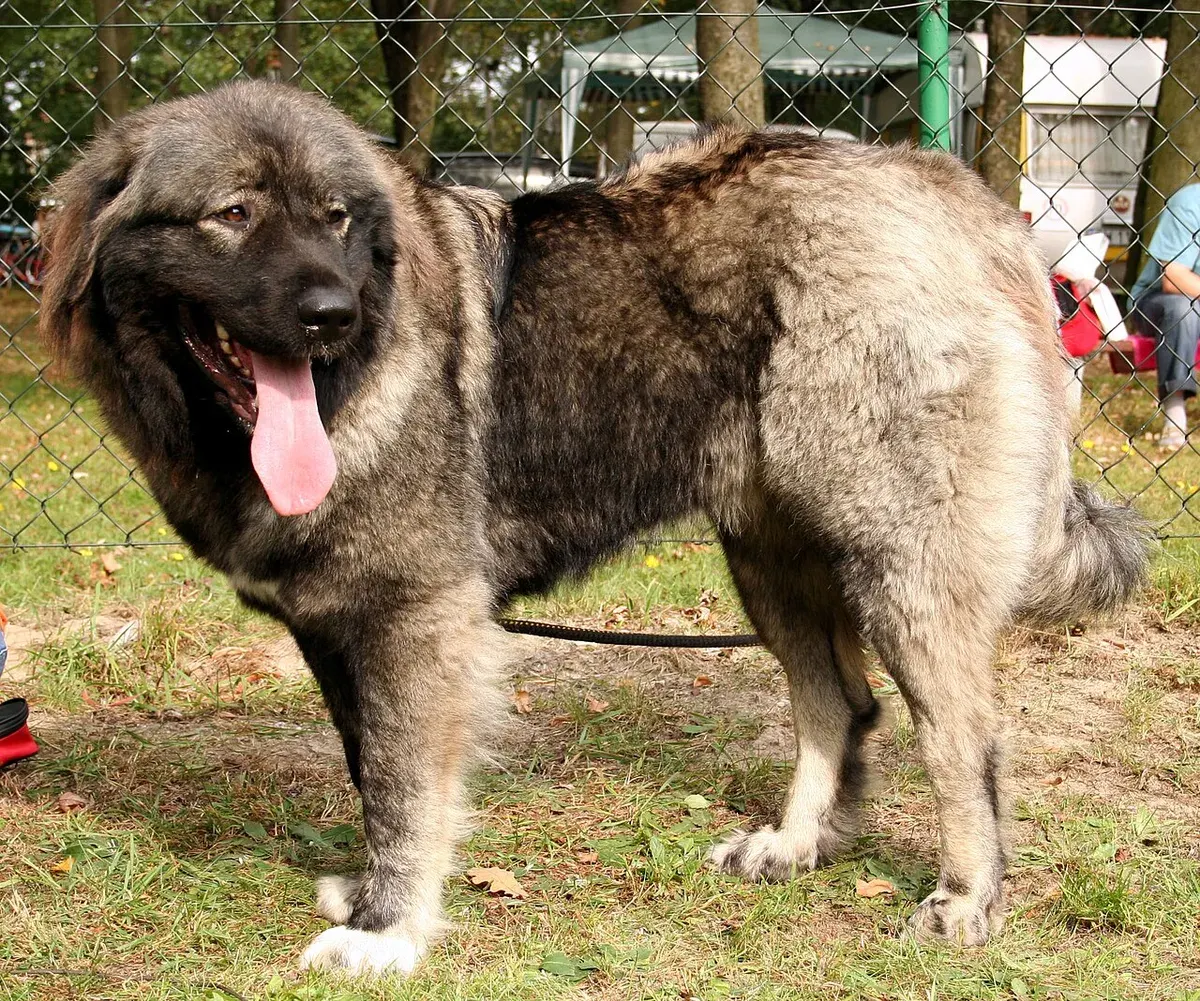
The FCI breed standard describes a harmoniously built, large, strong dog with plenty of bone and powerful muscles, slightly longer than tall, with marked differences between the sexes: males are more massive, with bigger heads. The large, massive head looks like a broad-based wedge from above.
The coat is straight, coarse and stand-off, with a well-developed undercoat, at least 5 cm long; longer-coated dogs have "brushes" on the ears, a mane around the neck and "trousers" on the thighs. Any solid, piebald or spotted colour is accepted, except solid black, diluted black or black in any combination, genetic blue and liver brown.
- Desirable height at the withers: 72–75 cm for males (minimum 68 cm), 67–70 cm for females (minimum 64 cm).
- Minimum weight: 50 kg for males, 45 kg for females.
Temperament
Highly protective, brave and independent, the Caucasian Shepherd is devoted to its family and extremely wary of strangers.
It only suits experienced owners able to provide intensive socialisation and strict management.
Some regions restrict ownership of this breed; check your local regulations.
With children and other pets
The standard describes a steady, active, self-confident, fearless and independent dog with a devoted attachment to its owner, and an excellent guard dog. It rates 2 out of 5 with children and 2 out of 5 with other dogs in our ratings.
- It is a powerful guardian: it is not suited to most family homes, and needs very secure fencing.
- Socialise it early and extensively, and supervise it with children and visitors.
Training tips
According to the standard, the breed descends from ancient Caucasian dogs, spread from the Caucasus range to the steppes of southern Russia, and was used to guard herds, flocks and homes from predators; selection began in the USSR in the 1920s. It rates 2 out of 5 for trainability in our ratings.
- Work with a trainer experienced in livestock guardian breeds.
- Never encourage protective or aggressive behaviour.
Health
Hip and elbow dysplasia and excess weight are the main concerns.
Growth should be slow and veterinary follow-up regular.
This is general information. For any question about your dog's health, consult a veterinarian.
Feeding
Good-quality giant-breed food in two meals suits it.
Avoid excess weight, which strains its joints.
Exercise
It needs daily walks and a large area to guard, without intense exercise.
High, solid fencing is essential.
In summer, shade, coolness and water are essential. It is completely unsuited to city life.
Grooming
Its thick coat needs brushing once or twice a week, daily during the heavy moult.
Do not shave it.
Choosing a puppy
The FCI standard disqualifies aggressive or overly shy dogs. Choose a breeder who selects for a stable temperament and can explain how the puppies have been socialised.
- Meet both parents and watch how they react to visitors.
- Ask whether the puppy will live as a working guardian or a companion.
Our guides on how to recognise a responsible breeder and on guard dogs and livestock guardians explain what to ask and what to expect.
Similar breeds
The Central Asian Shepherd Dog, Kangal Shepherd Dog, Tibetan Mastiff and Pyrenean Mountain Dog are other large flock guardians.