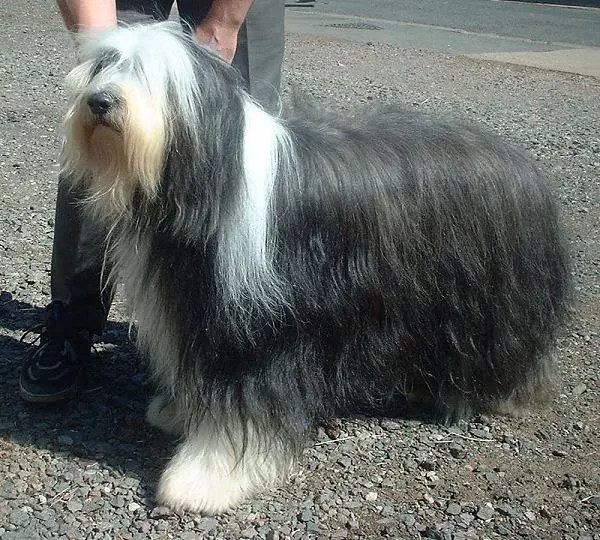
A sturdy, bearded farm dog, the Bouvier des Flandres is calm, protective and deeply loyal to its family.
History and origins
The Bouvier des Flandres was the all-purpose dog of farms in Flanders, between Belgium and northern France: driving cattle, guarding the farm and pulling carts.
Decimated during the First World War, it was revived from a few surviving dogs.
Appearance and colours
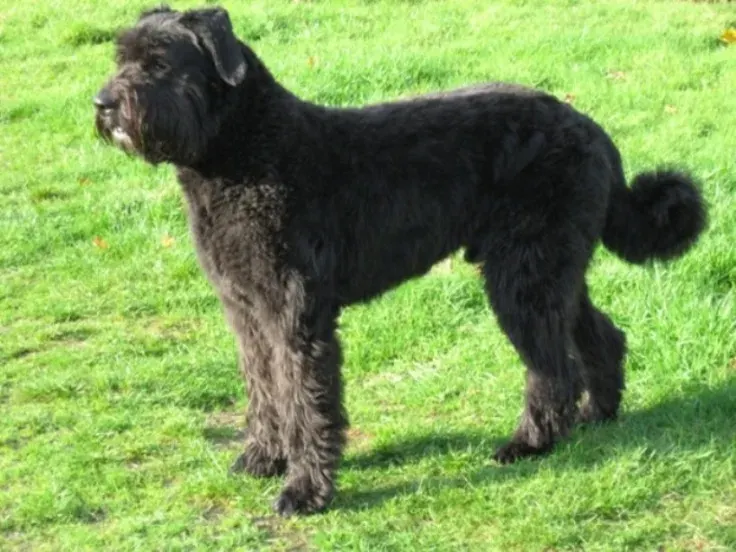
The FCI breed standard describes a short, compact, powerful dog with strong, well-muscled legs, giving an impression of power without clumsiness, its body about as long as it is tall. The massive head is accentuated by a moustache and full beard.
The very abundant coat forms, with the dense undercoat, a protective layer suited to the sudden weather changes of its homeland: coarse to the touch, dry and matt, about 6 cm long, slightly tousled but never woolly or curly. The Royal Kennel Club lists colours from fawn and blonde to grey and black, often brindle.
- Height at the withers: 62–68 cm for males (ideal 65 cm), 59–65 cm for females (ideal 62 cm).
- Weight: about 35–40 kg for males and 27–35 kg for females.
Temperament
Calm, steady and brave, the Bouvier is a natural guardian, attached to its family and patient with children. It is reserved with strangers.
Intelligent, it learns well but needs consistent training from an early age.
With children and other pets
The standard describes the calm, thoughtful character of a sensible but fearless dog, with a lively look showing intelligence, energy and boldness. It rates 4 out of 5 with children and 3 out of 5 with other dogs in our ratings.
- It is a devoted family guardian, calm at home.
- It is large and strong: supervise it with small children.
Training tips
According to the standard, the breed comes from Flanders, on both sides of the Belgian–French border, where cattle drovers selected local dogs for their working qualities. It was used to herd cattle, pull carts and turn butter churns; today it is above all a guard dog, a defence dog for police work and a companion. The standard insists that it must keep its aptitude for work. It rates 4 out of 5 for trainability in our ratings.
- Give it daily exercise and a job: obedience, tracking or carting.
- Use calm, consistent, reward-based training.
Health
Hip and elbow dysplasia, some eye conditions and hypothyroidism should be monitored.
Choose a breeder who screens their breeding dogs.
Common health issues in detail
The Royal Kennel Club recommends hip scoring, elbow grading and eye testing as best practice for breeding dogs.
We found no large population study of health in the breed.
This is general information. For any question about your dog's health, consult a veterinarian.
Feeding
Large-breed food in two meals suits it. Its thick coat hides its weight.
Avoid exercise straight after meals.
Exercise
It needs about an hour of daily activity, with walks and obedience or tracking exercises.
It enjoys having a job to do.
It needs a house with a garden rather than an apartment.
Grooming
Its rough, thick coat needs thorough weekly brushing and regular trimming or stripping at the groomer. It sheds little.
Clean its beard regularly.
Choosing a puppy
Choose a breeder who carries out the recommended hip, elbow and eye tests.
- Ask for the parents' test results.
- Meet the mother: she should be calm and confident.
- Ask how much grooming the coat needs each week.
Our guide on how to recognise a responsible breeder explains what to ask.
Similar breeds
The Giant Schnauzer and Black Russian Terrier are other large, bearded working dogs. The Briard is a shaggy French herding dog. The Belgian Groenendael is another Belgian working shepherd.