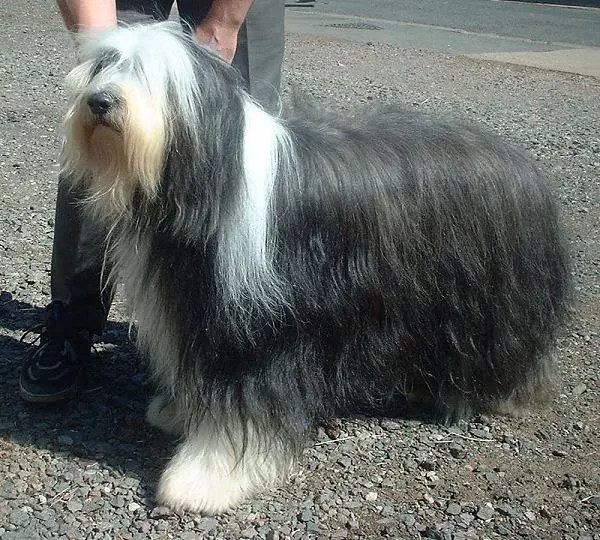
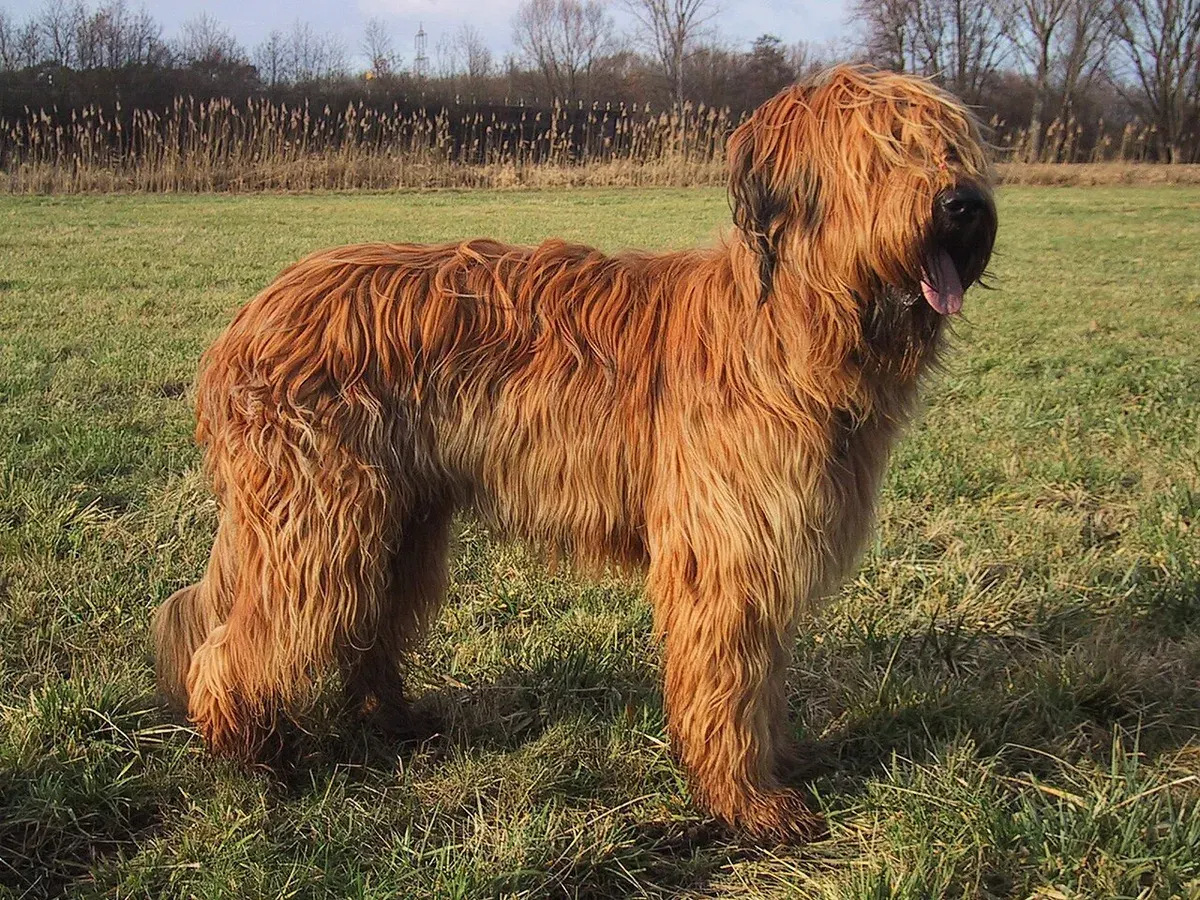
A large French shepherd with a long, goat-like coat, the Briard is a faithful, protective companion with plenty of character.
History and origins
The Briard is an old French herding dog from the plains around the Brie region. It guarded flocks against wolves and thieves and kept them in unfenced fields.
Like the Beauceron, it has double dewclaws on its hind legs.
Appearance and colours
The FCI breed standard describes a hardy, supple, muscular and well-proportioned dog, lively and alert, slightly longer than tall, with a long, strong head covered with hair that forms a beard, moustache and eyebrows lightly veiling the eyes. Like the Beauceron, it has traditional double dewclaws on the hind legs, forming well-separated "thumbs"; single or missing hind dewclaws are disqualifying. The Royal Kennel Club calls it a rugged, muscular and intelligent French flock guard and herder.
The coat is long, dry and supple, with a goat-like texture and a slight undercoat. Colours are black, fawn, fawn with a light to medium black overlay (often with a mask), grey or blue; all colours may show some greying.
- Height at the withers: 62–68 cm for males, 56–64 cm for females.
Temperament
Loyal, protective and very attached to its family, the Briard is often described as 'a heart of gold wrapped in fur'. It is reserved with strangers.
Intelligent but independent, it needs consistent, patient training and good socialisation.
With children and other pets
The standard asks for a balanced temperament, neither aggressive nor timid, and a steady, fearless dog. It rates 4 out of 5 with children and 3 out of 5 with other dogs in our ratings.
- It is devoted to its family and watchful with strangers.
- Its long coat brings dirt into the house and needs regular grooming.
Training tips
According to the standard, the breed was long known as the French Lowland Sheepdog; the name "chien de Brie" first appeared in 1809. It was selected for driving and guarding flocks, and the French army used it in both world wars as a sentry and as an ambulance dog searching for the wounded. It rates 3 out of 5 for trainability in our ratings.
- Give it daily exercise and a job: herding, obedience or tracking.
- Use calm, consistent, reward-based training.
Health
Hip dysplasia, bloat and some inherited eye diseases are the main concerns.
Ask for the parents' screening results and keep up regular veterinary check-ups.
Common health issues in detail
The Royal Kennel Club recommends as best practice for breeding dogs a DNA test for congenital sensory night blindness (CSNB), which imported dogs must also have to prevent its reintroduction, and hip scoring.
We found no large population study of health in the Briard.
This is general information. For any question about your dog's health, consult a veterinarian.
Feeding
Good-quality large-breed food in two meals suits it. Its long coat easily hides changes in weight.
Avoid exercise straight after eating.
Exercise
It needs one to two hours of daily activity: long walks, games, obedience or tracking.
It likes to stay close to its family.
In summer, walk it in the cool hours and give it a cool, shady spot. It needs a house with a garden; apartment life does not suit it.
Grooming
Its long, dry coat needs thorough brushing once or twice a week to prevent mats, even though it sheds relatively little.
Clean its beard and ears regularly.
Choosing a puppy
Choose a breeder who DNA-tests the parents for CSNB and hip-scores them.
- Ask for the parents' DNA and hip results.
- Meet the mother: she should be steady and fearless, neither aggressive nor timid.
- Ask how much grooming the coat needs each week.
Our guide on how to recognise a responsible breeder explains what to ask.
Similar breeds
The Beauceron is the short-coated French sheepdog with the same double dewclaws. The Bearded Collie, Bouvier des Flandres and Old English Sheepdog are other shaggy-coated herding dogs.