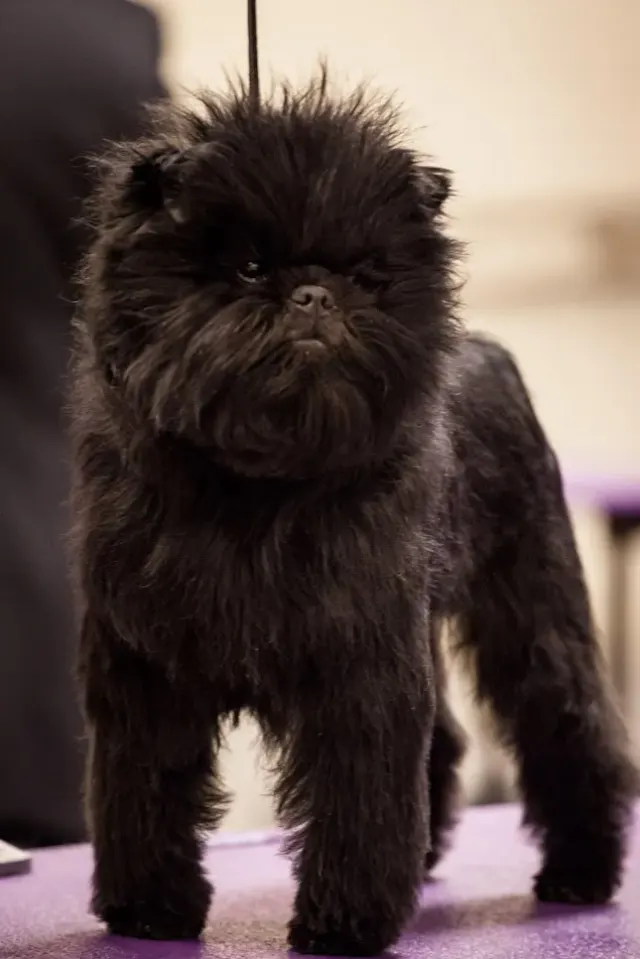
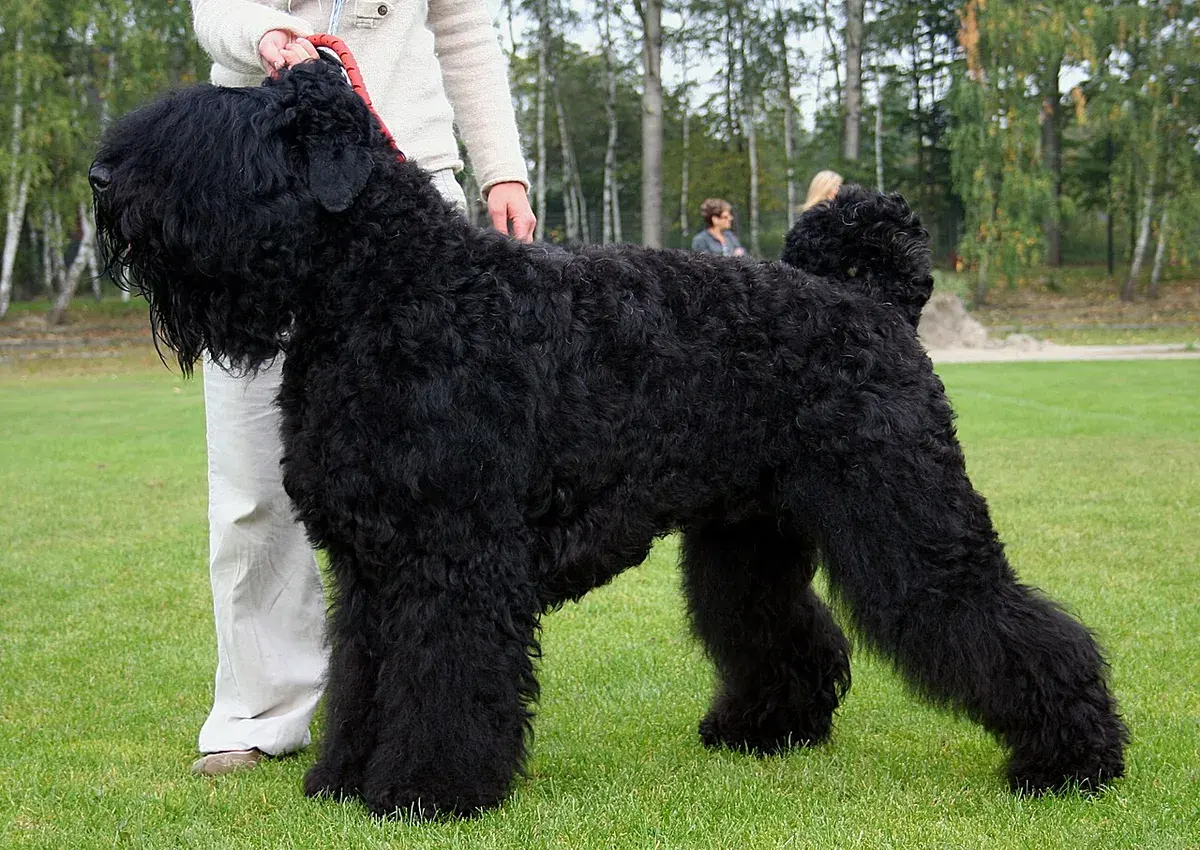
A large, bearded black dog created in the Soviet Union, the Black Russian Terrier is a calm, confident guardian devoted to its family.
History and origins
The Black Russian Terrier was created in the mid-20th century in a Soviet military kennel from breeds such as the Giant Schnauzer, Rottweiler and Airedale, to produce a sturdy, cold-resistant guard dog.
Despite its name, it is not a true terrier: the FCI groups it with pinschers and schnauzers.
Appearance and colours
The FCI breed standard describes a large, athletic dog of robust type and hardy constitution, with massive bone, powerful muscles, a large head and a deep chest, its body slightly longer than tall. The Royal Kennel Club says it was developed for Russia's challenging terrains and climate.
The double coat combines a coarse, thick, slightly waved outer coat with a soft, short, dense undercoat; untrimmed, it is 5–15 cm long, with abundant eyebrows, moustache and beard and long furnishings on the legs. It must be groomed to the correct shape. The Royal Kennel Club lists black and black with grey hairs.
- Height at the withers: 72–76 cm for males (70–78 cm accepted), 68–72 cm for females (66–74 cm accepted).
- Weight: 50–60 kg for males, 45–50 kg for females.
Temperament
Calm, confident and protective, the Black Russian Terrier is affectionate with its family and wary of strangers. It needs human contact.
Intelligent but sometimes dominant, it requires consistent training and early socialisation.
Some regions restrict ownership of this breed; check your local regulations.
With children and other pets
The standard describes a dignified, confident dog, well controlled in all situations: it takes an active defensive posture when needed but quickly calms down once a threat has gone, and is amiable, undemanding, smart and friendly. It rates 3 out of 5 with children and 2 out of 5 with other dogs in our ratings.
- It is a powerful guard: socialise it widely and supervise it with children and visitors.
- Introduce other dogs carefully.
Training tips
According to the standard, the breed was created in the late 1940s and early 1950s at the military dog school near Moscow (the "Red Star" kennels), mainly from the Giant Schnauzer with the Rottweiler, Airedale Terrier and Newfoundland, to produce a large, brave, strong and manageable working dog with a strong guarding instinct; the FCI recognised it in 1984. It rates 3 out of 5 for trainability in our ratings.
- The standard notes that it adapts well to training: use calm, consistent, reward-based methods.
- Give it daily exercise and a job.
Health
Hip and elbow dysplasia, some eye diseases and an inherited respiratory condition have been reported.
Ask for the parents' screening and test results.
Common health issues in detail
Polyneuropathy (POANV). A recessive inherited disease of Black Russian Terriers causes laryngeal paralysis and nerve damage in young dogs, together with eye abnormalities such as cataracts. Researchers traced it to a mutation in the RAB3GAP1 gene, which allows DNA testing.
Hyperuricosuria. A study found that the gene mutation causing high uric acid in urine, which can lead to urate bladder stones, was common in the breed: its frequency was 0.51, and about 27% of Black Russian Terriers were estimated to be affected. A DNA test can be used to select against it.
The Royal Kennel Club lists no specific health tests for the breed.
This is general information. For any question about your dog's health, consult a veterinarian.
Feeding
Good-quality large-breed food in two meals suits it.
Avoid exercise after meals.
Exercise
It needs about an hour of daily activity, including obedience or tracking.
It likes having a job.
It needs a house with a garden.
Grooming
Its harsh, wavy coat needs weekly brushing and a trim at the groomer every six to eight weeks. It sheds little.
Clean its beard after meals.
Choosing a puppy
Choose a breeder who DNA-tests the parents for the RAB3GAP1 (POANV) and hyperuricosuria mutations and selects for a steady temperament.
- Ask for the parents' DNA results.
- Meet the mother: she should be confident and calm.
- Ask how the coat is groomed and how often it needs trimming.
Our guide on how to recognise a responsible breeder explains what to ask.
Similar breeds
The Giant Schnauzer is its main ancestor, according to the FCI standard. The Rottweiler and Airedale Terrier also contributed to the breed. The Bouvier des Flandres is another large, rough-coated working dog.