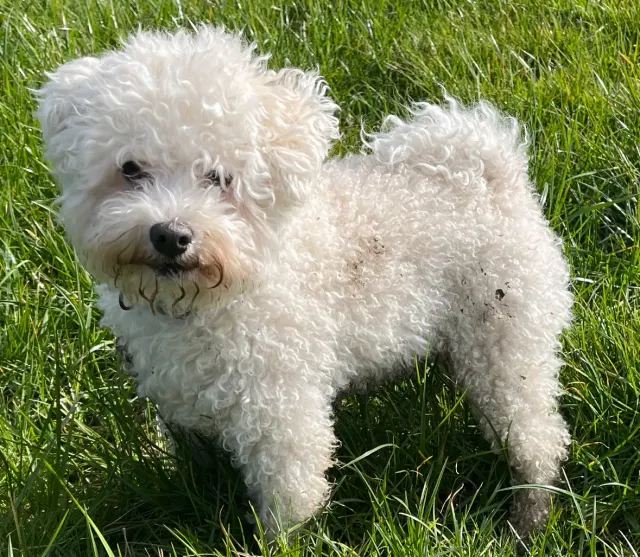
A small white dog with a coat as soft as cotton, the Coton de Tulear is cheerful, sociable and very attached to its family.
History and origins
The Coton de Tulear comes from Madagascar and is named after the port city of Toliara (Tuléar). Its ancestors, small bichons, are thought to have arrived with seafarers.
It was prized by well-off families on the island before spreading around the world.
Appearance and colours
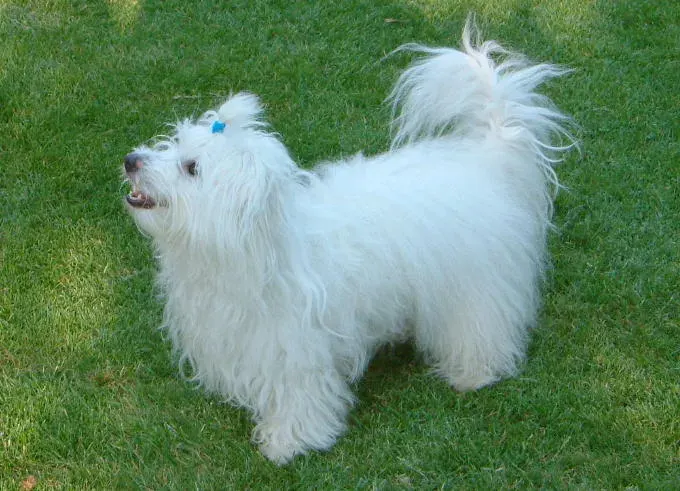
The FCI breed standard describes a small, long-haired companion dog with a white, cotton-textured coat, round dark eyes and a lively, intelligent expression; the body is clearly longer than tall (height to length 2:3). The coat is the breed's hallmark and gives it its name: very soft and supple, like cotton, dense and profuse, sometimes very slightly wavy.
The ground colour is white; a few light grey or red-roan shadings are allowed on the ears. The Royal Kennel Club also lists white with brown, grey, lemon or tan.
- Height at the withers: 26–28 cm for males, 23–25 cm for females (tolerance of 2 cm above and 1 cm below).
- Weight: 4–6 kg for males, 3.5–5 kg for females.
Temperament
Cheerful, affectionate and sociable, the Coton is excellent with children and other animals. It is playful, sometimes a clown, and very close to its family.
It learns easily with positive training but copes poorly with being alone.
With children and other pets
The standard describes a happy, stable temperament, very sociable with people and other dogs, adapting perfectly to all ways of life, and calls its temperament one of the breed's main characteristics. It rates 5 out of 5 with children and 5 out of 5 with other dogs in our ratings.
- It is a sociable family dog, but small: teach children to handle it gently.
- It adapts well to different homes.
Training tips
According to the standard, the Coton came to France from Madagascar long before its official recognition in 1970 and quickly became a popular companion. The Royal Kennel Club calls it the "Royal dog of Madagascar". It rates 4 out of 5 for trainability in our ratings.
- Short, cheerful, reward-based sessions work well.
- Start grooming early: the coat needs regular brushing.
Health
This is a fairly healthy, long-lived breed. Kneecap luxation, some eye diseases and dental problems should be monitored.
Regular veterinary follow-up is recommended.
Common health issues in detail
The Royal Kennel Club recommends eye testing as best practice for breeding dogs, and the breed has a breed club health scheme.
We found no large population study of health in the Coton de Tuléar.
This is general information. For any question about your dog's health, consult a veterinarian.
Feeding
Small-breed food in measured portions suits it.
Avoid excess weight.
Exercise
Daily walks and play are enough for its well-being.
It enjoys training games.
Coming from a warm island, the Coton copes reasonably with heat, especially with a summer clip; walk it during the cool hours.
Grooming
Its cottony coat sheds very little but mats: brush several times a week, or choose a shorter clip.
Clean around the eyes.
Choosing a puppy
Choose a breeder who eye-tests the parents and takes part in the breed club health scheme.
- Ask for the parents' eye certificates.
- Meet the mother: she should be happy and sociable.
- Ask how the coat is cared for.
Our guide on how to recognise a responsible breeder explains what to ask.
Similar breeds
The Bichon Frisé, Bolognese, Maltese and Havanese are other small white or Bichon-type companions.