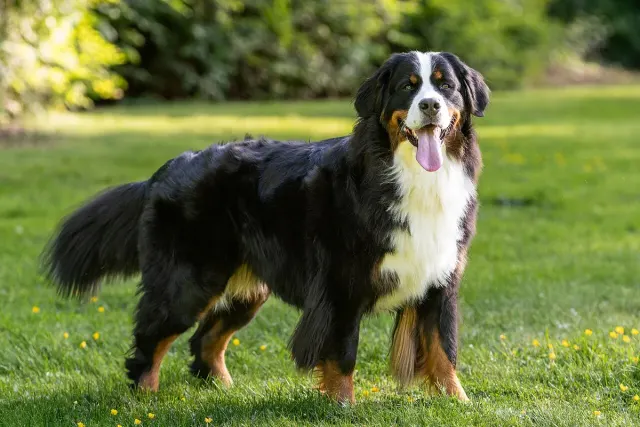
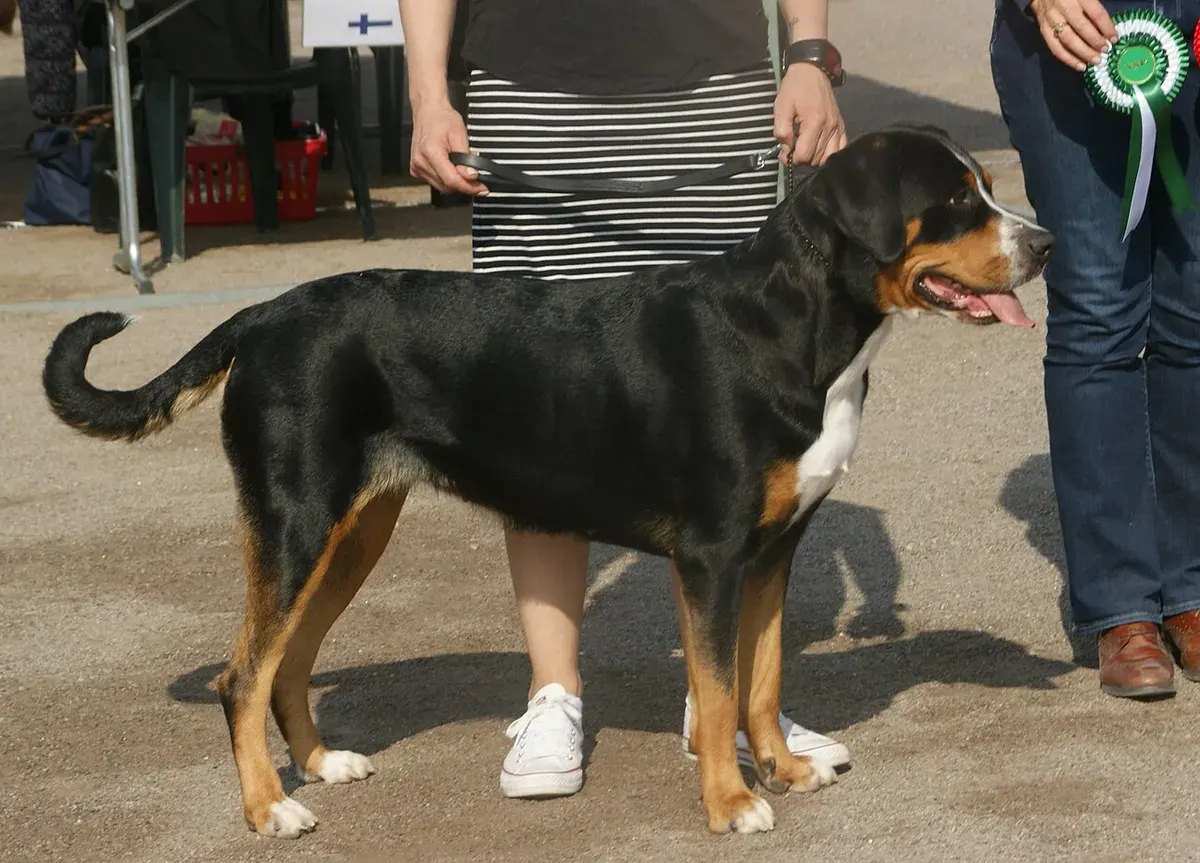
The largest of the Swiss mountain dogs, this short-coated tricolour dog is calm, reliable and very attached to its family.
History and origins
The Greater Swiss Mountain Dog is an old farm dog from the Swiss Alps, used for guarding, driving cattle and pulling carts for butchers and farmers.
Nearly extinct in the early 20th century, it was revived by Swiss enthusiasts.
Appearance and colours
The FCI breed standard describes a tricoloured, sturdy, heavy-boned and well-muscled dog that, despite its size and weight, shows endurance and agility; the body is a little longer than tall. It has a double coat: a thick outer coat of medium length and a dense, dark undercoat.
The colour is typically tricolour: black with symmetrical reddish-brown (tan) markings and clean white markings on the head, chest, feet and tail tip.
- Height at the withers: 65–72 cm for males, 60–68 cm for females.
Temperament
Calm, confident and affectionate, the Swissy is a good watchdog, alert without being aggressive. It is usually patient with children.
It matures slowly and can be stubborn, so consistent, early training is needed.
With children and other pets
The standard describes a self-confident, alert, watchful dog, fearless in everyday situations, good-natured and devoted to people it knows, and self-assured with strangers. It rates 4 out of 5 with children and 3 out of 5 with other dogs in our ratings.
- It is a calm family dog but very strong: start lead training early.
- It sheds a lot (4 out of 5 in our ratings).
Training tips
According to the standard, two short-haired dogs shown in 1908 at the Swiss Kennel Club's jubilee show were recognised as representatives of the old large mountain or butcher's dog, used as guard, draught and droving dogs; the breed was recognised in 1909. The Royal Kennel Club notes that it was used for herding cattle, guarding and pulling milk carts. It rates 3 out of 5 for trainability in our ratings.
- Use calm, consistent, reward-based training.
- Avoid exercise in the heat: it rates 2 out of 5 for heat tolerance.
Health
Hip and elbow dysplasia, bloat and epilepsy have been reported. Some dogs suffer from urinary incontinence.
Choose a breeder who screens their breeding dogs.
Common health issues in detail
The Royal Kennel Club recommends hip and elbow scoring as best practice for breeding dogs.
We found no large population study of health in the Greater Swiss Mountain Dog.
This is general information. For any question about your dog's health, consult a veterinarian.
Feeding
Puppies should grow slowly on large-breed food. Adults: two meals and rest after eating.
Avoid excess weight.
Exercise
It needs about an hour of daily activity: walks, hikes and carting.
Avoid intense effort in hot weather.
It is more comfortable in cool regions; in summer, walk it early and late, with shade and water. It needs a house with a garden rather than an apartment.
Grooming
Its short, dense coat with undercoat needs weekly brushing, more during the moult.
It sheds heavily twice a year.
Choosing a puppy
Choose a breeder who hip- and elbow-scores the parents.
- Ask for the parents' hip and elbow scores.
- Meet the mother: she should be confident and good-natured.
Our guide on how to recognise a responsible breeder explains what to ask.
Similar breeds
The Bernese Mountain Dog is its long-haired Swiss relative. The Rottweiler, Leonberger and Saint Bernard are other large working dogs.