A calm giant from the Spanish plateau, the Spanish Mastiff is a noble, serene flock guardian that is gentle with its family.
History and origins
The Spanish Mastiff has protected flocks of Merino sheep for centuries during seasonal migrations across Spain, guarding them against wolves and thieves.
Today it is still a livestock guardian and a property guard dog.
Appearance and colours
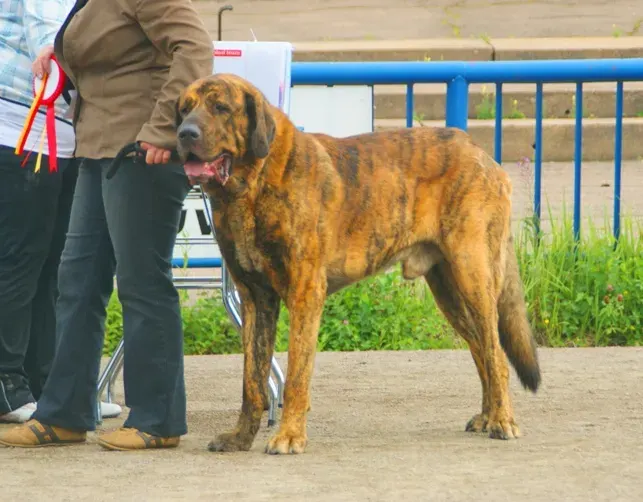
The FCI breed standard describes a dog of great size, well balanced, very powerful and muscular, with compact bones, a massive head and a semi-long coat; its bark is hoarse, low and deep. The coat is dense, thick, of medium length and smooth, longer and silky on the tail.
The colour is not important; the most appreciated are solid yellow, fawn, red, black, wolf colour and deer colour, and also brindle, parti-coloured or dogs with a white collar.
- Height at the withers: at least 77 cm for males and 72 cm for females, with no upper limit if the dog is harmonious.
Temperament
Calm, noble and self-assured, the Spanish Mastiff is affectionate with its family and wary of strangers. Its size and deep voice are a strong deterrent.
Independent, it needs a calm owner, early socialisation and patient training.
Some regions restrict ownership of this breed; check your local regulations.
With children and other pets
The standard describes a very intelligent dog, rustic, affectionate, kind and noble, very determined when facing dangerous animals and strangers, especially when protecting farms or livestock. It rates 3 out of 5 with children and 3 out of 5 with other dogs in our ratings.
- It is a working guardian that suits experienced owners with space.
- It is very heavy: start lead training early.
Training tips
According to the standard, the breed is closely linked to the seasonal movement of livestock, especially Merino sheep, which it already accompanied in the time of the medieval "Mesta", defending them from wolves; it still guards flocks and farms today. It rates 2 out of 5 for trainability in our ratings.
- Use calm, consistent training and early socialisation.
- It is an independent guardian by nature.
Health
Its size exposes it to hip and elbow dysplasia, bloat and eyelid problems.
Growth should be slow and supervised by a veterinarian.
This is general information. For any question about your dog's health, consult a veterinarian.
Feeding
Giant-breed food in two or three meals suits it. It often eats less than its size suggests.
Avoid exercise straight after eating.
Exercise
Calm walks and a large area to watch over are enough.
It is more active in the evening and at night.
It is an ideal guardian for farms and large properties but unsuited to apartments.
Grooming
Its medium-short, dense coat needs weekly brushing. It drools a little.
Check its eyes and ears.
Choosing a puppy
The FCI standard says only healthy dogs with typical breed conformation should be used for breeding.
- Ask what health checks the parents have had.
- Meet the mother: she should be calm and confident.
- Ask whether the parents work with livestock or live as companions.
Our guide on how to recognise a responsible breeder explains what to ask.
Similar breeds
The Neapolitan Mastiff and Mastiff are other giant mastiffs. The Pyrenean Mountain Dog and Central Asian Shepherd Dog are other livestock guardians.