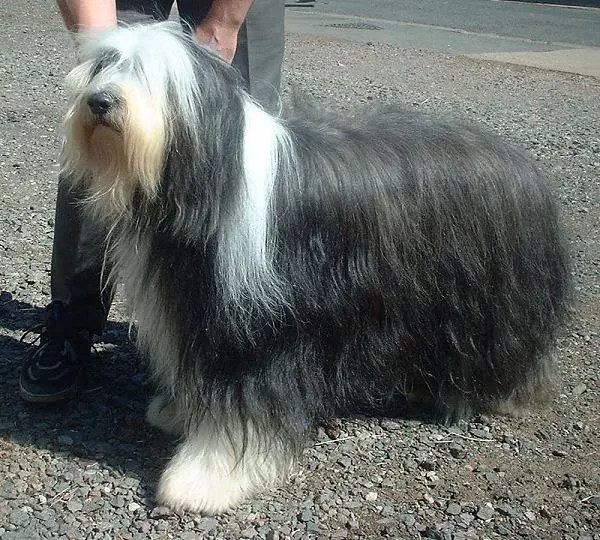
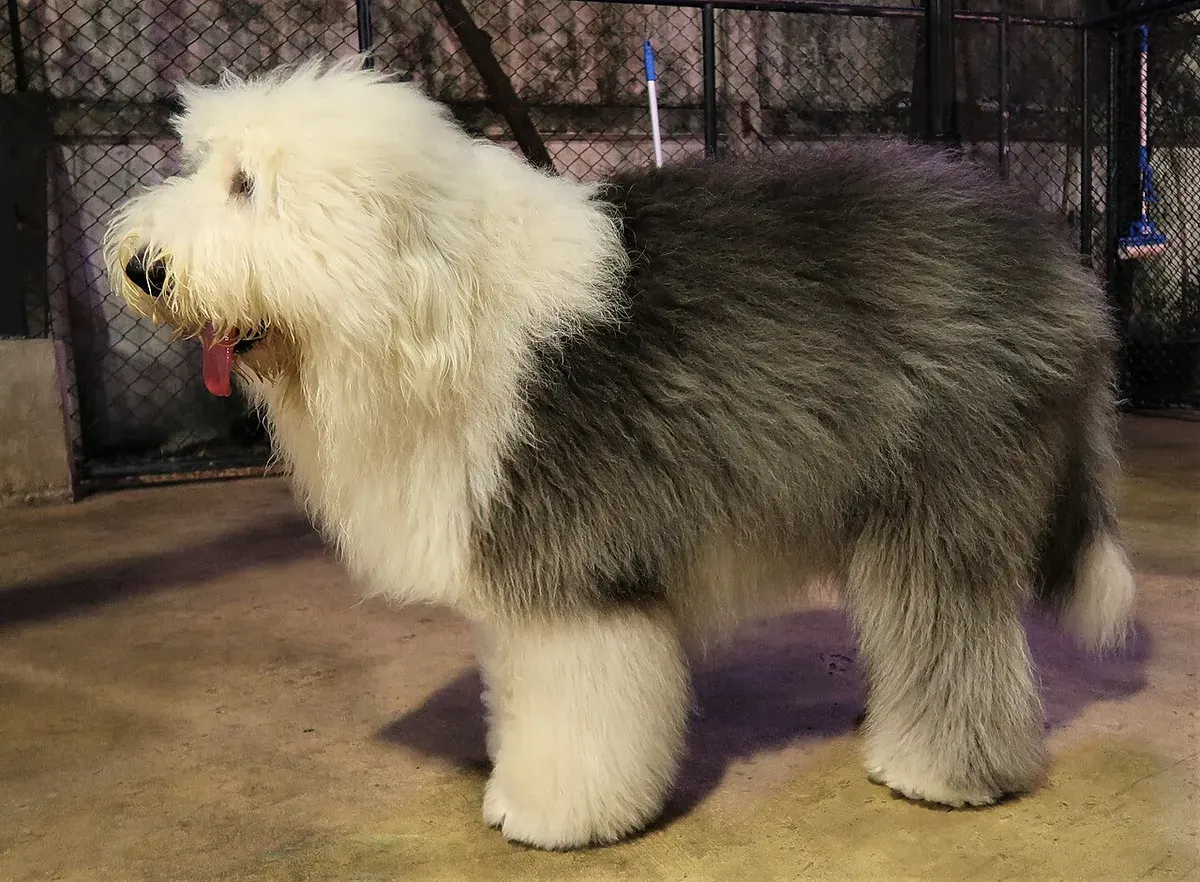
A big grey-and-white teddy bear, the Old English Sheepdog is a jolly, patient family dog, but very poorly suited to strong heat.
History and origins
The Old English Sheepdog, or Bobtail, was developed in western England to drive sheep and cattle to market. Its nickname comes from the short tail seen in many dogs.
Its teddy-bear look made it famous in advertising and cinema.
Appearance and colours
The FCI breed standard describes a strong, square-looking dog of great symmetry and soundness, thick-set and muscular, profusely coated all over, with a gently rising topline and a pear-shaped body seen from above. The coat is profuse, harsh and shaggy, not straight or curly, with a waterproof undercoat.
The colour is any shade of grey, grizzle or blue on the body and hindquarters, with a white head, neck, forequarters and belly, with or without markings.
- Height at the withers: 61 cm and upwards for males, 56 cm and upwards for females.
Temperament
Cheerful, affectionate and humorous, the Old English Sheepdog is usually very patient with children. It sometimes keeps the instinct to round up its family.
Intelligent but a little independent, it needs consistent training and plenty of company.
With children and other pets
The standard describes a biddable dog of even disposition, bold, faithful and trustworthy, with no nervousness or unprovoked aggression; it is a country dog, intelligent and friendly, with a particularly resonant bark. It rates 4 out of 5 with children and 4 out of 5 with other dogs in our ratings.
- It is a friendly family dog.
- Its coat needs a great deal of care (5 out of 5 for grooming needs in our ratings).
Training tips
According to the standard, its ancestry is thought to come from European shepherd dogs of the Ovcharka and Bergamasco types crossed with British sheepdogs; it is now regarded as a native British breed, often called the Bobtail. The Royal Kennel Club notes that, under its glamorous coat, it is still fit to work with flocks. It rates 3 out of 5 for trainability in our ratings.
- Use patient, reward-based training.
- Avoid exercise in the heat: it rates 1 out of 5 for heat tolerance.
Health
Hip dysplasia, some eye diseases, hypothyroidism and, in some dogs, sensitivity to certain drugs (the MDR1 mutation) should be monitored.
Its thick coat can hide skin problems, so inspect it regularly.
Common health issues in detail
Primary ciliary dyskinesia (PCD), an inherited disease of the tiny hairs that clear the airways, causes recurrent nasal discharge, coughing and pneumonia in the breed. A study of 578 Old English Sheepdogs found the causal mutation worldwide, with more carriers in the European dogs tested (19%) than in non-European dogs (7%), and concluded that genetic testing could help control the disease.
The Royal Kennel Club recommends as a minimum for breeding dogs hip and elbow scoring and eye testing, and as best practice a DNA test for PCD; in August 2026 it also recognised a DNA test for multiocular defect (MOD), to be added to its health standard from January 2027.
This is general information. For any question about your dog's health, consult a veterinarian.
Feeding
Good-quality large-breed food in measured portions suits it. Its coat easily hides excess weight.
Two meals a day are recommended.
Exercise
It needs about an hour of daily activity: walks, games and short training sessions.
It enjoys company and family games.
It needs a house with a shady garden rather than an apartment.
Grooming
Its long, profuse, shaggy coat is one of the most demanding: deep brushing several times a week, or a regular short clip at a groomer.
Keep the eyes and the area under the tail clear and clean.
Choosing a puppy
Choose a breeder who does the hip, elbow, eye and DNA tests recommended by the Royal Kennel Club.
- Ask for the parents' hip, elbow, eye, PCD and MOD results.
- Meet the mother: she should be friendly and steady.
- Ask the breeder to show you how the coat is groomed.
Our guide on how to recognise a responsible breeder explains what to ask.
Similar breeds
The Bearded Collie and Polish Lowland Sheepdog are other shaggy herding dogs. The Briard and Bouvier des Flandres are other large, rough-coated herders.