A specialist in tracking wounded game, the Hanoverian Scenthound is a calm, tenacious tracker deeply attached to its handler.
History and origins
The Hanoverian Scenthound was developed in Germany, notably in the 18th century at the royal hunts of Hanover, to find wounded big game by following a blood trail, even an old one.
It is mostly placed with specialist hunters and handlers.
Appearance and colours
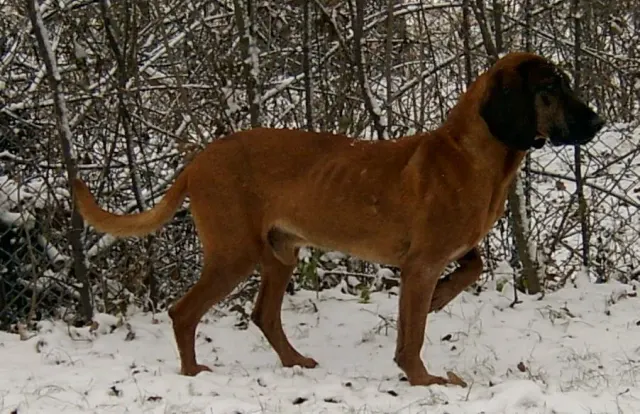
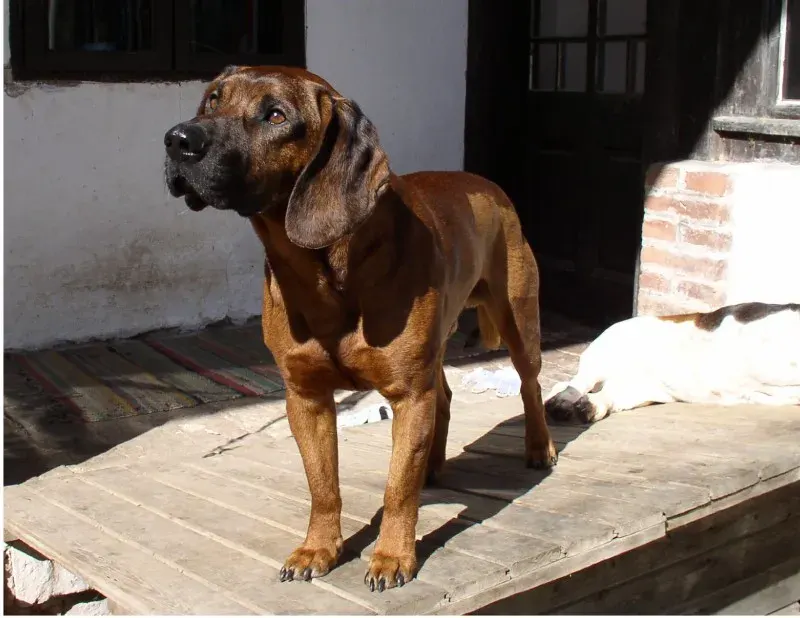
The FCI breed standard describes a medium-sized, well-proportioned and powerful dog, with strongly muscled legs for tireless work and a broad, deep chest for long, strenuous tracking; the forehead is slightly wrinkled. The coat is short, thick and coarse to harsh.
The colour is light to dark deer-red, more or less brindled, with or without a mask; small white patches on the chest are tolerated.
- Height at the withers: 50–55 cm for males, 48–53 cm for females.
- Weight: 30–40 kg for males, 25–35 kg for females.
Temperament
Calm, balanced and very attached to its owner, it is reserved with strangers. At work it shows great focus and remarkable tenacity.
It needs regular tracking work to be fulfilled.
With children and other pets
The standard describes a calm, assured temperament, sensitive with its handler, choosy and discerning with strangers, with great concentration in tracking work and strong loyalty to its hunter. It rates 3 out of 5 with children and 3 out of 5 with other dogs in our ratings.
- It is a specialised working dog, best suited to hunters.
- It needs regular tracking work.
Training tips
According to the standard, the Hanoverian Scenthound has developed almost unchanged from the leash hound of the early Middle Ages; when firearms changed big-game hunting, dogs were needed to find wounded game, and the hunting estate of the Kingdom of Hanover developed the breed further. The FCI describes it as a highly specialised tracking hound for wounded game. It rates 3 out of 5 for trainability in our ratings.
- Tracking work suits it best.
- Use calm, consistent training.
Health
This is a robust breed. Hip dysplasia and ear infections should be monitored.
Regular veterinary follow-up is recommended.
Leishmaniasis prevention is important for hunting dogs.
This is general information. For any question about your dog's health, consult a veterinarian.
Feeding
Food matched to its activity suits it.
Avoid excess weight.
Exercise
It needs long walks and, above all, regular tracking work.
It is not suited to a sedentary companion-dog life.
It mainly suits hunters and should live in a house with a garden.
Grooming
Its short coat needs weekly brushing. Clean its ears.
Check for ticks and grass seeds after work.
Choosing a puppy
The FCI standard says only healthy dogs with typical breed conformation should be used for breeding.
- Ask what health checks the parents have had.
- Meet the mother: she should be calm and assured.
Our guide on how to recognise a responsible breeder explains what to ask.
Similar breeds
The Bavarian Mountain Scent Hound is a lighter tracking hound for wounded game. The Bloodhound, Porcelaine and Grand Bleu de Gascogne are other scenthounds.