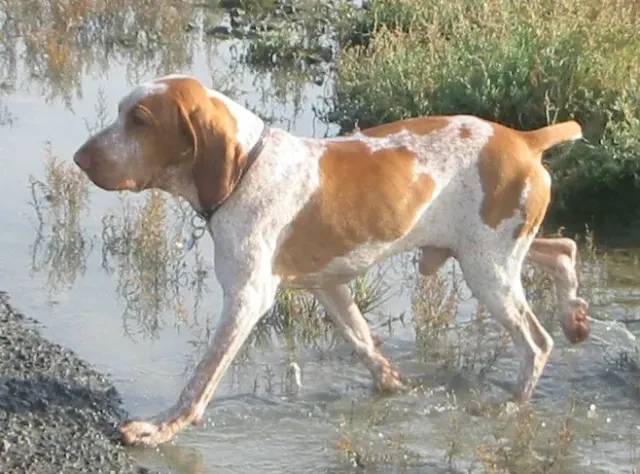
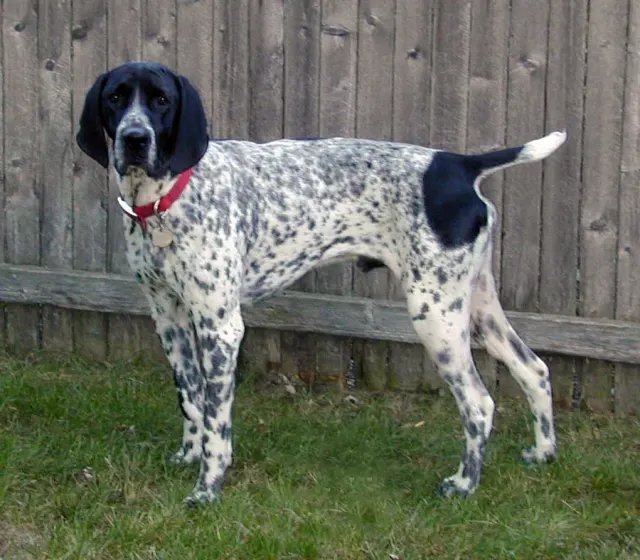
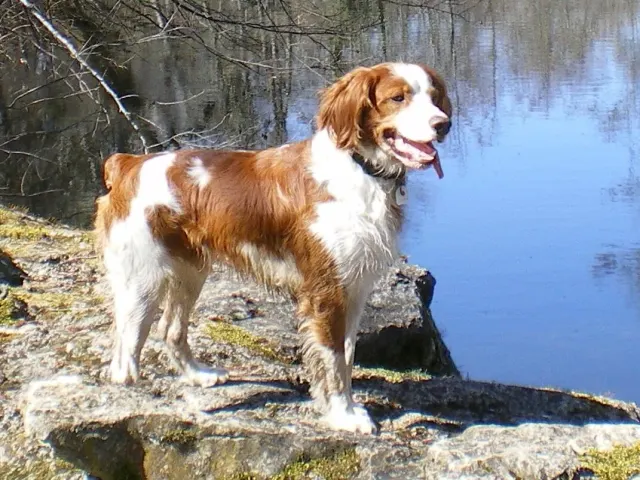
A large white-and-brown pointing spaniel, the French Spaniel is gentle, balanced and very close to its family, in the field and at home.
History and origins
The French Spaniel is one of France's oldest pointing dogs, valued since the Middle Ages. Close to extinction in the early 20th century, it was saved thanks to Father Fournier.
It is versatile and works equally well in open country and woodland.
Appearance and colours
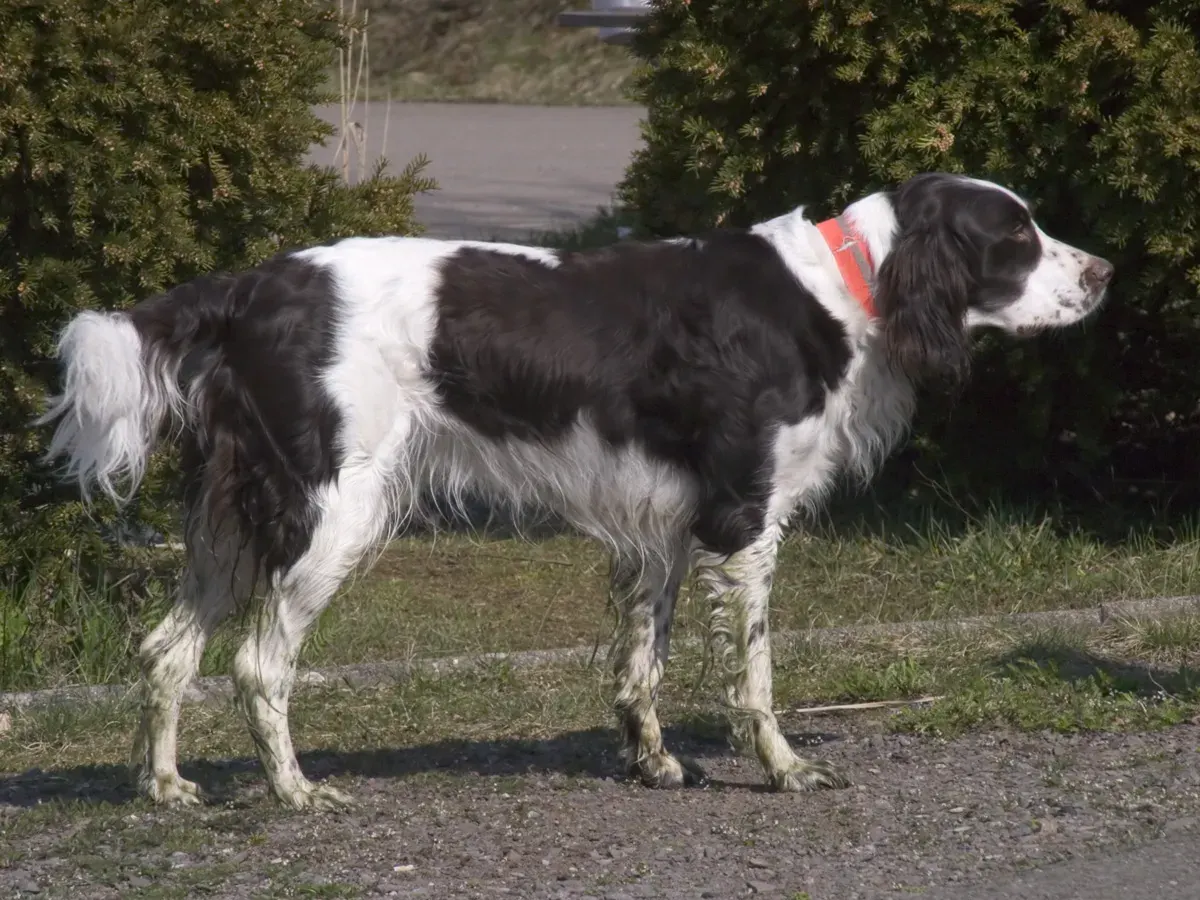
The FCI breed standard describes a medium-sized, elegant and muscular dog, strong-boned without coarseness, slightly longer than tall. The coat is flat and silky on the body, long and wavy on the ears, the back of the legs and the tail, and short and fine on the head.
The colour is white and brown, with medium patches that can become dominant, and slight to moderate flecking or roaning; the brown ranges from cinnamon to dark liver.
- Height at the withers: 56–61 cm for males, 55–59 cm for females (tolerance of 2 cm above and 1 cm below).
Temperament
Gentle, affectionate and well balanced, the French Spaniel is very good with children. It is calm at home and enthusiastic in the field.
Sensitive, it learns well with positive training.
With children and other pets
The standard describes a balanced, frank, gentle, calm and docile dog, sociable with other dogs and an ideal companion in all circumstances. It rates 5 out of 5 with children and 4 out of 5 with other dogs in our ratings.
- It is a gentle family dog.
- It needs regular exercise and activity.
Training tips
According to the standard, the French Spaniel descends from the bird dogs described by Gaston Fébus in the Middle Ages; the first standard was written in 1891. It is an excellent pointing dog that also has a talent for retrieving. The Royal Kennel Club calls it an ancient and versatile French pointing dog. It rates 4 out of 5 for trainability in our ratings.
- Retrieving and scent work suit it well.
- Use calm, reward-based training.
Health
This is a fairly robust breed. Hip dysplasia and an inherited neurological condition affecting the feet (sensory neuropathy) should be monitored.
Ask the breeder for screening results.
This is general information. For any question about your dog's health, consult a veterinarian.
Feeding
Food matched to its activity suits it.
Avoid excess weight.
Exercise
It needs one to two hours of daily activity: walks, hunting, swimming and search games.
It loves water.
It needs a house with a garden and an active family.
Grooming
Its medium-length coat needs brushing once or twice a week. Care for the feathering on the ears and legs.
Check for grass seeds after outings.
Choosing a puppy
The FCI standard says only healthy dogs with typical breed conformation should be used for breeding.
- Ask what health checks the parents have had.
- Meet the mother: she should be calm and gentle.
Our guide on how to recognise a responsible breeder explains what to ask.
Similar breeds
The Brittany, Small Münsterländer and Large Münsterländer are other spaniel-type pointing dogs. The English Setter is a British pointing dog with a long coat.