Bred from German Shepherds and Carpathian wolves, the Czechoslovakian Wolfdog is a tireless, fascinating dog for very experienced owners only.
History and origins
The Czechoslovakian Wolfdog came from an experiment begun in 1955 in Czechoslovakia: German Shepherds were crossed with Carpathian wolves to produce a working dog combining the wolf's stamina with the dog's cooperation.
The breed was recognised by the Fédération Cynologique Internationale in 1999.
Appearance and colours
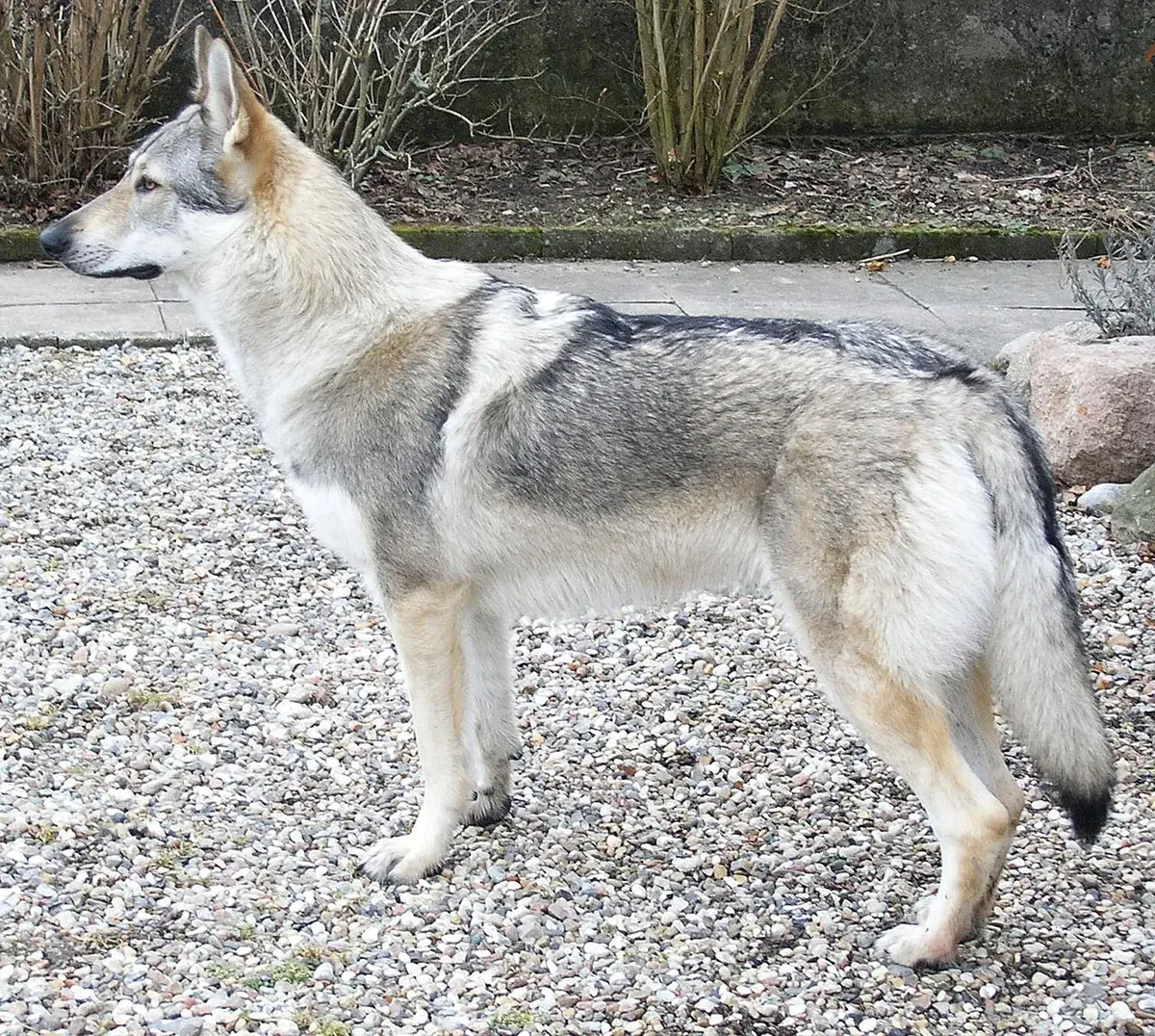
The FCI breed standard describes a firmly built dog, above average in size, with a rectangular frame; in body shape, movement, coat texture, coat colour and mask it resembles the wolf. The coat is straight and close, and the winter and summer coats differ greatly: in winter a heavy undercoat and the topcoat form a thick coat over the whole body, including the belly, the inner thighs and between the toes.
The colour is yellowish-grey to silver-grey with a characteristic light mask, and light hair under the neck and on the forechest. Dark grey with a light mask is also permitted.
- Height at the withers: at least 65 cm for males, at least 60 cm for females.
- Weight: at least 26 kg for males, at least 20 kg for females.
Temperament
Deeply attached to its owner and its 'pack', it is often wary or even fearful of strangers. It communicates a lot through howling and body language.
Independent and sometimes hard to motivate, it needs very early, intensive socialisation and copes very badly with being alone.
With children and other pets
The standard describes a lively, very active dog with great endurance, docile with quick reactions, fearless and courageous, but suspicious, and showing tremendous loyalty to its master. It rates 2 out of 5 with children and 2 out of 5 with other dogs in our ratings.
- It suits experienced owners who can give it a great deal of time and activity.
- It is suspicious of strangers: plan early, careful socialisation.
Training tips
According to the standard, the breed began with a biological experiment in Czechoslovakia in 1955, when a German Shepherd Dog was crossed with a Carpathian wolf; after the experiment ended in 1965 a breeding plan was drawn up to combine the useful qualities of the wolf with the favourable qualities of the dog, and the breed was recognised as a national breed in 1982. The FCI classifies it as a working sheepdog with a working trial. It rates 2 out of 5 for trainability in our ratings.
- Use patient, consistent, reward-based training.
- It rates 5 out of 5 for energy: it needs long daily exercise.
Health
This is a fairly robust breed. Hip and elbow dysplasia and some inherited conditions are monitored by responsible breeders.
Regular veterinary follow-up is recommended.
Common health issues in detail
A 2016 study found that pituitary dwarfism in Czechoslovakian Wolfdogs is linked to the same LHX3 mutation as in German Shepherd Dogs, and that about 21% of the 200 healthy breeding dogs tested were carriers. The authors stress the need for DNA screening before breeding and say the disease could be eradicated if all breeding dogs were tested.
We found no large population study of health in the Czechoslovakian Wolfdog.
This is general information. For any question about your dog's health, consult a veterinarian.
Feeding
Good-quality food matched to its high activity suits it. It can have a sensitive stomach.
Introduce dietary changes gradually.
Exercise
Extremely tireless, it needs long daily outings, ideally hiking, canicross or harness work.
Its prey drive calls for caution with small animals.
It needs shade, coolness and walks at dawn or in the evening in summer. It is a dog for very experienced owners with a large, secure property; it is unsuited to apartments and city life.
Grooming
Its wolf-like coat, very dense in winter, needs weekly brushing and much more during the moult.
It has little odour and stays fairly clean.
Choosing a puppy
Choose a breeder who DNA-tests the parents for the pituitary dwarfism (LHX3) mutation.
- Ask for the parents' LHX3 DNA results.
- Meet the mother: she should be confident, not fearful.
- Be honest with yourself about the time and exercise this breed needs.
Our guide on how to recognise a responsible breeder explains what to ask.
Similar breeds
The German Shepherd is one of the breed's founding parents. The Siberian Husky and Alaskan Malamute are other wolf-like dogs, and the Belgian Malinois is another energetic working shepherd.