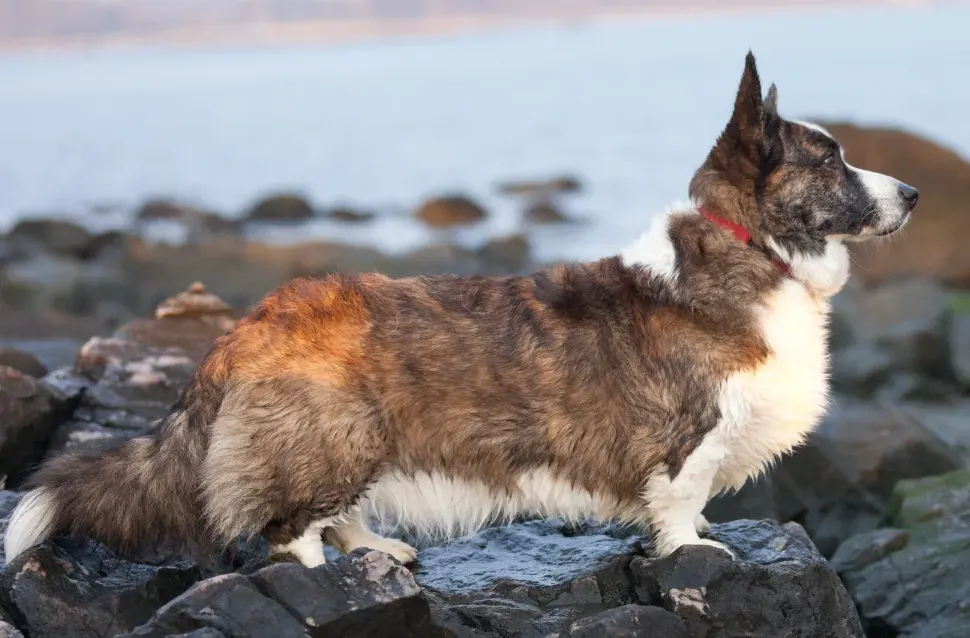
The long-tailed cousin of the Pembroke, the Cardigan Corgi is a sturdy little Welsh cattle dog, calmer and very loyal.
History and origins
The Cardigan Welsh Corgi comes from Cardiganshire in Wales and is thought to be one of the oldest herding dogs of the British Isles. Like the Pembroke, it drove cattle by nipping at their heels.
The two Corgis were long confused before being recognised as separate breeds in the 1930s.
Appearance and colours
The FCI breed standard describes a sturdy, tough, mobile dog capable of endurance, long in proportion to its height, ending in a fox-like brush set in line with the body, with a foxy head. The Royal Kennel Club calls it the traditional droving dog of Wales, short-legged and long-bodied.
The coat is short or medium, hard, weatherproof and preferably straight, with a good undercoat. Accepted colours are blue merle, brindle, red, sable, tricolour with brindle points and tricolour with red points, all with or without white markings on the head, neck, chest, underparts, legs and tail tip; white should not predominate.
- Ideal height at the withers: 30 cm, with weight in proportion.
Temperament
Loyal, intelligent and a little more reserved than the Pembroke, the Cardigan is affectionate with its family and cautious with strangers. It is a good watchdog.
It learns well with positive training and likes having a job.
With children and other pets
The standard describes an alert, active and intelligent dog, steady, neither shy nor aggressive. It rates 4 out of 5 with children and 3 out of 5 with other dogs in our ratings.
- It is sturdy and cheerful with children, but may try to herd them.
- Its long back needs care: discourage jumping from furniture.
Training tips
The FCI classifies the Cardigan as a cattle dog used for herding and as a companion. It rates 4 out of 5 for trainability and 4 out of 5 for energy in our ratings.
- Give it daily exercise and mental work: herding games, obedience or scent work.
- Use reward-based training; it learns well.
Health
Like all long-backed, short-legged dogs, it is prone to disc herniation. Progressive retinal atrophy, degenerative myelopathy and hip dysplasia are also reported.
Ask for genetic tests and keep it lean.
Common health issues in detail
The Royal Kennel Club recommends as best practice for breeding dogs a DNA test for progressive retinal atrophy (PRA-rcd3), which imported dogs must also have, eye testing and hip scoring.
We found no large population study of health in the Cardigan Welsh Corgi.
This is general information. For any question about your dog's health, consult a veterinarian.
Feeding
It tends to gain weight: measure portions and limit treats.
A stable weight is essential to protect its back.
Exercise
It needs about an hour of daily activity: varied walks, brain games and obedience.
Avoid jumping and sudden descents.
It can live in an apartment as long as repeated stair-climbing is avoided and it gets enough exercise every day.
Grooming
Its double coat sheds heavily twice a year. Weekly brushing, more frequent during the moult, is enough.
Check its nails and ears.
Choosing a puppy
Choose a breeder who DNA-tests the parents for PRA-rcd3, eye-tests and hip-scores them.
- Ask for the parents' DNA, eye and hip results.
- Meet the mother: she should be alert and steady.
- Ask about back problems in the parents and relatives.
Our guide on how to recognise a responsible breeder explains what to ask.
Similar breeds
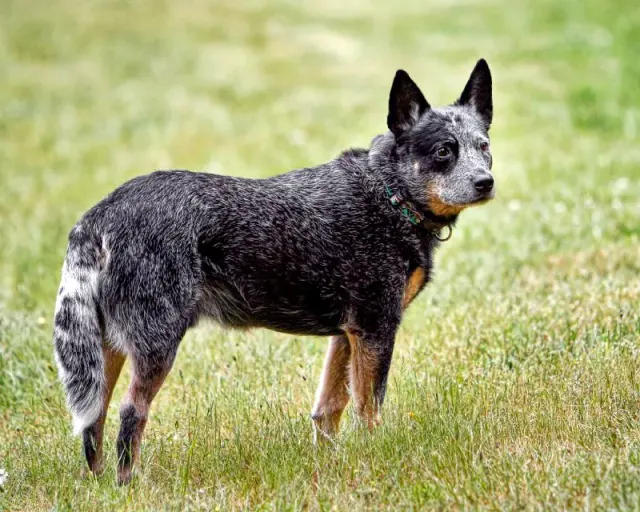
The Pembroke Welsh Corgi is the other Welsh corgi. The Australian Cattle Dog and Shetland Sheepdog are other herding dogs. The Dachshund is another short-legged, long-bodied breed.