A short-legged Welsh cattle dog with a big heart, the Pembroke Corgi is lively, funny and surprisingly athletic.
History and origins
The Pembroke Welsh Corgi comes from Pembrokeshire in Wales, where it drove cattle by nipping at their heels, its small size helping it dodge their kicks.
It became famous as Queen Elizabeth II's favourite dog; she owned dozens over her lifetime.
Appearance and colours
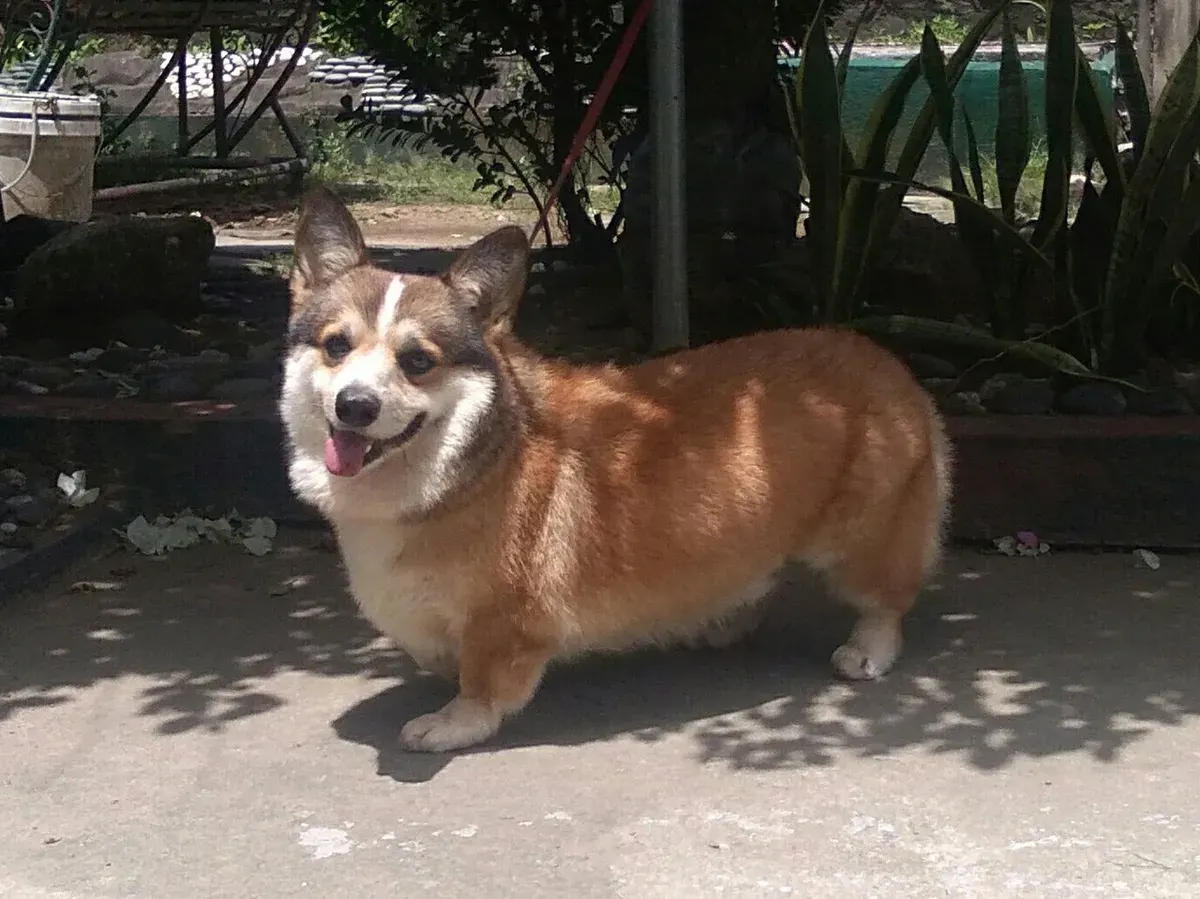
The FCI breed standard describes a low-set, strong, sturdily built dog, alert and active, that gives an impression of substance and stamina in a small space. The ears are pricked, medium-sized and slightly rounded, and the round, brown eyes blend with the coat. The Royal Kennel Club notes that the Pembroke is slightly smaller than the Cardigan Welsh Corgi, less long in the body, with smaller ears and straighter front legs, and that some breeders have worked to produce natural bobtails.
The coat is of medium length and straight, with a dense undercoat, never soft, wavy or wiry. Accepted colours are red, sable, fawn, and black and tan, with or without white markings on the legs, chest and neck; some white on the head and foreface is allowed.
- Height at the withers: approximately 25–30 cm.
- Weight: 10–12 kg for males, 9–11 kg for females.
Temperament
Cheerful, curious and very attached to its family, the Corgi is a true working dog in a small body. It is watchful, barks readily and may try to 'herd' children.
Clever and food-loving, it learns quickly with rewards but can be stubborn.
With children and other pets
The standard asks for a bold, workmanlike dog, outgoing and friendly, never nervous or aggressive. It rates 4 out of 5 with children and 3 out of 5 with other dogs in our ratings.
- It was bred to drive cattle, so running children may trigger an urge to chase. Teach children to stand still and call an adult rather than run, and redirect the dog to a toy.
- Its long back needs care: teach children to lift it with both hands, one under the chest and one under the hindquarters, or not at all.
- Socialise it with other dogs from puppyhood.
Training tips
A working cattle dog in a small body, the Pembroke rates 4 out of 5 for trainability in our ratings and enjoys having something to do.
- Use reward-based training, with food rewards counted in its daily ration.
- Give it mental work: obedience, scent games, tricks and, in moderation, dog sports.
- Teach a calm "settle" and reward quiet behaviour, so alert barking does not become a habit.
Health
Its long back and short legs expose it to disc herniation; avoid repeated jumping off sofas and lots of stairs. Degenerative myelopathy and hip dysplasia are also reported.
Excess weight greatly worsens back problems.
Common health issues in detail
Degenerative myelopathy is a known concern in the Pembroke Welsh Corgi, and breeders can DNA test for it; the Royal Kennel Club also lists hip scoring by X-ray as best practice for breeding dogs.
We found no large population study of the breed's general health, so this section relies on the Royal Kennel Club's health tests and on genetic research into this one serious disease.
Degenerative myelopathy (DM). This progressive disease of the spinal cord usually begins at 8 years of age or older, with weakness and loss of coordination in the hind legs that slowly worsens. The mutation in the SOD1 gene associated with it was discovered in a study of affected Pembroke Welsh Corgis, and a DNA test exists. Ask the breeder whether the parents have been tested.
This is general information. For any question about your dog's health, consult a veterinarian.
Feeding
The Corgi is very greedy and gains weight easily. Measure portions precisely and limit treats.
A lean Corgi protects its back and joints.
Exercise
It needs about an hour of daily activity: walks, games, obedience and even adapted agility.
Favour steady exercise over jumping and sudden descents.
In summer, walk it early and late and keep it cool. It adapts well to apartments if it gets enough exercise; beware of stairs in buildings without a lift, which are bad for its back.
Grooming
Its double coat sheds a lot, especially during moults. Brushing twice a week, more during the moult, is enough.
Keep an eye on its nails and teeth.
Choosing a puppy
Choose a breeder who has the parents' hips scored and their DNA tested for degenerative myelopathy, and who shows you the results.
- Ask about back problems and degenerative myelopathy in the parents' relatives.
- Meet the mother: she should be outgoing and friendly, as the standard asks, neither nervous nor snappy.
- Look at the parents' body condition: a lean corgi puts less strain on its back.
- Consider an adult corgi from a breed rescue.
Our guide on how to recognise a responsible breeder explains what to ask.
Similar breeds
The Cardigan Welsh Corgi is the other Welsh corgi, slightly larger and longer in the body. The Shetland Sheepdog is a small herding dog of similar weight with a long coat.