Recognisable by its egg-shaped head, the Bull Terrier is a muscular, playful clown devoted to its family, but stubborn.
History and origins
The Bull Terrier was created in mid-19th-century England by James Hinks from bulldogs and terriers, with the aim of a more elegant dog. The white coat was long the most sought-after.
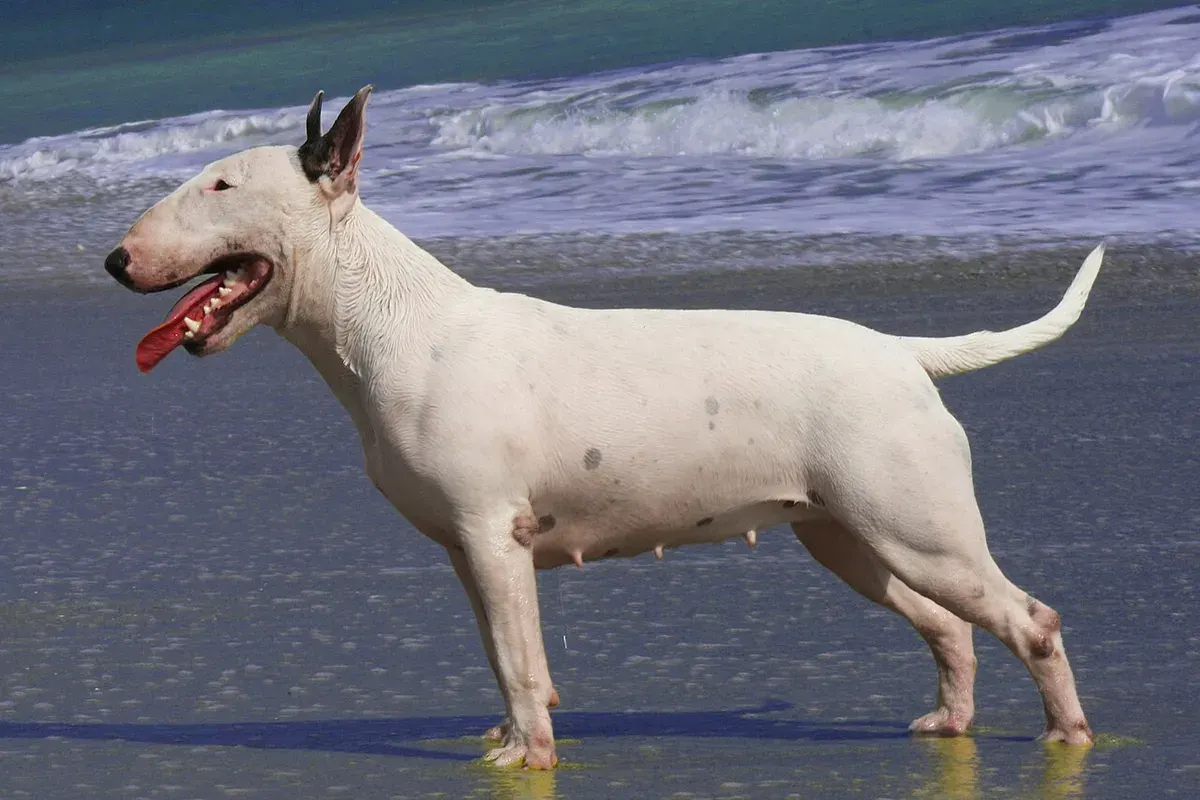
Its oval head with no stop is unique among dog breeds.
Appearance and colours
The FCI breed standard describes a strongly built, muscular, well-balanced and active dog with a keen, determined and intelligent expression. Its unique feature is the "downfaced", egg-shaped head, long, strong and completely filled, curving gently down from the top of the skull to the nose. Unusually, the standard sets neither weight nor height limits, but asks for maximum substance for the dog's size.
The coat is short, flat, even and harsh with a fine gloss. Dogs are either white (pure white, with head markings allowed) or coloured, with colour predominating; brindle is preferred, and black brindle, red, fawn and tricolour are acceptable.
Temperament
Playful, outgoing and very affectionate, the Bull Terrier loves to be the centre of attention. It can be stubborn, possessive and intolerant of other dogs.
It needs patient, playful, consistent training and early socialisation.
Some regions restrict ownership of this breed; check your local regulations.
With children and other pets
The standard describes a courageous, spirited dog with a fun-loving attitude, of even temperament and amenable to discipline: although obstinate, it is particularly good with people. It rates 3 out of 5 with children and 2 out of 5 with other dogs in our ratings.
- It is strong and boisterous: supervise play with children.
- Introduce other dogs carefully.
Training tips
According to the standard, James Hinks first standardised the breed in the 1850s, selecting the egg-shaped head; it was first shown in its present form in Birmingham in 1862, and the Bull Terrier Club was formed in 1887. It rates 2 out of 5 for trainability in our ratings.
- Use short, fun, reward-based sessions; it can be stubborn.
- Give it daily exercise and games.
Health
Congenital deafness mainly affects white dogs, so a hearing test is recommended. Inherited kidney and heart diseases, skin allergies and compulsive behaviours (tail chasing) are also reported.
Regular veterinary follow-up is important.
Common health issues in detail
Deafness. In a study of 1,060 Bull Terrier puppies hearing-tested (BAER) in England, 10.2% were deaf: 8.2% in one ear and 2% in both. Almost all deaf puppies (96%) had a white coat, with or without a patch, and about 19% of white puppies were deaf; hearing status was found to be heritable.
Health tests. The Royal Kennel Club recommends hearing testing (BAER), including litter screening, as best practice for breeding dogs. It also notes that the breed has a breed club health scheme and can be affected by conformational concerns.
This is general information. For any question about your dog's health, consult a veterinarian.
Feeding
It needs good-quality food in measured amounts to stay muscular.
Avoid too many treats.
Exercise
It needs about an hour of daily activity with lively games.
Keep it on a lead around other dogs.
It can live in an apartment if it gets enough exercise.
Grooming
Its short coat needs weekly brushing.
White dogs are prone to sunburn on the ears and muzzle.
Choosing a puppy
Choose a breeder who hearing-tests every litter and the parents, and takes part in the breed club health scheme.
- Ask for the puppy's own BAER result and those of the parents.
- Meet the mother: she should be even-tempered and good with people.
Our guide on how to recognise a responsible breeder explains what to ask.
Similar breeds
The Staffordshire Bull Terrier, American Staffordshire Terrier and American Pit Bull Terrier are other bull-and-terrier breeds. The Boston Terrier is a small companion of bull type.