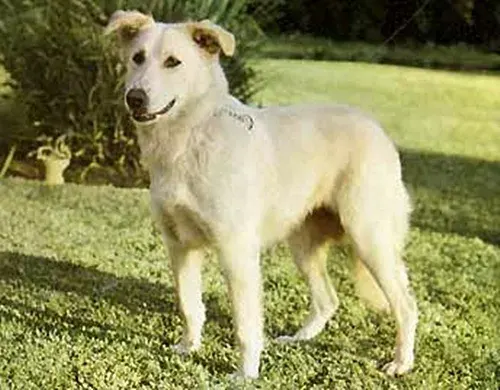
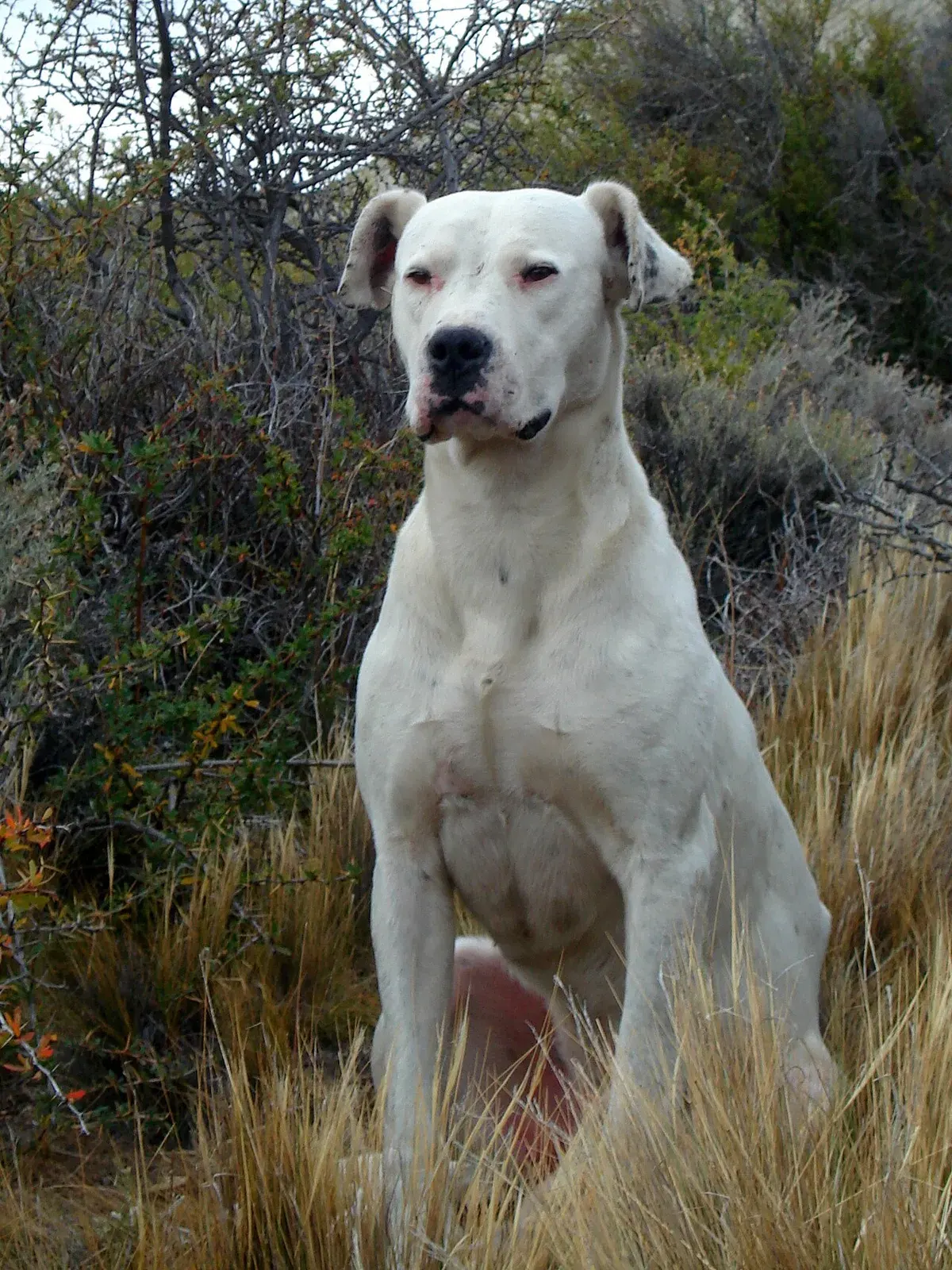
A powerful, tireless white athlete, the Dogo Argentino is a loyal, brave dog best suited to experienced owners.
History and origins
The Dogo Argentino was created in the 1920s in Argentina by Dr Antonio Nores Martínez, who wanted a dog able to hunt wild boar and puma in a pack while remaining a reliable companion.
It is the only Argentine breed recognised by the Fédération Cynologique Internationale.
Appearance and colours
The FCI breed standard describes an athletic, harmoniously proportioned dog with powerful muscles, giving an impression of power and energy that contrasts with its friendly, gentle expression. The coat is uniform, short and smooth, about 1.5–2 cm long.
The colour is entirely white; a single black or dark patch on the head (on the skull, an ear or around an eye) is allowed if it covers no more than 10% of the head. Between two dogs of equal quality, the whiter one is preferred.
- Height at the withers: 60–68 cm for males, 60–65 cm for females.
- Weight: about 40–45 kg for males.
Temperament
Brave, determined and very affectionate with its family, the Dogo is also dominant towards other dogs and can be highly intolerant of them, especially those of the same sex.
It requires early socialisation, firm yet kind training and owners able to manage a powerful dog with a strong hunting instinct.
Some regions restrict ownership of this breed; check your local regulations.
With children and other pets
The standard describes a brave, silent hunting dog with a keen nose, which must never be aggressive towards people. It rates 3 out of 5 with children and 1 out of 5 with other dogs in our ratings.
- It suits experienced owners and is usually best as the only dog.
- Early, careful socialisation with people and other animals is essential.
Training tips
According to the standard, the breed was created in the province of Córdoba, Argentina, by the surgeon Antonio Nores Martínez from the "Old Fighting Dog of Córdoba", crossed with several breeds including the Great Dane, Pointer, Boxer, Dogue de Bordeaux and Irish Wolfhound; its standard was presented in 1947. It was bred to hunt wild boar, peccaries and pumas. It rates 3 out of 5 for trainability in our ratings.
- Use calm, consistent, reward-based training.
- It rates 4 out of 5 for energy: give it plenty of daily exercise.
Health
As in many white-coated dogs, congenital deafness occurs in the breed, so a hearing test for puppies is advisable. Hip dysplasia and skin problems (allergies, sunburn) should also be watched for.
Regular veterinary follow-up is recommended.
Common health issues in detail
Congenital deafness is common in this white breed. A study of 811 Dogo Argentinos tested with BAER found that 25.8% were deaf in one or both ears (20.4% in one ear and 5.4% in both); dogs without a dark head patch were more often affected.
We found no large population study of other health problems in the Dogo Argentino.
This is general information. For any question about your dog's health, consult a veterinarian.
Feeding
Very muscular and active, it needs good-quality, protein-rich food matched to its energy use. Puppies should grow slowly on large-breed food.
Two meals a day are preferable.
Exercise
It needs plenty of exercise: long walks, running, games and obedience work, for at least one to two hours a day.
Keep it on a lead in public because of its hunting drive and reactivity towards other dogs.
It needs a house with a securely fenced garden and experienced owners.
Grooming
Its short white coat needs brushing once a week. Clean its ears regularly.
Its pale skin is sensitive to the sun, so check the muzzle, belly and ears.
Choosing a puppy
Choose a breeder who BAER-tests every puppy and the parents.
- Ask for the puppy's own BAER hearing result.
- Meet the mother: she should be calm and stable with people.
- Ask how the puppies are socialised with people and other dogs.
Our guide on how to recognise a responsible breeder explains what to ask.
Similar breeds
The Cane Corso and Presa Canario are other powerful molossers. The American Pit Bull Terrier and Boxer are other athletic dogs of bulldog descent.